Friday, December 9, 2022

Will Verizon and T-Mobile Have 11% Share of Home Broadband by 2025?

T-Mobile and Verizon are expected to have 11 to 13 million total fixed wireless customers by the end of 2025. If total U.S. internet  accounts are somewhere on the order of 111 milliion accounts, and if small business users account for 11 million of those accounts, then home users might amount to about 100 million accounts. 
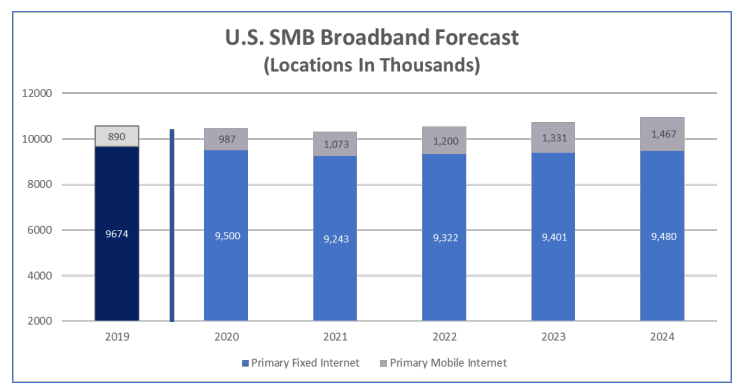
source: Ooma, Independence Research 


If Verizon and T-Mobile hit those targets, their share of the home broadband market--counting only fixed wireless accounts-- would be about 10 percent. Significantly, most of those accounts will be gained “outside of region” for Verizon. That is significant as Verizon’s fixed network only reaches about 20 percent of U.S. households. Fixed wireless allows Verizon to grow its account base among the 80 percent of U.S. home locations that cannot buy Verizon fixed network service. 


For T-Mobile, which in the past has had zero percent market share in home broadband, all of the growth is incremental new revenue. If those accounts add $600 per year in added revenue, then the 11 percent share of home broadband supplied by fixed wireless represents perhaps $6.6 billion in new revenue for the two firms. 


That is a big deal, considering how hard it is for either firm to create a brand-new line of business that generates at least $1 billion in new revenue. 


The other apparent takeaway is the size of the market segment that cares more about price than performance. 


Segments exist in the home broadband business, as they do in many parts of the digital infrastructure and digital services businesses. In other words, even if some customers want faster speeds at the higher end of commercial availability, up to 20 percent of the market cares more about affordable service that is “good enough.”


The center of gravity of demand for 5G fixed wireless is households In the U.S. market who will not buy speeds above 300 Mbps, or pay much more than $50 a month, at least in the early going. T-Mobile targets speeds up to 200 Mbps. 


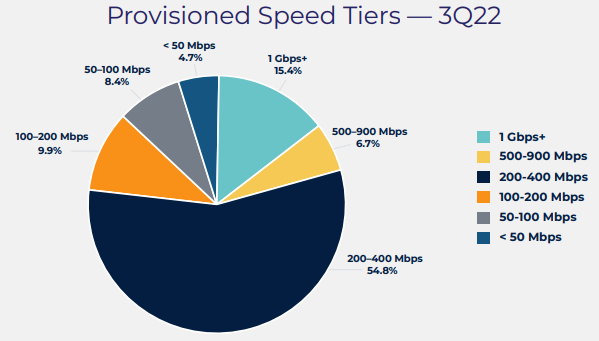
During the third quarter, about 22 percent of U.S. customers bought service at speeds of 200 Mbps or below. In other words, perhaps a fifth of the home broadband market is willing to buy service at speeds supported by fixed wireless. 


source: Openvault  


The other takeaway is that home broadband net account additions over the past year have disproportionately come on the fixed wireless platform, representing about 78 percent of all net new accounts. 

source: T-Mobile 


To hang on to those accounts, Verizon and T-Mobile will have to scale speeds upwards, as the whole market moves to gigabit and multi-gigabit speeds. Some percentage of those upgraded accounts could come on some fiber-to-home platform. Even out of region, both firms could strike deals for use of wholesale assets. 


But the bigger part of the retention battle is going to center on ways of increasing fixed wireless speeds to keep pace with the ever-faster “average” speed purchased in the home broadband market. 


And that almost certainly means using millimeter wave spectrum to a greater degree. In the end, even using small cell architectures, there is only so much capacity one can wring out of low-band or mid-band spectrum. 


As a practical matter, almost all the future bandwidth to support mobility services or fixed wireless is to be found in the millimeter wave regions. 


Thursday, December 1, 2022

What Comes Next for Mobile Operator Revenue Drivers?

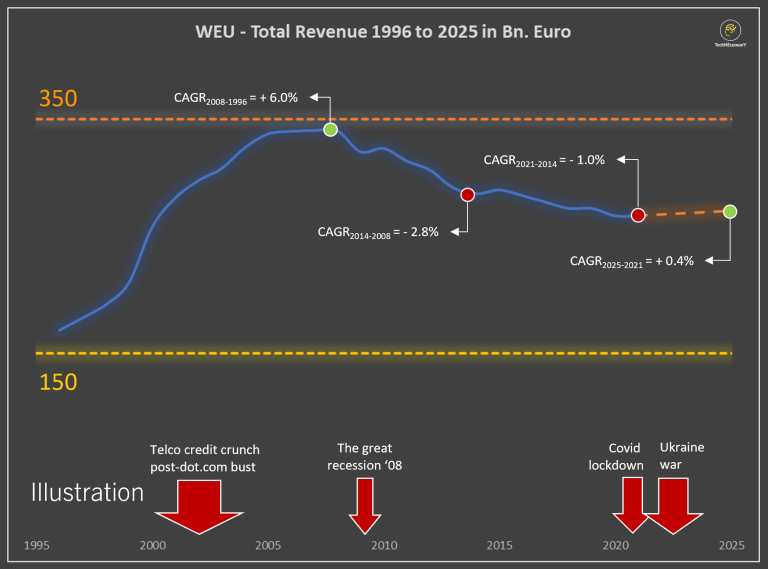
If you subscribe to the theory that every product has a life cycle, and if you are a mobile service provider, then this data on European mobile revenue should worry you. The reason is that the data fits the product life cycle suggesting that every product eventually reaches saturation and then declines. 


And it that is true, the mobile business--in the most mature markets--faces product decline issues. One might well argue that the mobility business already has had to deal with such product life cycles. It replaced 1G (analog voice) with 2G, then 3G, then 4G and now 5G, with 6G coming in about eight more years, virtually indefinitely. 


Subscriptions have been the mobile revenue driver, but the value proposition and revenue contributions have evolved over time. The value of a mobile subscription once rested solely on voice communications. 


But average revenue per account began to decline in the 2G era, and growth came from text messaging. That revenue source, in turn, declined, to be replaced by mobile internet access during the 4G era. What changes in the 5G era is not yet decided.


source: Techeconomy 


One might also note other life cycles at work. Though subscriptions are essentially saturated in developed countries, subscription growth continues at a high level in other markets that have not yet reached saturation (virtually everyone has a mobile subscription).


The point is that European mobile operator revenue trends might suggest that “mobile device service” has reached a phase of decline, unless other new services can be created to run on the platform, as has happened in the past. 


Perhaps metaverse or augmented or extended reality services could provide that driver. It is just too early to say. 


We might also note product life cycles in the fixed networks business as well. Revenue once was driven by voice services, and profit by international and national long distance calling. As voice revenues dwindled some operators sparked growth by adding subscription TV, financial services or home security. Only linear video proved to be a major revenue driver.


With the decline of linear video, internet access has emerged as the growth driver. But even that product has reached saturation levels in many markets. 


One might argue that internet access products also have changed, though. Dial-up internet access at kilobit-per-second levels arguably is a different product than access at megabit-per-second levels. Access at 100 Mbps arguably is a different product than gigabit-per-second access. 


And multi-gigabit service arguably will be a different product than gigabit access. For fixed network operators, no less than mobility service providers, the issue is to keep finding new products with mass appeal, to replace maturing products. 


Both mobile and fixed network services also have had business and consumer segments, though the business segment has been easier to delineate in the fixed, compared to mobile networks. In the fixed networks business, there are products that “only” businesses buy. 


In the mobility access business, businesses have essentially purchased the same product, albeit with different packaging (volume discounts, more-detailed account tracking). 


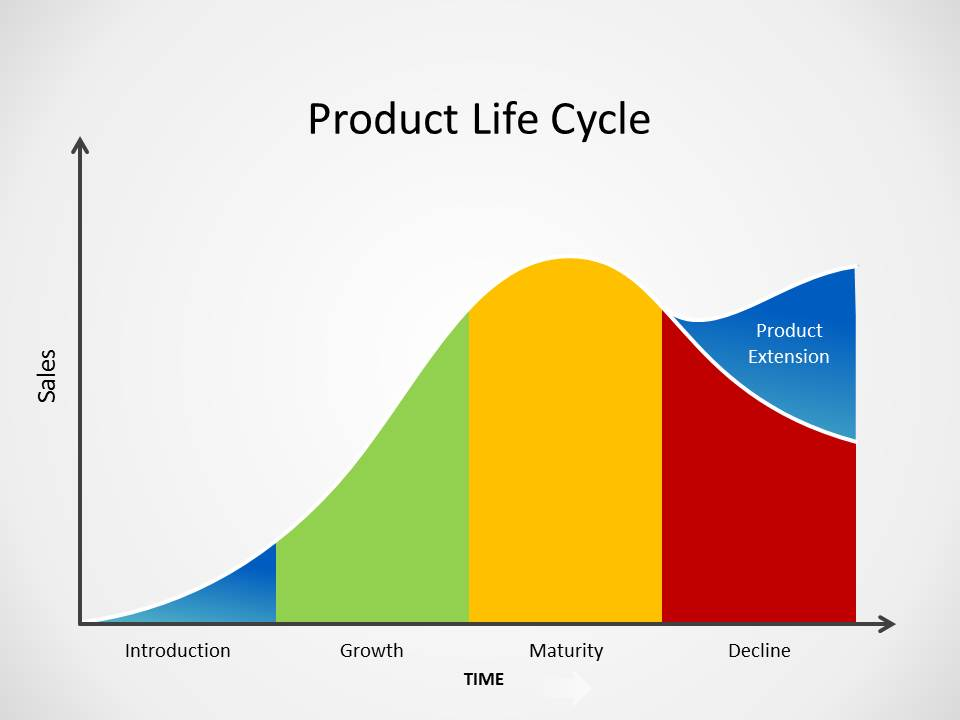
 Here is a generic product life cycle illustration, with the possibility that product extensions can extend a product’s useful commercial life. Of course, some would argue that what is here noted as a “product extension” actually is a different product, with a different life cycle. 


Think about mobile subscriptions. In that analogy, mobile voice is one cycle; text messaging another; mobile internet access a third. Others might argue that text messaging was a product extension, as was mobile internet access. 


https://wholesalesuiteplugin.com/product-life-cycle/ 


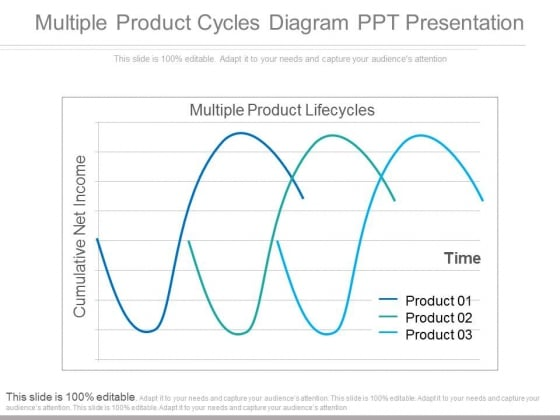
If one assumes text messaging and mobile internet access actually are different products from voice, albeit sold using the same common platform, then one has a sort of conceptual product roadmap. As product 01 reaches saturation--and before decline--work must have begun on product 02. Before product 02 reaches saturation, work must have begun on product 03, and so forth. 


source: Slidegeeks 


The big question we might ask is “what drives revenue growth after mobile broadband saturates?” If one views the mobile access network as a platform, what is the next big driver of revenue that can be developed on the platform? 


Many would argue that internet of things, edge computing, private networks or network slicing are part of the answer. And they could help. On the other hand, it is hard to see any single one of those innovations driving total revenue the way that voice, messaging or internet access has done. 


Applying the Pareto theorem, which generally is popularized as “20 percent of the instances drive 80 percent of the results,” ask yourself whether it seems possible that edge computing, private networks, IoT or network slicing could, at some point, drive 80 percent of total mobile operator revenue. If the answer is “no,” then those are not the drivers of the next wave of mobile operator revenue, in the mold of voice, messaging or internet access.


Wednesday, November 30, 2022

Is "Lack of Wi-Fi" the Rural Home Broadband Problem?

All observers agree that rural broadband is difficult for any number of reasons, but mostly because the cost of access network infrastructure is high when population density is low or there are physical barriers to building networks affordably. 


So it might come as a surprise that “indoor Wi-Fi” is proposed as a solution for rural broadband. Ignore for the moment that such arguments, if accepted, benefit the Wi-Fi ecosystem. The argument is seemingly curious or nonsensical: “Indoor Wi-Fi” requires internet access already be present, and that means an access network to support the private indoor signal distribution.


Arguing “”indoor Wi-Fi is a solution for rural broadband” is nonsensical unless it is preceded or accompanied by adequate internet access service and facilities. How that access is provided is not important. But “internet access” must be available or no indoor Wi-Fi is going to provide any value at all. 


In a document calling for use of indoor Wi-Fi for rural broadband, it is not clear until far into the discussion that what is proposed is not actually “indoor Wi-Fi” at all, but rather “public Wi-Fi” where the network infrastructure of a public Wi-Fi network is built and maintained by a network operator of some sort.”


In other words, a “community network” is proposed as the solution, not “indoor Wi-Fi” as such. 


The proposed solution for “indoor Wi-Fi” is actually a “public Wi-Fi” network built by some service provider that actually provides the internet access function. In other words, the solution for rural broadband “using indoor Wi-Fi” is for an internet service provider to provide service to an area so “indoor Wi-Fi” can be used


The proposed solution is actually not “indoor Wi-Fi” at all, but rather “a community network in a rural area that is built by a municipality, or a non-profit.” 


I’m sorry. This is an arguably illogical line of reasoning. The key “rural broadband problem” is lack of internet access. It does not matter what sort of network we use for that purpose. “Indoor Wi-Fi” is therefore not a solution for rural broadband, rural broadband access is that solution. 


That requires an optical fiber “backhaul” to a termination point “in a village,” for example. Only at that point can the actual “indoor Wi-Fi network be created. From that fiber termination point other point-to-point wireless extensions might be built to serve other nearby communities. 


The key point is that it is community broadband that is the solution, not indoor Wi-Fi itself. That is a signal distribution mechanism once the community broadband network already exists. 


It is what we call a tautology: a statement that is “true” by virtue of its logical form. A tautology often is known as an “argument in a circle.” Note that the truth or falsity of a tautology is meaningless. The logical arrangement of arguments cannot be proved or disproved as they only refer to each other. 


Essentially, the argument is “A is A.” That is “true" in a logical sense whether “A” is itself true or false. Rural broadband equals community broadband equals indoor Wi-Fi is the explicit argument. We might similarly argue that rural broadband equals devices equals knowledge of how to use the internet equals ability to pay. 


It’s an application of mathematical or logical reasoning (without any necessary empirical proof):  A equals B. B equals C. Therefore A equals C. 


Why not just make the argument that community broadband is the key for rural broadband? Probably because the Wireless Broadband Association is, by definition, a trade group supporting use of Wi-Fi. 


But “Rural Wi-Fi Connectivity,” as the document is titled, is not the issue. “Rural internet connectivity” is the issue. Wi-Fi plays a role, just as it does in urban areas. But the core problem is not Wi-Fi. It is the cost of internet access facilities in rural areas.


Saturday, November 26, 2022

Some Trends are Universal, in Malta or Anywhere

Every “telecom” market in the world will show some version of this Malta usage trend. People have more ways to communicate these days than they used to, so voice calls and minutes of use are declining. 


source: Malta Communications Authority 


Mobile phones are the preferred devices and means for voice usage. 

source: Malta Communications Authority 


But for most product categories, revenue is flat or declining. 

source: Malta Communications Authority 


Casual observers might confuse the relationship between some trends, such as home broadband being a substitute product for text messaging. It would be highly unusual for any industry insider to see things that way. Most would likely say internet messaging has been the substitute for text messaging, while messaging is a substitute for voice. 


Casual observers might believe that the Covid pandemic and stay-at-home policies increased usage of messaging because of increased “on the go” activities. That is hard to square with less geographic or outside the home mobility. If anything, messaging increased in part because people were not able to go to school or work. 


Still, most usage trends seen in Malta are reflected in every market globally: higher data usage, on mobiles or fixed networks; flat or declining revenue per account and more broadband subscriptions, both mobile and fixed. 


Saturday, November 19, 2022

5G Fixed Wireless Might Appeal to 20% of U.S. Home Broadband Customers

Critics are correct that 5G fixed wireless--at least in the medium term--has capacity limitations compared either to fiber-to-home or advanced hybrid fiber networks. But it also is true that the home broadband market has a value segment for whom fixed wireless seems to be in demand. And that segment might represent more than 20 percent of all home broadband customers.


According to the latest data from Leichtman Research Group, during the third quarter of 2022, some 825,000 net new home broadband accounts were added in the U.S. market. But the two major fixed wireless service providers--T-Mobile and Verizon--added 920,000 net accounts during the quarter. 


Fixed Wireless Services, Third Quarter 2022

Fixed Wireless Supplier

Total Accounts

Net Additions

T-Mobile

2,122,000

578,000

Verizon

1,063,000

342,000

source: Leichtman Research Group


Total cable industry net adds were about 39,000, while telcos collectively lost about 136,000 fixed network accounts. 


During the third quarter, about 22 percent of U.S. customers bought service at speeds of 200 Mbps or below. In other words, perhaps a fifth of the home broadband market is willing to buy service at speeds supported by fixed wireless. 


source: Openvault  


Predictably, supporters and detractors offer the expected defense of advantages and weaknesses. Cable operators note the bandwidth limitations. Verizon and T-Mobile point to the ease of installing and price advantages. In some cases fixed wireless might actually be faster than the other alternatives available from other local home broadband providers. 


Critics do correctly note that fixed wireless home broadband is carefully marketed in areas where new 5G networks have spare capacity. That capacity will disappear as 5G adoption increases, the critics say.


But Verizon and T-Mobile might argue they have ways to boost capacity over time, as 5G networks are used more heavily and as bandwidth demand keeps increasing. Higher-capacity millimeter wave spectrum is the obvious early answer. 


Longer term, Verizon and T-Mobile are likely to explore ways to add fiber to home coverage as well. For Verizon, that means finding new says to secure FTTH capacity outside its historic fixed network footprint. For T-Mobile, that means getting into FTTH for the first time. 


Up to this point, T-Mobile has been focused on areas where there is less competition, such as rural markets. 


Verizon’s geography is the roughly 80 percent of U.S. homes outside Verizon’s fixed network service territory, as well as its own mobile customer base, who are encouraged to bundle fixed wireless with existing mobile service. 


The center of gravity of demand for 5G fixed wireless is households In the U.S. market who will not buy speeds above 300 Mbps, or pay much more than $50 a month, at least in the early going. T-Mobile targets speeds up to 200 Mbps. 


Verizon fixed wireless service plans also suggest that existing Verizon mobile customers are key targets. In the meantime, there is 4G fixed wireless, which will have to be aimed at a lower-speed portion of the market, albeit at about the same price points as 5G fixed wireless. 


Up to this point, Verizon 4G fixed wireless, available in some rural areas, offers speeds between 25 Mbps and 50 Mbps. That might appeal to consumers unable to buy a comparable fixed network service. 


By some estimates, U.S. home broadband generates $60 billion to more than $130 billion in annual revenues. 


If 5G fixed wireless accounts and revenue grow as fast as some envision, $14 billion to $24 billion in fixed wireless home broadband revenue would be created in 2025. 


5G Fixed Wireless Forecast


2019

2020

2021

2022

2023

2024

2025

Revenue $ M @99% growth rate

389

774

1540

3066

6100

12,140

24,158

Revenue $ M @ 16% growth rate

1.16

451

898

1787

3556

7077

14,082

source: IP Carrier estimate


If the market is valued at $60 billion in 2021 and grows at four percent annually, then home broadband revenue could reach $73 billion by 2026.


2022

2023

2024

2025

2026

Home Broadband Revenue $B

60

62

65

67

70

73

Growth Rate 4%


Higher Revenue $B

110

114

119

124

129

134

source: IP Carrier estimate


If we use the higher revenue base and the lower growth rate, then 5G fixed wireless might represent about 10 percent of the installed base, which will seem more reasonable to many observers. 


Assuming $50 per month in revenue, with no price increases at all by 2026, 5G fixed wireless still would amount to about $10.6 billion in annual revenue by 2026 or so. That would have 5G fixed wireless representing about 14 percent of home broadband revenue, assuming a total 2026 market of $73 billion.


If the home broadband market were $134 billion in 2026, then 5G fixed wireless would represent about eight percent of home broadband revenue. 


Fixed wireless might be even more important elsewhere in global markets.  


The point is that the near-term market is substantial for both T-Mobile and Verizon in “out of region” geographies. For T-Mobile that is 100 percent of U.S. homes. For Verizon that is about 80 percent of U.S. homes.


Friday, November 18, 2022

Will Digital Infra Asset Shifts Change?

Higher interest rates affect most parts of any economy. What we will have to see is the impact on digital infrastructure ownership in the near term. If interest rates climb to five percent or more, it is going to affect the payback model for taking digital infra (towers, data centers, distribution networks) private.


Low interest rates have meant cheap borrowing costs. All that is going in reverse now, as monetary policy is shifting to higher rates to halt inflation. Higher borrowing costs should slow dealmaking, as payback models get worse. 


source: Bain 


On the other hand, if inflation remains high there are other risks, including severe recession, which likewise would affect deal flow. On the other hand, severe recessions also create buying opportunities for firms with available capital, able to snap up distressed properties. 


So the digital infrastructure investing boom will face new challenges over the next several years, some negative, some perhaps positive. Continued high inflation will mean continued rate increases, a negative. On the other hand, high inflation also can boost asset values, a possible positive. 


Stagflation and recession should slow dealmaking while putting pressure on price multiples. Again, some negative and some positive effects will occur. 


Still, a clear impact might be that the wave of private equity purchases of formerly public infrastructure from service providers would slow, as interest rates rise. 


How much slower is the issue, and for how long. Observers do not expect five-percent (or higher) interest rates for the long term, but activity will hinge on the level of rates and their duration. 


In fact, the whole digital infra privatization business has been fueled by near-zero “real” interest rates. Inflation rates also matter, as they affect “real” interest rates. For the whole class of “alternative” infrastructure (power utilities, roads, airports, oil and gas, renewable energy and data centers, towers and fiber infrastructure), expected returns have been dropping, and specific returns for digital infra might arguably be closer to five percent than 10 percent. 


source: McKinsey 


But that is why five-percent interest rates slow activity. If the expected return is five percent, borrowing costs are five percent and inflation rates are high, investments no longer make sense. 


The point is that it would not be unexpected to see a slowdown in digital infra privatizations for a while. The business case--with higher interest rates--does get worse.


Is Sora an "iPhone Moment?"

Sora is OpenAI’s new cutting-edge and possibly disruptive AI model that can generate realistic videos based on textual descriptions.  Perhap...