Thursday, December 16, 2021

80/20 Rule for Cell Site Traffic

Cell site data demand provides a good illustration of the Pareto distribution so often found in nature. Commonly known as the 80/20 rule, Pareto distributions suggest that about 80 percent of results are produced by about 20 percent of instances. 


Mobile networks, for example, commonly have 37 percent of cell sites handling 75 percent of traffic. Just seven percent of sites handle 25 percent of total traffic. But 75 percent of cell sites are required to support just 25 percent of total end user traffic. 

source: Ericsson

U.K. 5G Fixed Wireless Coverage Already Exceeds Gigabit or FTTH Coverage

Fixed wireless supplied by 5G networks already reach a subatantial portion of U.K. homes and businesses.


Ofcom notes that “94 percent of U.K. premises have access to an MNO (mobile network operator) FWA (fixed wireless access) service.” 


Mobile operators claim average download speeds up to 100 Mbps to 200 Mbps on their 5G fixed wireless services, Ofcom says. 


The reason that coverage could be important is that most customers in the United Kingdom buy internet access service at about 30 Mbps. So 5G fixed wireless offers faster speeds. The issue, as always, is demand.


Ofcom’s latest research shows the continuing lag between broadband supply and demand. In other words, it is one thing to make FTTH or gigabit-per-second internet access available. It is something else to entice customers to buy such services.


Fiber-to-home facilities now are available to more than eight million U.K. homes, or 28 percent of dwelling units. 
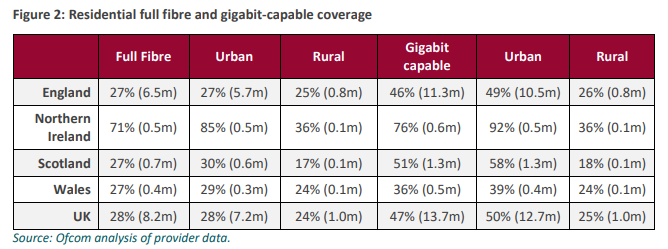

Meanwhile, gigabit-capable broadband is available to 13.7 million homes, or 47 percent of total homes. But take-up of gigabit speed services is still low, with around seven percent of FTTH  customers buying gigabit services, says Ofcom. 


ThinkBroadband claims gigabit coverage is about 65 percent of U.K. homes. If that is correct then take rates for gigabit service are lower than seven percent.  


source: Ofcom 


Fully 96 percent  of U.K. premises have access to 30 Mbps broadband connections. About 69 percent of locations able to buy 30 Mbps actually buy it, says Ofcom.


Satellite services add more potential coverage. “For example, Konnect states that its satellite covers around 75 percent of the U.K. and offers commercial services on a 24/7 basis direct to consumers with download speeds between 30 Mbps and 100 Mbps, with upload speeds averaging 3 Mbps.”


New low earth orbit satellite services such as Starlink also are coming. “Starlink indicates that users can currently expect to see 100 Mpbs to 200 Mbps or greater download speeds and upload speeds of 10 Mbps to 20 Mbpss with latency of 20 milliseconds or lower in most locations,” says Ofcom. 


The point is that although we might think consumers would jump at the chance to buy either FTTH service or gigabit-per-second service, that is not the case. Only about 28 percent of households able to buy FTTH service do so, while just seven percent of households able to buy gigabit service do so. 


To a large extent, internet service providers are investing ahead of demand, rather than following consumer demand. That is one key reason why customer experience did not fall off a cliff when pandemic-related shutdowns happened. ISPs already had created excess supply. 


That is likely to be the trend virtually forever.


Wednesday, December 15, 2021

When Do We Hit Peak 4G?

Precisely when 4G reaches its peak adoption is debatable. 


Some argue that, globally, peak 4G remains perhaps five years off, even as 5G launches accelerate, Rethink Technology argues. Others believe 5G adoption is happening faster than did 4G, with the result that 4G might well peak in 2021. 


That “peak in a few years” projection would be quite consistent with past trends. Each mobile generation has reached its peak some years after the next-generation replacement has launched. 

sources: GSMA, 3G4G blog, University of Surrey 


But the countervailing argument is that 5G is being adopted faster than 4G. While it might be somewhat unprecedented, 5G might already be capping 4G market share globally, on the strength of 5G adoption in China, for example. 


sources: IEEE, Ericsson 


It generally has taken more than a decade for any next-generation mobile network to hit its peak and then begin to decline some years after its replacement network has been launched. 

source: Telegeography


If we use 2010 as the year 4G launches (we also could use 2009 for the first early deployments), 4G peak market share happens more than a decade after launch. 4G, for example, took about eight years to reach 50 percent share of all mobile subscriptions.  


4G arguably will reach 55 percent global mobile platform share in 2024, GSA predicts. But there are some forecasts that suggest 4G will peak in 2021, at least in some markets. One might include Ericsson as among those firms believing 4G peaks in 2021, for example. 

Monday, December 13, 2021

If Malaysia Wholesale 5G Plan Holds, Will There Be Unbundling?

It remains unclear whether Malaysia’s proposed mandatory wholesale approach to 5G will proceed. Nor is it clear whether any forms of unbundling will be allowed, if the plan proceeds. 


In other words, if the plan proceeds, will 5G service providers be forced to buy the entire set of functions (core, access and features) as an integrated product, or will some leeway be possible for unbundled radio network access?


How much ability will 5G service providers have on choices operations software, for example, or the ability to use a separate 5G core network? It is not clear, from what I’ve read, that much unbundled access will be possible for core network functions, for example. 


In principle, mandated wholesale networks are the opposite of network unbundling or network element sharing. The former, based on an infrastructure monopoly, arguably applies most often to access functions. 


It is less clear whether the access (radio network) monopolies also apply to core network functions. In principle, an access monopoly based on mandatory wholesale could allow unbundled use of other network functions. 


That arguably becomes more tricky when applied to 5G networks that are virtualized.


Friday, December 10, 2021

Is AWS a Threat to Mobile Operator Private 5G?

As always, opinions differ about the amount of market share the new AWS Private 5G offer will take. Amazon Web Services says it is a pre-packaged offer aimed at smaller organizations. AT&T seems to agree, at least for the moment, saying its own offers are aimed at more-complicated use cases. 


Predictably, Verizon says it is not worried about AWS Private 5G. Ignore for the moment that this is what always is said when a new competitor enters a market. Ignore for the moment the typical attack profile, which is for a competitor to start out on the low end of the market, then gradually add more features and robustness, eventually creating a product able to compete at every level of the market.


One might make the same observation about AWS Cloud WAN, which offers a “managed wide area network (WAN) service that makes it faster and easier for enterprises to build, manage, and monitor a unified global network that seamlessly connects cloud and on-premises environments,” says Amazon Web Services. 


Early deployment data shows that mobile operators already compete with the expected range of competitors, including system integrators, do it yourself, specialist providers and--perhaps most importantly--mobile infrastructure providers. 


In the third quarter of 2021, mobile operators supplied a significant number of private 5G networks for which data was available, according to Analysys Mason. Still, infrastructure providers supplied the greatest number of networks. 

source: Analysys Mason


The point is that private 5G already is supplied by a range of contestants. AWS is simply the latest new entrant. And while future trends may unfold in a different pattern, mobile operators are today the second-largest provider of private 5G networks. 


And there is at least some evidence of significant demand for mobile operator supply of private 5G networks.   


Thursday, December 9, 2021

T-Mobile Reaches 500,000 Fixed Wireless Accounts

Mike Sievert, T-Mobile CEO says the company has added 500,000 home broadband customers. T-Mobile ho0pes to grow that base of customers to seven million to eight million accounts by 2025. That might equate to perhaps six percent of the U.S. home broadband installed base. 


The service delivers speeds in excess of 100 Mbps, with typical downloads in the range of 35 Mbps to 115 Mbps for $50 per month with the AutoPay option, or $55 per month without it. 


Skeptics will argue that will not compete with other platforms offering gigabit speeds. But a significant portion of the market buys service in the 100 Mbps or slower regions. In 2021, nearly half the U.S. customer base buys service between 100 Mbps and 200 Mbps.  


It is a reasonable assumption that performance will improve over time, but it will remain the case that a significant portion of the customer base will prefer to buy services at the lower range of speeds. That might represent about 20 percent of the market. 


source: Openvault


Verizon added 50,000 fixed wireless accounts in the third quarter of 2021 and had about 150,000 total subs by the end of the third quarter. 


Fixed wireless, under most scenarios, will remain a relative niche in the home broadband market. But fixed wireless will matter at the margin, representing four to 13 percent of accounts in many countries globally. Globally, fixed wireless can represent about nine percent of the home broadband market, some would argue. 


For a firm such as T-Mobile that had zero installed base share until this year, that would be a significant incremental revenue driver.   


In fact, fixed wireless might generate more revenue than edge computing, private networks or internet of things, for most service providers.


Wednesday, December 8, 2021

Survey for NTT Shows Robust Potential Demand for Mobile Operator Supplied Private 5G Networks

5G private networks are widely seen as a revenue growth opportunity. The issue is “for whom?” A survey conducted for NTT of 216 enterprise technology executives in Germany, Japan, the United Kingdom and the United States suggests significant interest in private 5G networks. 


The C-level and senior information technology decision-makers from firms with global annual revenue ranging from a minimum of US$250m to over $1 billion also suggests most now believe they would source their networks from a managed service provider. 


But significant percentages say they also would consider outsourcing to a mobile service provider, including both fully leased as well as networks using network slicing. 

source: NTT 


The results suggest that potentially 45 percent of private 5G networks would use mobile operator services (operator supplied and managed or based on 5G network slicing).


That is about the most-robust demand-side data I have seen on the upside for mobile operators as suppliers of private 5G network services.


Is Sora an "iPhone Moment?"

Sora is OpenAI’s new cutting-edge and possibly disruptive AI model that can generate realistic videos based on textual descriptions.  Perhap...