Wednesday, October 20, 2021

Fixed Wireless Marketing Battle Begins

Fixed wireless has become a hugely-important means for Verizon to expand its home broadband footprint. Over the last year, though the fiber to home footprint grew by 500,000 locations, the fixed wireless footprint added 11.6 million locations. 


In fact, fixed wireless now accounts for about 41 percent of Verizon’s home broadband passings.  


source: Verizon 


The full-on market share battle with other major internet service providers will take some time, as Verizon still has to activate more of that footprint for gigabit capabilities using millimeter wave capacity, and most of the footprint using mid-band spectrum including C-band and Citizens Broadband Radio Service, which will take some time.


Until then, Verizon can compete head to head over only part of its fixed wireless footprint. The portion of that base able to buy milimeter wave services supporting gigabit access remains at about 17 percent of total fixed wireless reach. C-band capacity will not be available for a year or so.


So the range of potential customers Verizon can reach with its gigabit services and mainstream "hundreds of gigabits per second" services, will be contrained for a time.


But that big an increase in footprint--mostly outside its fixed network footprint--in just a year is significant. 


Unless the marketing bundle and packaging are completely inept (and that does not seem the case), Verizon is going to start gaining market share in its fixed wireless areas. In the past, many observers have suggested fixed wireless suppliers can get take rates in the 15 percent to 20 percent range.


In a saturated market, those gains largely represent market share taken from another supplier. So the market share implications are quite significant, representing a change between 30 percent to 40 percent in overall share. 


The expansion of millimeter radio and C-band radio assets will be important. Roughly half the U.S. home broadband base has been content to buy service in the 100 Mbps to 200 Mbps range. C-band will help boost fixed wireless into those ranges, while millimeter wave will enable speeds approaching the top tier of consumer demand (gigabit service).  


Even where not yet available, services using millimeter wave assets or new C-band assets can support access at speeds between 25 Mbps and 50 Mbps.


Such lower-speed home broadband might appeal to customers content to purchase service operating at the lower ranges of bandwidths at or below 50 Mbps. That still represents 10.5 percent of the market, according to Openvault. 


Combined with marketing by T-Mobile, we are going to get a good test of fixed wireless as a major platform for home broadband services in the U.S. market.


Tuesday, October 19, 2021

Business Case for 5G is Pretty Simple, Really

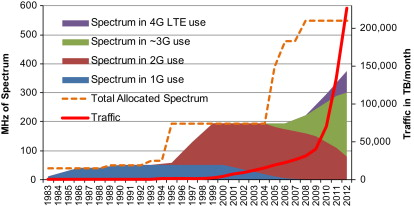
Despite some hand wringing over the “5G business case,” the payoff is about as prosaic as could possibly exist. Each mobile network generation relies on a fixed allocation of spectrum. Though smaller cells help with frequency reuse, which boosts total available capacity, there still are limits. 

source: TeleGeography 


If mobile customer accounts increase every year, and the amount of data each customer consumes also increases every year, by as much as 40 percent per year, any platform will eventually run out of capacity. 


source: Researchgate


Each successive mobile next-generation network is required, in large part, simply to accommodate the increased data demand, which in turn requires additional spectrum. 


source: Science Direct 


Reducing cell size helps. Better radios help. But, in the end, the only way to increase bandwidth enough to keep up with annual demand increases of 40 percent is to add more spectrum.


5G Core Networks are a Five-Year Project, Globally

We might infer from this forecast by the Small Cell Forum of radio deployments that network slicing--contingent on 5G virtualized core networks--might not be widespread until about 2026. It is a somewhat indirect relationship, to be sure. 

source: Small Cell Forum 


But widespread deployment of 5G radio infrastructure using standalone (5G core only, not 4G evolved packet core) requires that the new 5G core network be in place. 


More Spectrum Sharing for 5G

Spectrum sharing is going to be an important trend for 5G deployments--especially enterprise and private network deployments in many global markets, a study by Small Cell Forum suggests.


In many markets, regulators are designating some spectrum for shared usage, short-term or localized licences that are designed to stimulate enterprise adoption of 5G, SCF says. 


The other important new trend, in some markets, is use of shared or unlicensed airwaves for cellular networks. Informal methods--such as using Wi-Fi for mobile handset data connections--are common. 


What is new are structured methods for taking advantage of spectrum that is licensed to third parties; use of 4G spectrum to support 5G access and aggregation of both licensed and unlicensed spectrum by a single carrier to support customer network access. 


The use of spectrum sharing in the U.S. market for 3.5-GHz spectrum Citizens Broadband Radio Service provides one example. The Small Cell Forum believes spectrum sharing will represent a growing number of radio sites over the next five years. 

source: Small Cell Forum 


Monday, October 18, 2021

Of Course There is a Business Model for Millimeter Wave


When service providers talk about "5G business models," they usually are referring to something else: the financial return from investing in the 5G network, right now. At a high level, the business model for 5G is largely the same as for 4G, 3G or 2G: mobility services.

That is not to deny some incremental upside from new use cases and applications such as internet of things, edge computing or private networks. Still, the larger point is that the mobility business model hinges on lower costs per bit over time, as customers continue to consume ever-more data, but can be enticed to spend more only with great reluctance.

The same reasoning applies to use of new spectrum resources. The high-level justification for mid-band spectrum (2 GHz in the 3G and 4G era) is that it allows mobile operators to supply more bandwidth for existing customers, while reducing the cost of providing that bandwidth. 

The cost per gigabyte delivered can be reduced by up to 75 percent with millimeter wave spectrum, compared to sub-6 GHz solutions, according to Nokia Bell Labs. 

Millimeter wave was a bit different, as it requires smaller cell sizes than used by mid-band spectrum. But that is not a qualitatively new problem, either. Mid-band required smaller cells than low-band spectrum required. 

Going forward, every mobile next-generation network--from 5G on--is going to require use of millimeter wave spectrum because it is the only unconstrained, unallocated set of spectrum resources left to use in the radio frequency domain. 

Also, millimeter and teraHertz spectrum are the only radio frequency resources able to support the increases in expected data demand (higher frequencies can supply more bandwidth, per megaHertz. 

Sunday, October 17, 2021

Where 5G and Wi-Fi 6 Will Enable New Apps

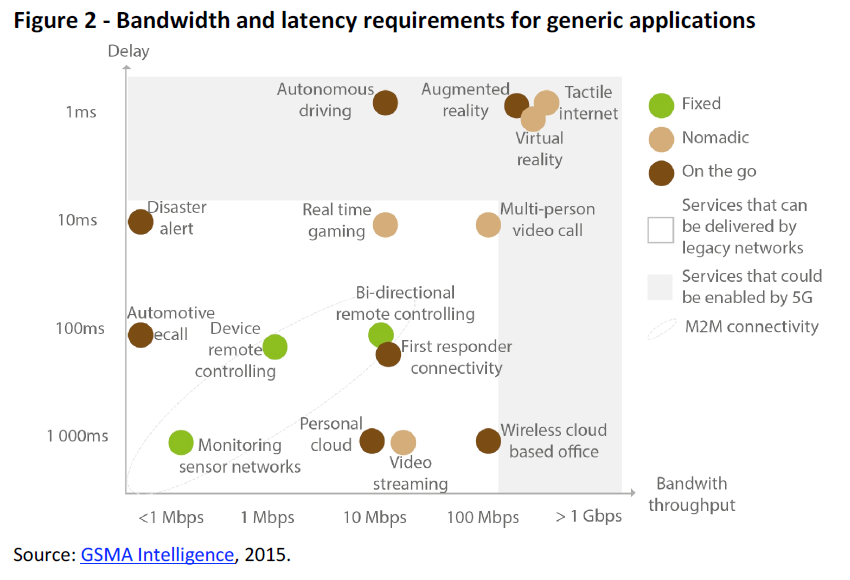
5G likely will prove important at the margin for emerging new applications, especially applications which require ultra-low latency that mobile and other networks prior to 5G or prior to Wi-Fi 6 cannot supply. Some of those new use cases also require 5G bandwidth, especially immersive applications. 


source: GSMA


source: Researchgate


source: Researchgate   


Thursday, October 14, 2021

A Visual Look at Mobile Spectrum

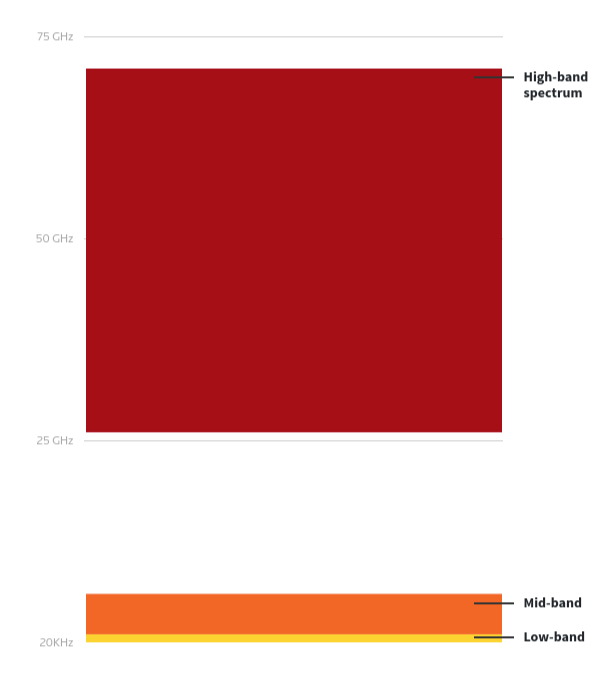
It often is difficult to visually represent how much more bandwidth millimeter wave spectrum represents for mobile operators. Here is one way. The yellow rectangle shows the relative spectrum available in the low bands between 600 MHz and 850 MHz. 


The orange rectangle shows the mid-band resources in the range between 1.9 GHz and 6 GHz or so. 


source: Reuters 


The red rectangle shows millimeter spectrum presently licensed, up to about 70 GHz. But the millimeter wave radio spectrum extends up to about 300 GHz in frequency, and almost all of it has not been used for commercial communications applications and networks such as mobile networks. 


Millimeter spectrum matters for coming mobile networks because most of the other spectrum already is licensed for other purposes and users.


Is Sora an "iPhone Moment?"

Sora is OpenAI’s new cutting-edge and possibly disruptive AI model that can generate realistic videos based on textual descriptions.  Perhap...