Monday, January 18, 2021

Mobile Roaming Drops 73%, Revenue Drops 54%

On a global level, international mobile roaming usage dropped 73 percent in 2020 and might not recover the 2019 levels until 2024, Juniper Research now projects. Wholesale roaming revenue might have been down 54 percent, Kaleido Intelligence estimates. 

source: Kaleido Intelligence


Of course, much depends on mobile operator marketing practices and consumer behavior. Operators might try to stimulate demand by dropping prices, something they did with roam like home plans. Likewise, business travel demand, especially, might not assume former levels (either in terms of destinations or volume). 


Where in 2019, some 918 million people used mobile roaming, indicating they were traveling outside their home areas, in 2020 just 243 million people had roaming activity. 


source: Kaleido Intelligence


Others estimate a recovery of roaming revenues to 2019 revenues faster, reaching the former level by 2022. 


International mobile roaming is a proxy for travel, and suggests global travel levels will take three years to return to 2019 levels. Some 1.3 billion fewer trips will take place by the end of 2020, a year on year fall of 64 percent, Kaleido Intelligence estimates. 


Best Opportunities for Private Mobile Networks: Enterprises and Service Providers

At least at the moment, the more-promising verticals for mobile operators hoping to earn direct revenue are in the public safety, utilities, railroad, smart cities and communications verticals, a study by the Global Mobile Suppliers Association suggests. 


One commonality in such verticals is the need for mobility, wide area coverage and outdoor coverage. Those are use cases highly favoring use of a mobile network. 


Use cases best suited to private network operation (LAN use cases) include manufacturing, mining and seaports, where sensors and device tracking or equipment performance are key, but WAN coverage is not needed. 


source: GSA 


Private mobile networks using 4G (Long Term Evolution) seem to dominate the ranks of existing private "5G" networks, though 5G projects are poised to increase as well, the GSA study suggests. 


The identifiable base of private network users or intended users might number as few as 500 at the moment, GSA estimates. That includes 263 end users as well as several hundred whose spectrum acquisition posture indicates they are planning to become private network users. 


source: GSA 


Since private mobile networks based on LTE or 5G can be deployed in licensed mobile spectrum, subleased licensed spectrum, shared or unlicensed spectrum, the range of possible users and deployment modes is a bit complex. 


Further complicating the analysis, private mobile networks sometimes will be operated “as a service” by a mobile operator or a system integrator on behalf of a customer; or operated by the enterprise directly. In the former case a private mobile network is a direct revenue stream earned by a mobile operator. In the latter case a private network might represent a direct revenue stream for network infrastructure suppliers and local area network support services firms. 


Private mobile networks therefore straddle two different parts of the networking market: LAN infrastructure and public network services. Estimates of market size therefore will have to blend sales of infrastructure; services to design, install and maintain such networks; plus mobile operator revenues from supplying turnkey private networks “as a service.” 


Inevitably, some will also include the revenue earned by connectivity providers for connections to the public internet, or other access connection revenue that often also will be used for other purposes. 


Enterprise private networks might also be built using network slices (a wide area network revenue source for the operator) as well as local site infrastructure (LAN infrastructure; system integration services and support).


Saturday, January 16, 2021

The "Rule of Three" and "Rule of Four" in Mobile Operator Markets

Business strategy in competitive markets largely free of regulatory constraints and major entry barriers tend to evolve towards a specific and stable market structure including the “rule of three” and the “rule of four.”


The rule of three states that a stable market is led by three firms. The rule of four refers to the expected market share in a stable market, where leader market share is twice that of provider number two, and where the number-two supplier has share double that of the number-three provider. 


Which does raise an obvious question: is telecommunications the sort of business “free of regulatory constraints and entry barriers?” Many would say that is not the case. If so, the rules of three and four might not ever apply. 


That was the case in the days of monopoly telecom, but that era has given way to competition. 

Competitive telecom markets already exhibit reduced regulatory constraint (deregulation) and lower entry barriers (wholesale access, for example).


And though BCG founder Bruce 


Henderson believed industries such as consumer electronics, software and computing hardware, investment banking and telecommunications would be the exceptions to the rule, others might argue the classic rule of three and rule of four pattern already has emerged in the internet ecosystem, software and hardware. 


Others might note that one way of changing a market share position is to disrupt the industry, changing the basis of competition; the product; the experience or the value. 


Bruce Henderson, founder of the Boston Consulting Group is credited with a few foundational ideas about business, including the notion of the experience curve, which explains how the cost of products decreases with volume.


“Costs characteristically decline by 20 percent to 30 percent in real terms each time accumulated experience doubles," Henderson posited in 1968.


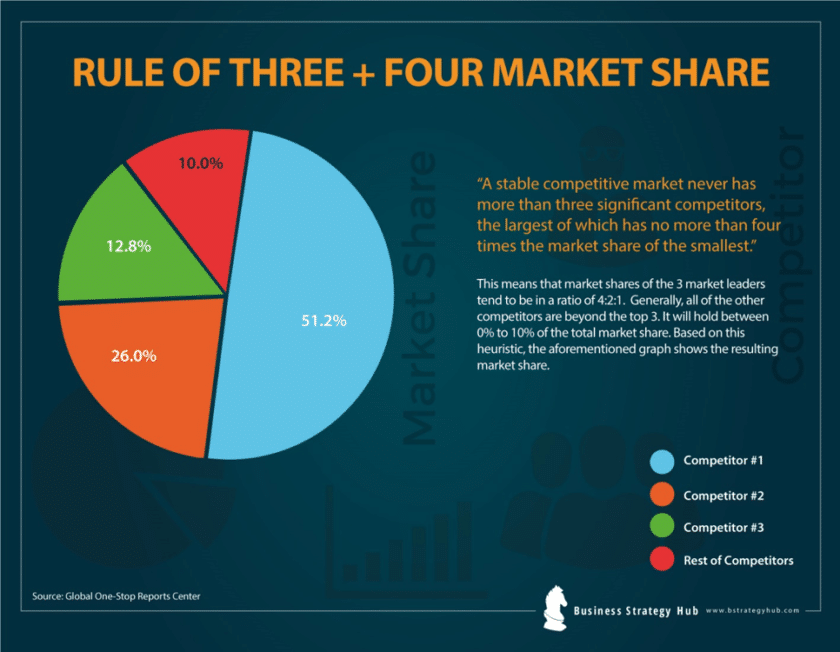
Among his other key ideas is the shape of market structure under conditions of competition. "A stable competitive market never has more than three significant competitors, the largest of which has no more than four times the market share of the smallest,” Henderson argued. He called that the rule of three. 

source: BCG 


Related is the “rule of four,” which speaks to expected stable market share structure. Henderson argued that stable and competitive industries will have no more than three significant competitors, with market share ratios around 4:2:1.


Industry structure will become stable once the market share between two companies reaches a ratio of 2:1, Henderson theorized. “At this point, it is neither advantageous nor practical for either company to decrease or increase share,” Henderson noted. 


Those ratios also have been seen in a wide variety of industries tracked by the Marketing Science Institute and Profit Impact of Market Strategies (PIMS) database.


Researchers Rajendra S. Sisodia and and Jagdish N. Sheth analyzed the evolution of about 200 competitive markets about the year 2000. 


“Competitive markets evolve in a predictable manner and, once mature, exhibit many similarities across industries and geographies,” said Jagdesh Sheth. Stable markets tend to be dominated by three major, volume-driven firms


The three large firms typically represent 70 percent to 90 percent of the total market share. To be viable, a leader requires a market share of at least 10 percent, Sheth argues. 


The starting point for a new market is almost always a new technology, and new markets tend to be highly fragmented, Sheth says. Early entrants tend to be product specialists in such areas. 


New markets tend to have few technical standards at first, with low barriers to entry and exit, and a decidedly local geographic focus. If the market satisfies a legitimate need, it will generate excess capacity as more entrants emerge. 


That leads to consolidation, standards-based competition and rationalized competition. Government regulators or collective industry data sharing, electronic exchange and other measures to improve the speed and ease of transactions often are part of the rationalizing process. 


Scale and efficiency, in other words, become important as the market matures. 


The mature phase in any industry also has some common characteristics. When markets become saturated, growth slows dramatically. That tends to raise costs and reduce profit margins. 


As total revenues decline over time, firms tend to focus on profit margins rather than gross revenue, as, by definition, gross revenues are shrinking overall. Operational efficiency becomes paramount, as there is limited upside from investing in new features and products. 


Outsourcing and other moves to lower breakeven costs are logical. 


Investment will be optimized and controlled, as deploying new capital produces a limited financial return. 


Other firms begin to exit the business and merger activity increases. 


Strategy Options for Market Leaders and Specialists

Characteristics

Generalists

Specialists

Sources of Advantage

Size x Speed

Selectivity x Service

Cost Structure

High Fixed Costs

High Variable Costs

Scope of Offerings

Full Line of Products

Limited Line of Products

Positioning and Branding

One Stop Shop Positioning with Single Brand (Corporate) or Dual (Upscale and Mainstream) Brand Identity

Target Market Positioning, Multiple Brand Identity

Distribution Channels

Multiple Channels

Focused Channels

source: Jagdesh Sheth 


The takeaway is that every firm has to decide whether it really can hope to become a leader of the industry or must operate as a specialist of one sort or another. Any firm realistically contending for leadership of the market must decide whether it is realistic to make an assault on the market leader, or whether it is feasible to supplant the firm which is number two in share. 


When market share reaches a clear 4:2:1 pattern, observers might say the market is so settled that the effort to change share is doomed to failure. Few mobile markets are in such a settled condition. 


Are Mobile Operator Markets Subject to Rule of Three and Rule of Four?

The French mobile services market, like the U.S. and U.K. markets, has a market share structure that some researchers might say is not yet “settled” in the sense of established and stable markets that follow a rule of three. The implication is that all those markets remain contestable. 


In the French mobile market: Orange has about 37 percent market share, Altice has about 31 percent market share, Bouygues claims 16 percent share while Iliad (Free) has 16 percent.


The U.K. mobile market, after the O2 merger with Virgin Mobile, which should have that firm with about 30 percent share, followed by EE with about 27 percent share and then Vodafone at about 21 percent.


The U.S. mobile operator market likewise features one leader and two equally matched other contestants in early 2021. 


source: Evercore ISI Research 


Bruce Henderson, founder of the Boston Consulting Group is credited with a couple of foundational ideas about business, including the notion of the experience curve, which explains how the cost of products decreases with volume.


“Costs characteristically decline by 20 percent to 30 percent in real terms each time accumulated experience doubles," Henderson posited in 1968.


Among his ideas is market structure under conditions of competition. "A stable competitive market never has more than three significant competitors, the largest of which has no more than four times the market share of the smallest,” Henderson argued.


Henderson argued that stable and competitive industries will have no more than three significant competitors, with market share ratios around 4:2:1.


Those ratios also have been seen in a wide variety of industries tracked by the Marketing Science Institute and Profit Impact of Market Strategies (PIMS) database.


Such markets are stable precisely because the attackers cannot hope to unseat the market leader. This stable market structure is quite common in industries operate in markets largely free of regulatory constraints and major entry barriers (such as restrictive patent rights or government-controlled capacity licences). 


source: The Rule of Three 


There is, to be sure, it can be argued that the rules about market share in stable markets do not apply to telecom, as they might not apply in any market where market entry is restricted or where other large barriers to entry exist. 


If regulation prevents the market from acquiring its competitive outcome, or because entry barriers are so high competition cannot occur, or both, telecom arguably would be an exception to the rules of three and four. 


Still, a wider range of industries and markets once thought not to be subject to the rules of three and four arguably are now taking that shape. The emergence of “winner takes all” dynamics in social media, for example, suggests the rule of three might well apply in many parts of the internet ecosystem. 


The issue is whether the relevant metric is usage, revenue or profit. The browser market, measured in terms of usage, fits the pattern. 


source: statcounter 


source: w3schools.com


E-commerce and smartphone markets do not yet have the settled rule of three and rule of four pattern. 


Still, the point is that if connectivity service provider markets are subject to the rules of three and four, most mobile markets are not yet stable.


Friday, January 15, 2021

Headlines Trumpeting C-Band Spending are Correct, But Also Misleading

Most of the stories you will see about the C-band auction will emphasize the sheer amount of money spent to acquire some of the 280 MHz of spectrum. The auction will set a new record for spending in a single auction.


The reason is that the Federal Communications Commission has never before auctioned so much desirable mobile spectrum (low band or mid band) in a single auction. The prior record was the sale of AWS-3 licenses for about 65 MHz of capacity that were crucial for 4G networks. 


The final prices vary by market and type of license, but nationwide average prices were 94 cents per MHz-POP. 

source: Sasha Javid 


All prior auctions for low-band or mid-band spectrum were for even-smaller allotments.


The AWS-3 auction made available a total of 65 MHz of capacity. The C-band auction was for 280 MHz of capacity, about four times as much as the AWS-3 auction. All other things being equal--the AWS-3 auction being central for U.S. 4G and C-band being central for U.S. 5G--the total amount of assets at stake in the C-band auction is four times the amount of AWS-3 assets. 


So one would expect, based simply on volume, to see C-band proceeds four times greater than was bid for AWS-3. That auction raised $45 billion. So four times more spectrum, with the same strategic value--would in principle not be out of line in costing $180 billion. 


Nobody believed that would happen, and it did not. On a cost per MHz basis, C-band prices were clearly less expensive than was the AWS-3 4G spectrum. The difference is simply the amount of spectrum being purchased. 


AWS-3 prices were far higher, at an average of $2.72.

5G "Plus" Might be the Best Way to Evaluate Upside from 5G

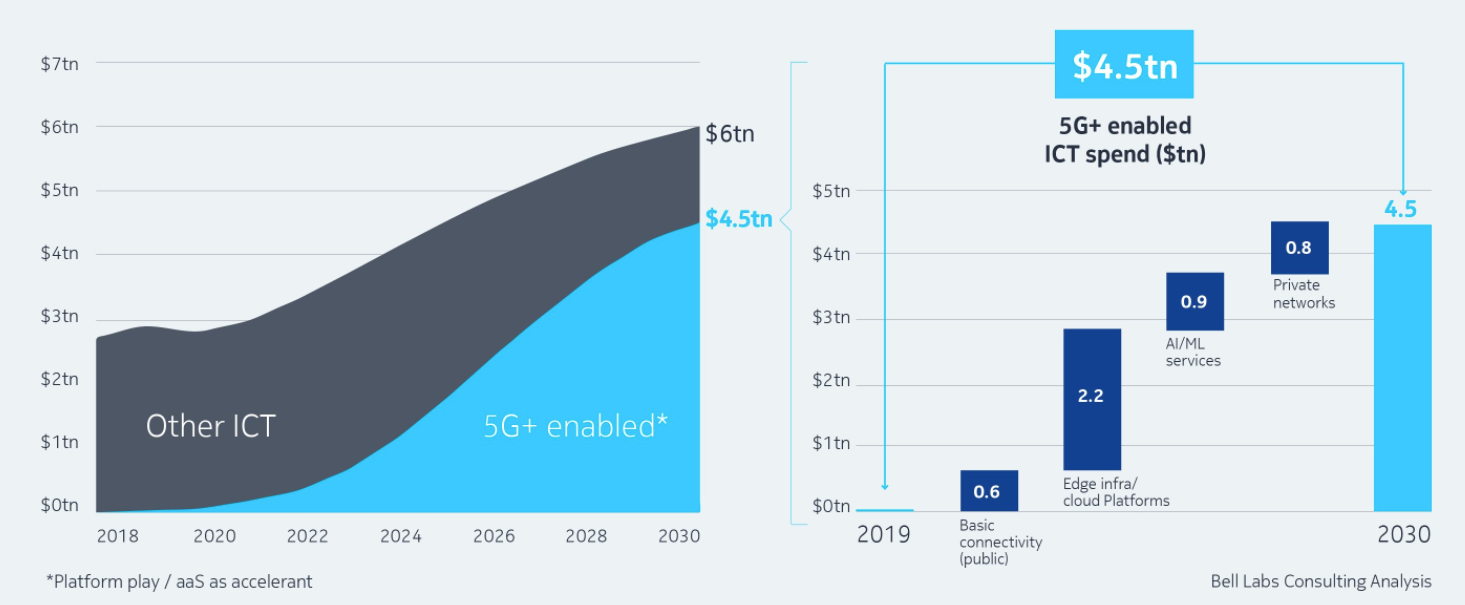
5G+ is as good a way as any to assess the value 5G might produce. Bell Labs Consulting uses “5G+” as an umbrella term for a broad ecosystem of technologies that will unlock the future economic potential of industry.


And that makes sense for observers who argue that 5G is but part of a complex of emerging technologies including edge cloud infrastructure, private networks, augmented intelligence, automation, sensing and robotics, as well as platform and as-a-service business models that will have a collective impact. 


As a corollary, assessment of the economic value of that complex of technologies produces big numbers, as would be the case if one tried to quantify the impact of value created by all uses of computing or electricity in a modern economy. 


But even infrastructure spending can reach lofty levels when looking at the full complex of 5G+ technologies. 


Bell Labs Consulting estimates spending of up to $4.5 trillion in 2030 for the 5G+ enablers and about $8 trillion in new economic value in 2030 from the 5G+ complex. 


source: Nokia Bell Labs Consulting 


Perhaps most significantly, Bell Labs Consulting notes that early 5G+ adopters report the number-one and number-two benefits as being “incremental revenue growth” and the “ability to enter new or adjacent markets.


For those who believe long-term connectivity provider strategy has to be based on movement into new roles in the internet ecosystem and value chain, those are suggestive findings. Indeed, though incremental revenue growth always is important, the enabling of moves into adjacent markets might be the most important. 


The caveat might be that it will remain hard to quantify the various contributions of 5G+ capabilities. It might also be argued that 5G is so new that it is likely other parts of the technology complex--such as computing as a service--have been the actual value drivers and enablers, not 5G connectivity as such.


Thursday, January 14, 2021

More Uncertainty Than Typical as 5G Rolls Out

Some possible fluidity is possible in the mobile operator business in the wake of the Covid-19 pandemic and the cost of 5G networks. There are relatively prosaic unknowns, but also some bigger challenges related to strategy. 


Network architects face a greater degree of uncertainty around usage patterns. After the pandemic, will downtown area traffic return to former levels, or remain permanently lower? Will more capacity be needed in residential areas? Will millimeter wave support be as important in high-traffic areas right away, or will the reinforcement demand now be more gradual?


Conversely, will residential tower sites need to be reinforced if more people use their mobile devices for group video calling, at a higher rate than originally forecast before the pandemic? Some permanent increase in demand seems most likely, but how much of an increase will be seen near term, as work and education patterns resume a pre-pandemic form?


Will network virtualization prove its value as traffic patterns assume new forms, or continue changing?


And if 4G performance gets better, even as 5G launches and also gets better, how will consumers evaluate the experiences? Where mobile operators require more-expensive 5G plans, will that be an inhibitor? Will more churn happen if rivals do not charge a premium? 


Aside from the immediate post-pandemic issues, longer-term challenges also will have to be met, ranging from debt reduction to new product development to earning a return commensurate with higher spending to acquire new 5G spectrum. 


As a practical matter, capital invested to acquire spectrum and build the network cannot be spent to acquire or build new revenue-generating assets and create new lines of business. As a practical matter, will mobile operator efforts to create new lines of business slow down as capital has to be deployed into the core connectivity function?


At a high level, new capex to boost capacity or performance is bumping up against relatively low financial returns from doing so. 


In many markets, subscription growth is quite low, as nearly everybody who wants to use a mobile phone already does so. For many customers, 4G might meet their needs, making an upgrade to 5G more challenging.


Since competition has not diminished and markets are saturated, gross revenues and profit margins from legacy connectivity services are falling. 


That implies a few key challenges: optimizing the cost of the legacy business and finding additional new and substantially-sized new revenue streams. 


So what if much invested 5G capital produces modest revenue upside, initially? And what if new revenue sources do develop over time, but are of relatively low magnitudes? At a high level, if a typical mobile operator must expect about five percent erosion of revenue every year from legacy services, new sources must generate five percent a year, simply to prevent revenues from falling, to say nothing of growth. 


What happens to consumer behavior after the pandemic ends is one set of issues. How to reap a reasonable return from 5G investments is the bigger concern.


Is Sora an "iPhone Moment?"

Sora is OpenAI’s new cutting-edge and possibly disruptive AI model that can generate realistic videos based on textual descriptions.  Perhap...