Thursday, October 14, 2021

A Visual Look at Mobile Spectrum

It often is difficult to visually represent how much more bandwidth millimeter wave spectrum represents for mobile operators. Here is one way. The yellow rectangle shows the relative spectrum available in the low bands between 600 MHz and 850 MHz. 


The orange rectangle shows the mid-band resources in the range between 1.9 GHz and 6 GHz or so. 


source: Reuters 


The red rectangle shows millimeter spectrum presently licensed, up to about 70 GHz. But the millimeter wave radio spectrum extends up to about 300 GHz in frequency, and almost all of it has not been used for commercial communications applications and networks such as mobile networks. 


Millimeter spectrum matters for coming mobile networks because most of the other spectrum already is licensed for other purposes and users.


Millimeter Wave Really is Different

Many understand that millimeter wave spectrum offers much-higher bandwidths than signals transmitted at low-band and mid-band frequencies. To be sure, we see the confluence of several trends including use of small cells, spectrum aggregation, spectrum sharing, new spectrum and better radios and modulation techniques, each of which helps increase usable bandwidth. 


source: Nokia 


What typically is less well understood is why the increase in bandwidth from millimeter wave frequencies is possible. 


Professor Robert Heath, Jr.


The answer lies in the physics of radio waves at different frequencies. Consider a simple explanation. Assume that the ability to code symbols hinges on the oscillation of a radio signal from high to low.


As a simple example, assume that every zero crossing of any wave represents the opportunity to code a bit (one or zero). Using a very simple coding method, the total amount of bits that can be represented in one second of time hinges on the number of oscillations a wave makes over that period of time. 


A slightly more complex method able to code on four different amplitudes of a wave would yield four symbols per second. 


source: Wikimedia


Of course, modern coding and modulation techniques are far more substantial than that. But looking only at the number of zero crossings per second, millimeter wave spectrum increases potential capacity simply because there are so many more “zero crossings” per second of time. 


source: Wikipedia


To the real extent that each oscillation of a radio wave in a second of time dictates the number of symbols which can be represented, increasing the number of oscillations necessarily increases the potential symbol representation, whether the coding uses signal amplitude or phase modulation. 


That also means radio channels can be much higher. Where 2G and 3G channels might have used as little as 5 MHz, and 4G could use channels of 20 MHz, 5G allows channels that are routinely 100 MHz wide. Wider channels means more bandwidth; more bandwidth more speed. 


Roughly speaking, compared to low-band radio signals, millimeter wave spectrum can support at least an order of magnitude higher bandwidth. 


Wednesday, October 13, 2021

Federated Wireless Hopes to Create a New Platform Business

Federated Wireless now provides an example of how a “pipeline” provider business model can lead to a “platform” business model, without abandonment of the original business. 


A platform business model essentially involves becoming an exchange or marketplace. Instead of operating as a direct supplier of some essential input in the value chain, owning assets and creating products, the platform functions as a matchmaker, bringing buyers and sellers together. 


Pipeline business models are the way most businesses always have worked: an innovator identifies a customer need; sources all the materials required to create a solution; creates distribution channels and fulfills delivery of the product.  


A pipeline business creates and owns the products it sells. Exchanges or marketplaces most often do not own the products bought and sold on their exchanges. 


As always, there are exceptions in the real world. Amazon does actually source, brand and sell some of the products sold on its website. 


The Federated Wireless Spectrum Exchange allows third party use of Citizens Broadband Radio Service (CBRS) Priority Access Licenses by third parties.


Participant sellers can publish their assets, seek buyers and receive instant payment. 


“Organizations seeking assured, PAL-grade connectivity throughout the 3.5 GHz CBRS band will simply visit the Spectrum Exchange, browse through the lists of providers, spectrum availability, time periods and locations, and place an order online,” the company says. “Spectrum is allocated almost instantly for the period requested through the Federated Wireless Spectrum Access System.”


Another firm attempting to create a platform business, in addition to its own “pipeline” business, is PCCW Global. Though PCCW Global owns and creates its own network services, it also is working to create a platform business allowing customers to sell and buy capacity and  data center services using an automated exchange. 


source: PCCW Global, MEF 


In essence, the platform would create a new platform business where some of the revenue comes from sale of its own network products, but hopefully much of the revenue comes from transactions. 


For Federated Wireless, the new shift moves it from providing the spectrum controller function (allowing shared use of spectrum while avoiding interference) to providing a spectrum exchange.


Tuesday, October 12, 2021

How Much IoT Service Revenue for Mobile Operators?

Service provider 5G service revenues will reach $73 billion globally this year, while growing to $600 billion by 2026, analysts at Juniper Research predict. $73 billion in 5G revenues would represent about 8.5 percent of total mobile operator revenue in 2021, according to Juniper Research. 


That is likely correct as far as it goes. The other important observation is that those 5G service revenues do not represent very much incremental revenue, as most of those subscriptions will be matched by a lost 4G, 3G or or 2G subscription. 

source: Statista 


It is possible, however, that sensor, server and other connections already are included in the Statista figures. That seems likely as it is unlikely either edge computing using 5G, or internet-of-things connections at the moment amount to more than a few billion dollars worth of revenue globally (for service providers). 


Also, “service” revenue does not represent the full extent of mobile operator revenues, which include other notable revenue sources such as device sales. 


Global Mobile Service Provider Total Revenue (Subscriptions plus Devices)


year

2021

2022

2023

2024

2025

2026

revenue $B

1400

1414

1428

1442

1457

1471

IP Carrier estimate based on $1.4 trillion in 2021 revenue, including service, device and other revenues


Perhaps the more-important figures to track are incremental service revenues that do not represent a replacement of consumer or business user mobile phone subscriptions. Connected sensors, servers or other machines provide one example of possible incremental use case and revenue growth. 


If one assumes an IoT market generating about $1.8 trillion worth of revenue in 2026, and if connectivity revenue is about 10 percent of that amount, then IoT service revenue could be a $180 billion market, representing as much as 12 percent (potentially) of total mobile operator revenues, if mobile operators had 100 percent share of the IoT device connectivity services market, which will not happen. 


If mobile operators had 50 percent share of the IoT connectivity market, then the incremental revenue would be $90 billion, or about six percent of total revenues. That is significant, if not overwhelming.


Saturday, October 9, 2021

5G Revenue Model is Largely "Replace 4G"

Lots of mobile industry executives have worried about 5G monetization. The concern is real, but arguably exists because the payback from new capital investment to support dense backhaul networks and small cells is a concern, not the actual revenue from 5G. 


The industry-standard high-level argument has been that 5G would enable faster speeds, lower latency and support for dense networks of sensors.  All that is true, but arguably does not speak to the ways revenue will be earned in a concrete sense. 
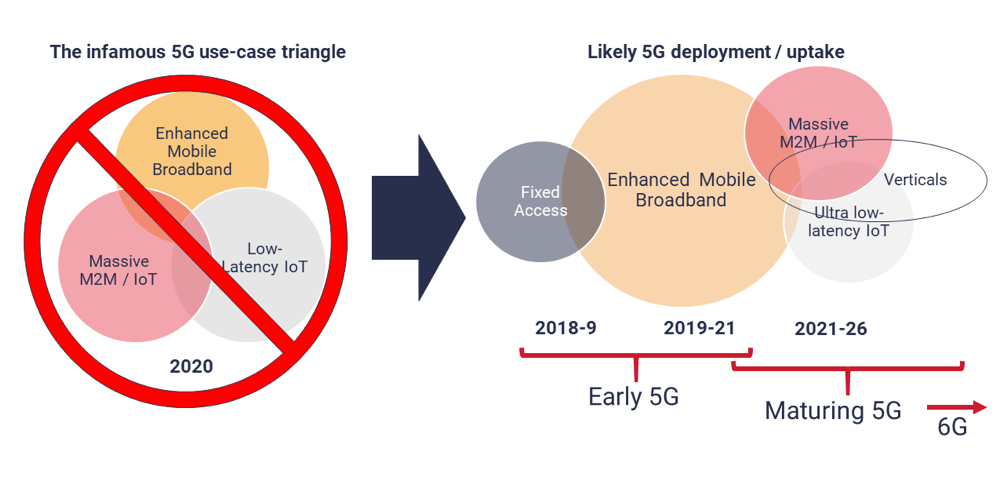
source: STL Partners 


As a rule of thumb--as shocking as it might seem at first--service providers tend to replace about half of their existing revenue every decade. 5G provides one very concrete example, as did 2G, 3G and 4G. 


5G accounts will eventually replace half of all other accounts--primarily 4G but also 3G and 2G--over a decade. 

source: Statista 


The same process happened for analog mobile, 2G, 3G and 4G. By design, each successive mobile next-generation network displaces the older networks. A common pattern is for the latest generation to get about 50 percent share of accounts within five to six years. 
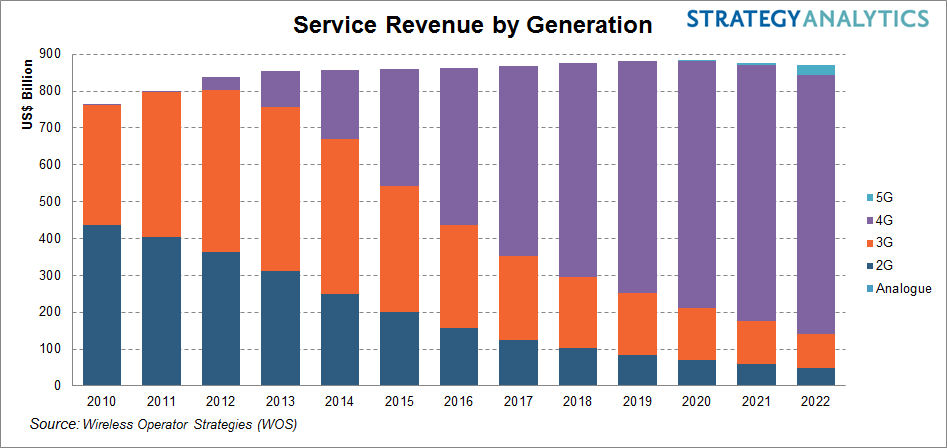

source: Strategy Analytics


The same process arguably also held for home broadband and fixed network internet access services. As typical speeds increase over time, customers upgrade. The product we called “dial-up internet access” was replaced by “broadband” access at single-digit or low double-digit rates. 


But speeds keep increasing. And customers gradually replace older services with newer services operating at higher speeds. 
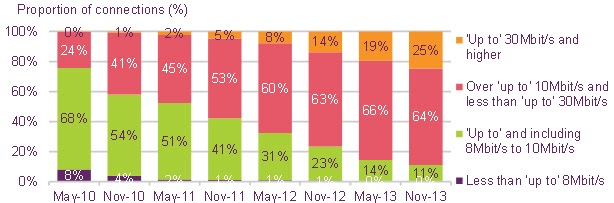

source: Ofcom 


Access speeds  in the U.S. and other markets have grown by an order of magnitude (10x) every five years, since about 1990. 


source: iconnect007 


So, in a real sense, both mobile and fixed network internet service providers do replace at least half of all existing revenue every decade, looking only at a single product: consumer internet access. 


source: Openvault


For example, about a third of U.S. home broadband customers in early 2019 bought services operating at 100 Mbps to 150 Mbps. Two years later nearly half were buying services operating between 100 Mbps and 200 Mbps. 


source: Openvault  


In early 2019 some 54 percent of U.S. households purchased services operating at speeds less than 75 Mbps. By mid-2021, all customers buying services at less than 50 Mbps had fallen to 10.5 percent. 


Enterprise data services show the same trend. Where enterprises once bought X.25, they later switched to ISDN, also frame relay, then to T-carrier, followed by ATM, then witching to dedicated internet access and MPLS. Now many are moving to SD-WAN. 


The point is that the products enterprises purchased--and service providers sold--evolves over time. The same general pattern--replacement of half of current products--every decade also holds. 


So, to answer the question about where 5G revenue will come, it will mostly come from the same places it does now. There will be new revenue sources over the decade, including fixed wireless, sensor connections and edge computing revenues. But the mainstay will remain consumer and business mobile connections.


Thursday, October 7, 2021

Key 6G Features?

Nobody knows what 6G will entail, except faster speeds and lower latency, as those have been features of every successive mobile next-generation network. Beyond that, power consumption requirements are likely to be lower. Most expect a greater ability to “use any available access platform” than presently is the case.  


source: Cabe Atwell 


As is expected for virtually all business processes in virtually every industry, there will be more reliance on artificial intelligence and machine learning. It is hard to predict which new applications will emerge, but immersive video and entertainment and support for autonomous vehicles are good bets.


Wednesday, October 6, 2021

5G Vertical Applications

As many mobile operators explore vertical market opportunities for 5G networks, some argue they ought to go horizontal, creating platforms where possible. That might arguably be harder to achieve. 

Is Sora an "iPhone Moment?"

Sora is OpenAI’s new cutting-edge and possibly disruptive AI model that can generate realistic videos based on textual descriptions.  Perhap...