Wednesday, May 9, 2018

Apple Wants More Unlicensed, Shared Spectrum. Why?

An absolutely accurate observation can be made the the global mobile service provider business has relied on access to licensed spectrum to support its business models. Just as certainly, supply and demand affects prices of spectrum, as well as the value of spectrum.

It also is just as accurate to note that some other service providers have relied just as substantially on access to unlicensed spectrum; and to note that unlicensed spectrum now is a substantial method to support mobile access indoors, as a complement to licensed access.

Itr would be equally true to argue that shared spectrum and unlicensed spectrum now are viewed as major opportunities by a growing number of tier-one application and now device suppliers, enterprises, infrastructure and device suppliers, including Apple, which wants the U.S. Federal Communications Commission to increase the amount of unlicensed spectrum to be made available above 95 GHz on an unlicensed basis, and on a shared basis.

Apple also wants wider contiguous bands of spectrum, creating blocks of spectrum wider than 1 GHz to 7 GHz.

A larger point is that licensed spectrum essentially acts a means to create scarcity, historically seen as a business asset by mobile service providers. Unlicensed spectrum arguably always acts to decrease scarcity, and therefore increases the potential for competition.

So it should come as no surprise that tier-one application, platform and device suppliers favor greater reliance on unlicensed and shared spectrum. Those assets make it easier for application, platform or device suppliers to create communications capabilities that support use of their products and business models.

Tuesday, May 8, 2018

How Big is CBRS or DAS Leased Access Market?

Service and product suppliers are interested in Citizens Broadband Radio Service (CBRS) for obvious reasons: it creates new sales opportunities for infrastructure and possibly services.

Some also are interested in CBRS because it also is a substitute product, and therefore could reduce sales of some existing products.

CBRS, which will enable creation of private 4G LTE networks, often is considered a partial product substitute for the distributed antenna system (DAS), since CBRS can be used by an enterprise to improve indoor mobile coverage, just as DAS does.

Many others are interested in CBRS because it is one more step towards a future where licensed or high-cost spectrum is less a business “moat” for some entities, and where unlicensed spectrum lowers the cost of communications across the board.

With all new markets, it is necessary and helpful to quantify revenue upside and downside. And since DAS is in many ways a substitute for CBRS, the size of the DAS market is instructive.

To be sure, it is conceivable the space will become even more complicated if future small cells supporting CBRS also become integrated antenna sites supporting 5G, 4G, Wi-Fi and other protocols inside the building . In that sense, CBRS and DAS both will be part of the broader “small cell” market.

Up to this point, DAS has proven feasible in larger venues. The issue is whether CBRS could apply in a wider range of settings. While there are five million commercial buildings in the United States, more than 90 percent of those buildings occupy 200,000-square-feet or less, according to the U.S. Energy Information Administration. That might imply that 30 percent, or roughly 1.5 million sites, are the best candidates for DAS, and possibly CBRS.

That might be too optimistic. Boingo, which already is heavily in the DAS and indoor venue Wi-Fi business, believes the addressable market for DAS is about 20,000 more locations (in addition to the sites already installed).

In terms of all small cell venues, there are perhaps 400,000 such potential locations.

So one way of setting parameters is to assume the number of U.S. venues where either DAS or CBRS makes sense ranges from a low of 20,000 locations to a high of 1.5 million locations, with 400,000 possibly representing reasonable CBRS potential.

In terms of business upside, much of the opportunity is infrastructure to create the CBRS nodes. But some might also be looking at potential service revenue. That would include third parties such as Boingo and enterprises directly selling access services to mobile service providers.

Consider that Boingo now serves 41 venues, with 24,000 nodes, and earning recurring access revenue from 3.4 mobile service providers per venue. Boingo reported that 41 percent of its total revenue for the first quarter of 2018 came from its DAS segment, or about $23.6 million in the quarter.

Boingo reports 81 venues in current backlog.

“Project revenue,” which is upfront or one-time payments by would-be customers, is reported as amounting to $18.6 million. Recurring service revenue was $5 million in the first quarter.

That works out to about $122,000 per venue per quarter; $40,650 per venue per month; or $11,956 per carrier, per month.

If 24,000 nodes are in operation, then perhaps “per node” access payments to Boingo amount to about $208 per node, per month.

The issue is how many additional nodes would tend to be added at progressively-smaller venues. At $40,650 per venue, per month at the largest venues, lighting 400,000 smaller locations might generate access revenue far less rich. Assume half the number of nodes are required at the smaller locations. That might generate $20,325 per venue in monthly access revenue.

That implies possibly $8.13 billion in monthly access revenues, or $97.6 billion per year. That clearly is way too high. Total mobile revenues are about $271 billion, so carriers cannot afford to pay 36 percent of revenue just for DAS access.

By a rule of thumb, the annual cost of the access network should not exceed 20 percent of total costs. If margins are assumed to be 20 percent, then total annual costs for U.S. mobile operators might be about 80 percent of total revenue, or about $216 billion. If so, the total cost of all mobile infrastructure should not exceed $43 billion or so, per year.

Obviously, neither DAS nor CBRS can cost as much as an extrapolation from current DAS revenues earned by Boingo would suggest. If DAS represents 10 percent of annual access network spending, then perhaps 4 billion in annual access payments is feasible.

If DAS represented 20 percent of total access network spending (unlikely), then DAS and CBRS theoretically could amount to $8.6 billion.

Some of us therefore would conclude that DAS and CBRS cannot represent much more than $2 billion worth of annual recurring access payments to enterprise infrastructure operators. Beyond that, it will make more sense for carriers to build their own facilities, or simply avoid indoor CBRS or DAS altogether.


Enterprise small cells (which arguably includes the distributed antenna system segment) will by 2022, account for almost half of all small cell deployments, up from seven percent in 2014, according to Rethink Research.

The installed base will reach 14.8 million in 2022, up from 185,000 in 2014, according to Rethink Research.


source: Mobile Experts

Thursday, May 3, 2018

Comcast Mobile Seems to be Taking More Customers from Verizon, AT&T, Sprint than from T-Mobile US

A new study by Market Strategies International suggests that Xfinity Mobile is taking customers from all major carriers, in perhaps the proportions one would expect, based on overall market share held by Verizon, AT&T and Sprint, but with ess share being taken from T-Mobile US.

That might suggest the “value pricing” positioning by Comcast has more value for customers of Verizon, AT&T and Sprint than T-Mobile US, which is the “value leader.”

Verizon has about 32 percent share; AT&T some 26 percent share; T-Mobile US perhaps 16 percent share and Sprint about 14 percent share.


Almost 60 percent of current Xfinity Mobile customers said they switched because of the better deal, while an additional 27 percent cited the better deal and dissatisfaction with their previous provider as the reasons for switching.

If HHI Score for Sprint Merger with T-Mobile US is Not Different, How Will Antitrust Recommendation be Different?

The last time Sprint and T-Mobile US talked about merging, that transaction would have boosted HHI scores by as much as 486 points. So it came as no surprise that DoJ likewise opposed that merger.

One has to ask whether the U.S. mobile has become less concentrated than it was three years ago, and whether the HHI score for the exact same transaction is going to be different.

The Herfindahl-Hirschman index (HHI) is a commonSome of us find curious the argument that the DoJ will reverse course and approve the recent Sprint-T-Mobile US merger when the likely increase in HHI scores is likely to remain in the vicinity of a 400-point increase in HHI scores that scuttled prior proposed transactions.

While the Herfindahl-Hirschman index (HHI) is a tool used by regulators to determine market concentration, it is a tool, not an absolute dictator of policy, of course.

On the other hand, recent proposed blockbuster mergers in the U.S. mobile market that would have increased HHI scores by 400 points have been opposed by the antitrust officials, and the latest merger is likely to generate an HHI score in about that same range.  

When the U.S. Department of Justice signaled opposition to the proposed AT&T purchase of T-Mobile, the transaction would have raised HHI scores by more than 200 points in 94 percent of markets.

The proposed AT&T acquisition of T-Mobile would have resulted in AT&T having 43.7 market share, resulting in an HHI of 3,335, an increase of 951 points. It is no surprise that the merger effort failed.

By some estimates, HHI would have increased by more than 416 points in more than 93 percent of local markets.ly accepted measure of market concentration. It is calculated by squaring the market share of each firm competing in a market, and then summing the resulting numbers, and can range from close to zero (virtually unlimited competition) to 10,000 (actual monopoly).

As a general rule, mergers that increase the HHI by more than 200 points in highly concentrated markets raise antitrust concerns. So there is no reason to believe HHI will be much less an issue this time around.

Tuesday, May 1, 2018

One Good Argument for Fixed-Mobile Product Bundles

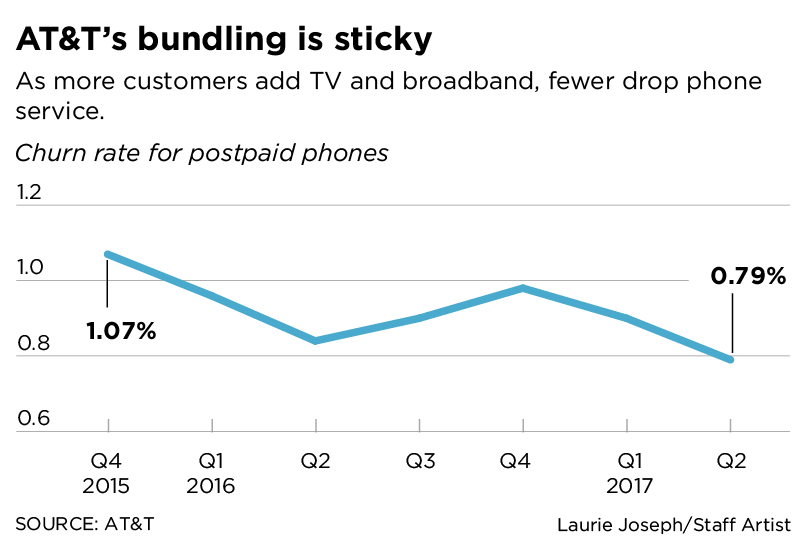
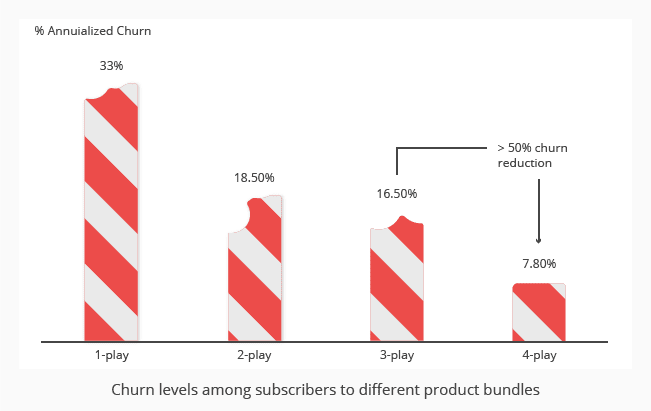
One argument for bundling mobile and fixed network services, it now is clear, are advantages on the customer acquisition and customer churn fronts. To the extent that multi-user plans are a form of bundling, such accounts generally feature lower churn than single-user accounts.

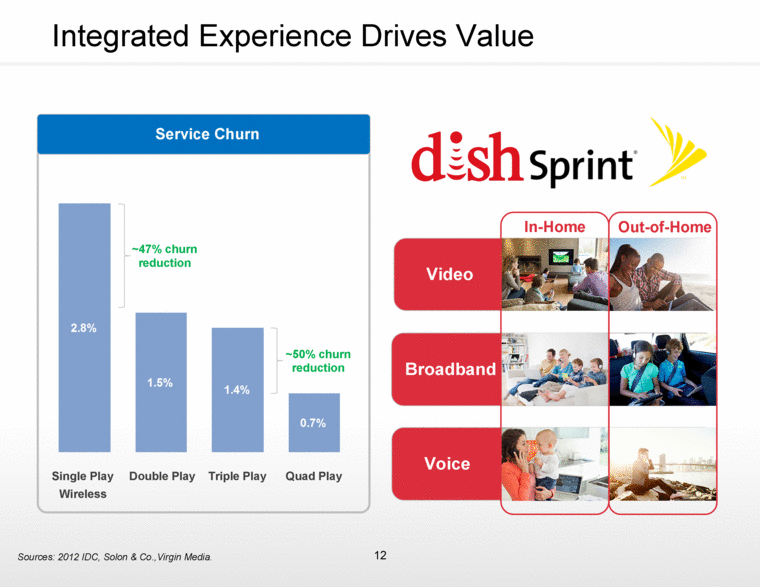
Greater advantages are reaped when multiple services--including fixed and mobile--are offered. In some cases, the churn reduction from adding just one additional service to a single-service account cuts churn in half.

Adding one additional service to a triple-play package likewise can reduce churn another 50 percent.

Bundling of consumer services has been a mainstay of consumer services packaging for decades, for good reasons. Selling a package of services (triple play of voice, internet access, voice, for example) has been shown to reduce churn.

Also, packaging multiple services for one price is a form of discounting, with the advantage that any buyer cannot easily determine how much each constituent service costs, providing some protection against price-based offers from rival providers selling any single one of the services.


Now Comcast is bundling free speed increases for customers who buy a dual-play package of linear video and internet access.

In its Houston market, Comcast is upgrading such dual-pay customers who have the 60-Megabits-per-second tier and whose internet service is bundled with other Comcast products to 150 Mbps.

Customers on the 150 Mbps tier (and buying one or more services) will see speeds increased to 250 Mbps.

Customers with the 250-Mbps service will see their speeds jump to either 400 Mbps or 1 Gbps, depending on the package.

Those deals seem to require use of the X1 modems, which Comcast wants consumers to have for other reasons, and which use the faster DOCSIS 3.1 platform.

Mobile service providers have found that consumers who buy family or multi-user plans, supporting multiple phones and services on a single account, likewise have found such customers also tend to have lower churn.

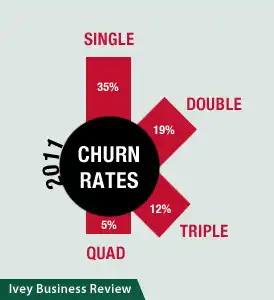
A European mobile operator able to bundle multiple services found much-lower churn rates on accounts buying two, three or four services.


In the Canadian market, quadruple-play, triple-pay and dual-play customers have lower churn rates than customers only a single service, by significant margins. The absolute lowest churn happens on accounts with four services, where accounts churned at one-seventh the level of single product accounts.


Changing Channels Will be an Important 5G Value Driver

Though it might seem almost trivial, "changing TV channels" is one of the important values to be provided by ultra-low-latency 5G mobile networks, working in tandem with edge computing centers.

As more entertainment video is provided using a live streaming format, how fast video appears on the screen when a channel is changed becomes a major driver of experienced quality.

Significantly, the biggest contributor to perceived streaming quality already is “startup time,” the lag between selecting a channel and seeing the desired content displayed on the screen. Some 76 percent of respondents to a survey published by Akamai said startup time was an important quality issue.

That has some implications for 5G mobile networks and edge computing. As video resolution continues to climb (4K and 8K TV), the amount of instantaneous bandwidth required to support startup times when changing channels becomes even more important.

It might seem trivial, but given the amount of online content being consumed, ultra-low-latency 5G networks, paired with edge computing data centers, will provide value precisely as they enable no-lag display of TV content on streaming services when remote control channel change operations are conducted.
source: Akamai

Will 5G be the Fastest-Adopted Consumer Product, Ever?

If forecasts by GSMA Intelligence prove accurate, 5G will be among the fastest-adopted mobile technologies ever, and among the fastest-adopted consumer products ever.

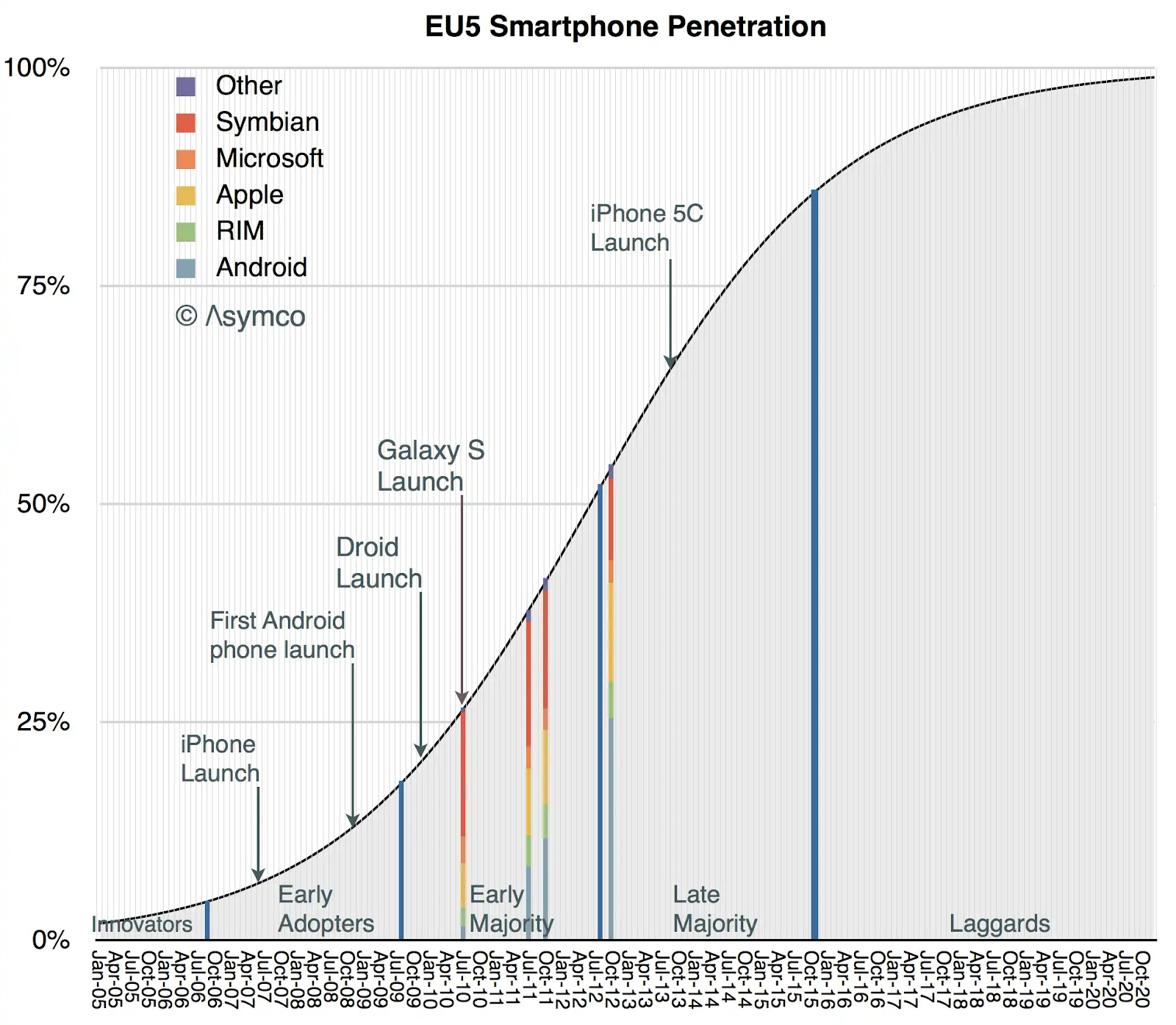
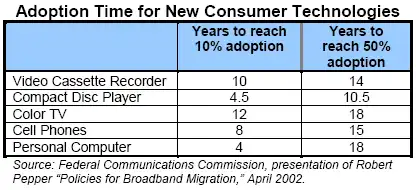
For any successful consumer product, 10 percent adoption tends to the inflection point. That is the point at which adoption sharply accelerates. That has tended to be the pattern for mobile subscriptions as well.


So it would not be at all unusual to predict that 5G adoption, in any market, will hit an inflection point at about 10 percent adoption. That is basically what a forecast by GSMA Intelligence implies.


The issue, of course, is how long it takes to reach that crucial 10-percent adoption mark. GSMA Intelligence believes that could take as little as two years, a breathtakingly fast adoption of a new product.


You can liken the 10-percent adoption to the shift from bleeding edge innovators to “early adopters,” which is about what 10-percent adoption represents. The key point is that adoption rates tend to accelerate after the 10-percent adoption point is reached.

In fact, smartphone adoption provides a good example of that pattern.


Is Sora an "iPhone Moment?"

Sora is OpenAI’s new cutting-edge and possibly disruptive AI model that can generate realistic videos based on textual descriptions.  Perhap...