Friday, November 10, 2017

Mobile Data Drives Small Cell Need

Mobile data traffic already is dominated by video. By 2022 video will drive 75 percent of mobile data traffic, up about seven to eight times from 2016 levels, according to Ericsson.

That is a major reason why new approaches, such as use of millimeter wave spectrum, spectrum sharing, aggregation of licensed and unlicensed spectrum, plus small cell architectures and better radios are so important.

In office environments, small cells might be located just 20 meters (65 feet) apart. In dense urban environments, small cells might be located 200 meters (656 feet) apart. In other areas small cells might be located 1732 meters apart (5682 feet, or about a mile).
source: 5G Americas

LAA is Part of Shift from Scarcity to Abundance

The shift from scarcity to abundance--with all that could imply--is coming to the global communications business. Where end user capacity has often been expensive, it is going to get cheaper; where limited, capacious; where supplier access has been limited, it will become widespread.

As you can well imagine, that shift from scarcity to abundance will cause business model upheaval. To the extent that business models are built on “moats” caused by resource scarcity, abundance will weaken or eliminate such moats.

New competitors will be enabled. The prop that spectrum scarcity arguably provides for profit margins--and keeping competitors away--will fall. Not only will it be possible for new suppliers to enter the market, but access might well shift in a historic way from fixed to mobile or wireless modes.

That might shift the business value of most fixed networks to mobile backhaul, in a major sense. At the same time, the cost structure of the fixed network will become a bigger issue, as more of the value is created at a wholesale level, not retail. That means potentially-less retail revenue.

And sustainable wholesale business models necessarily require operation at lower costs than retail networks.

Better technology is part of the supply push. But so is radically new spectrum quantity; new network architectures and new ways of authorizing spectrum use.


Consider just one of those trends, the ability to aggregate licensed and unlicensed spectrum.

“Operators don’t have enough licensed spectrum to get to gigabit,” said Qualcomm Technologies Senior Director of Marketing Peter Carson. Those comments come in the context of 4G networks.

Using license assisted access, which aggregates licensed mobile and unlicensed Wi-Fi spectrum, “literally 90 percent of all operators in the world can get to gigabit LTE.

“This is the great equalizer,” he said. Of course, as we move forward to 5G, in many markets there will be even more unlicensed spectrum available, as well as network protocols that will allow creation of private LTE networks, especially for venues and campuses.

Precisely how much all that changes present retail markets for mobility services is unclear. In some senses, private 4G networks (or 5G networks, eventually) simply become new forms of venue access, as we have seen with Wi-Fi.

But we might see new premises access providers that supply indoor or venue access on a wholesale basis (neutral host providers). As has been the case with Wi-Fi, we might also see use of LAA and other approaches (shared spectrum) as a tool for supplying access bandwidth at lower cost than relying exclusively on the licensed assets.

source: Nokia

Thursday, November 9, 2017

Price Hikes at Sprint?

Are price hikes coming from Sprint? Carefully, and as Sprint is able to boost network coverage, probably so. If Sprint has to run as a stand-alone business, at least for a while, it will have to boost prices to sustain its business model.

In the third quarter of 2017, Sprint, though making progress, was not profitable.


source: Business Insider

Tuesday, November 7, 2017

U.S. Mobile Churn is Low and Dropping, Net Adds from IoT

Low U.S mobile service provider churn rates illustrate the extreme difficulty of taking an account away from a competitor. And though the larger customer bases owned by Verizon and AT&T mean that the actual number of customers “churning” every quarter still is a sizable number, desertion rates are historically low.

In past decades, consumer service churn rates have been as high as three percent a month. In recent years,  Verizon and AT&T experience just about 1.25 percent churn over a three-month period.

In its latest quarter report, AT&T reported just 0.84 percent churn, while adding a net 327,000 accounts. Verizon added about 115,000 net accounts. A growing percentage of those gains are non-phone adds (connected cars, sensors).

T-Mobile US, on the other hand, had both higher churn rates and much-higher net additions. Churn rates also dropped to about 1.25 percent.  

Sprint added some 370,000 net new accounts.

But none of that moves the needle too much in a market with 400 million total accounts.

Some might find odd the notion that net new accounts are being added at a time when churn is low and markets are saturated. The answer is that incremental growth already is coming from internet of things or machine-to-machine accounts. IoT and cars accounted for 62 percent of the net-adds for the quarter, according to Chetan Sharma.


Sunday, November 5, 2017

We Now Use Millimeter Wave Spectrum Because of Moore's Law

Between 1956 to 2015, computing devices--thanks to Moore’s Law--achieved a trillion times increase in  in performance. With declining cost, those advances now make possible the commercial use of millimeter wave frequencies for mass market communications.

In the past, use of millimeter wave frequencies for end user communications was too difficult, in part because of line of sight requirements, in part because of limited propagation distance, in part because of cost.

But Moore’s Law improvements now mean sophisticated signal processing is cheap enough to build receiving and transmitting devices that can overcome the line of sight, signal fade and cost issues.

Consider that  the Cray-2 supercomputer had the same processing power as an Apple iPhone 4. The point is that we now can harness supercomputer processing power in everyday consumer appliances.

Without Moore’s Law, consumer applications for millimeter wave spectrum  would not be possible.


The other often-missed element is that millimeter wave frequencies inherently are capable of delivering more bandwidth per unit of spectrum, compared to the traditional sub-gigaHertz frequencies used for mobile communications.

It is no exaggeration to say that new millimeter capacity coming to market expands mobile capacity by an order of magnitude (10 times greater) to two orders of magnitude (100 times increase).


The reason for millimeter wave capacity advantages is frequency itself. At a fundamental level, the amount of information radio waves can carry (at a physical level) is dictated by frequency. The higher the frequency, the greater the number of transitions between high and low states, and therefore the greater ability to code symbols--and therefore information--in binary form.


Also, as sometimes happens, a bug becomes a feature. Because millimeter wave propagation distances are so limited, small cells are necessary. But as you already know, use of smaller cells has historically been a major way mobile operators have been able to reuse any amount of existing spectrum.

The point is that, without Moore’s Law, we would not today be planning to use millimeter wave spectrum for mobile access operations.

Friday, November 3, 2017

5G, Like All Prior Mobile Generations, Will Have Distinct Revenue Growth Profile

One can argue that mobile networks have moved through three distinct eras since 2G, and will change again in the 5G era.

Looking only at data use cases, in the 2G era mobile was a reasonable choice only for messaging. In the 3G era, mobile internet access improved, but Wi-Fi still offered higher throughput. Consumer web surfing became a tolerable experience, but video streaming remained a challenge.

The 4G era was the first where mobile user experience of web applications actually became comparable to fixed network experience, for most apps, including streaming video.

The Long Term Evolution 4G network also became the first mobile network to routinely offer higher performance than Wi-Fi.

In the coming 5G era, the mobile network will, in many cases, become a fully-functional substitute for the fixed network, for all applications.

To be sure, platform roles have changed quite a lot over the past few decades.

The roles and values provided by various access networks (telco, cable TV, satellite, Wi-Fi, fixed wireless) tend to shift over time, based in part on ubiquity, in part on economics, in part on performance, in part on the value-price relationship, in part on end user behavior.

Over time, telco fixed networks have carried less traffic than the mobile networks, and have in many markets lost usage, compared to the mobile networks. Cable TV networks have in some markets become viable alternatives to telco services. In a few markets, cable networks are the market share leaders.

Satellite networks continue to have an exclusive role in some use cases, but are challenged as communications and app consumption move to point-to-point, on-demand use modes, and away from point-to-multipoint content delivery.

Wi-Fi has virtually everywhere become an integral part of the access fabric, and will be further integrated with licensed access modes. Fixed wireless, traditionally a niche option for rural service, is on the precipice of major use in urban markets in the 5G era.

In the 3G era, Wi-Fi’s main attractions were better performance and better value (mobile users did not incur mobile usage charges). In the 4G era, this has changed.

For users with very-large or unlimited usage plans, there is no advantage to switching to Wi-Fi for access, either in terms of performance or cost. Also, 4G access tends to outperform Wi-Fi, so there is no advantage to switching to Wi-Fi, in terms of user experience.

In the 5G era, at least some 5G fixed wireless services will be full and direct substitutes for fixed network cabled access. At the same time, mobile access will likely continue to offer higher value for internet access, in more use cases, compared to alternatives such as Wi-Fi.


The 5G era also is likely to be the first where the business model changes again. In the 2G era, voice and text messaging drove value and revenue. In the 3G era, mobile internet access emerged as the growth driver.

In the 4G era, streaming video was the revenue driver, largely because video drives so much data usage, shaping demand for both larger-usage plans and unlimited plans or video-exempt plans.

In the 5G era, incremental revenue is likely to shift from consumer to enterprise apps, returning to a pattern first seen in 1G and early 2G, where business accounts drove growth.

What will be different in the 5G era is that the incremental new accounts will be driven by enterprises and organizations deploying sensors, not human users. Those internet of things and machine-to-machine use cases will not be based primarily on human users, their smartphones, tablets, internet TVs or PCs.

The point is that each generation of mobile networks has had different and new revenue growth drivers. The coming 5G network will not be any different, in that sense.

What will be new is a shift to incremental growth driven by non-human use cases.

Thursday, November 2, 2017

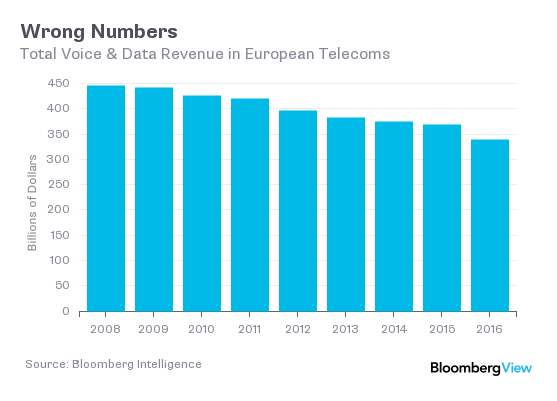
How Much Time Do Executives Have to Replace Legacy Revenue?

Some business problems appear to be theoretical (“someday our business will have to change”); other times clear problems, but to be left the next generation of leaders (“I will retire in two years, those problems will be severe only after that”); in some cases clear and immediate realities (“core revenue already is declining, we need to reignite growth”).


In the telecom business, the need to find new sources of revenue growth arguably is clearest in Western Europe, North America and parts of East Asia, but not an immediate problem in much of Asia or Africa.


For the most part, mobile service providers in much of Asia can afford to take a longer view, as subscriber growth is not yet exhausted; while mobile internet growth is in early stages. Both those sources of growth remain intact for much of Asia, though not in some countries such as South Korea, Japan, Taiwan, Hong Kong or Singapore.


“Companies need to diversify their revenue sources amid sustained declines in the traditional voice telephony and SMS businesses,” Moody’s argues. “We expect companies will continue to expand into digital media, advertising, and mobile payments to future-proof their revenue streams.”


In emerging Asian countries, excluding India, Moody's expects revenue growth of about 3.5 percent in 2018, lower than the forecast gross domestic product growth of about 5.8 percent.


Revenue growth in developed markets will remain in line with expected GDP growth of around 1.5 percent.


The average profit margin (EBITDA) for Moody’s-rated telecommunications companies in Asia Pacific will contract to around 39 percent to 40 percent over the next 12 to 18 months, reflecting intensifying competition, higher costs for providing data services, and investments in margin-dilutive digital businesses, Moody’s predicts.


Meanwhile, the capex-to-revenue ratio will fall to around 25 percent in 2018 from 27 percent in 2016.


India will be the only country where telecom sector's revenue will continue to decline for some time, Moody’s says. "India will be the only country in Asia where industry-wide revenue is declining due to unprecedented price competition spurred by a new entrant.”


All that noted, eventually subscriptions will reach saturation. Eventually, mobile internet revenues likewise will hit a natural limit, as everyone who wants to use mobile service, and every customer who wants mobile internet access, already will be a buyer, and will be paying as much as they can afford to, or want to.

That is pretty much the situation developed market mobile service providers already face. At best, markets are saturated. At worse, revenue already is declining. Asia will not escape that maturation, either. But how soon that saturation is reached remains an issue.

Is Sora an "iPhone Moment?"

Sora is OpenAI’s new cutting-edge and possibly disruptive AI model that can generate realistic videos based on textual descriptions.  Perhap...