Sunday, November 21, 2021

5G Skepticism is Completely Unwarranted

Skepticism about prospects for any new technology are common, perhaps even natural, which is why the Gartner emerging technology hype cycle exists. The pattern is overblown expectations, followed by a period of disillusionment, with eventual emergence as a useful tool.


It appears 5G is no exception, as some observers complain that new use cases and apps are not developing. It is worth noting that such concern was expressed as 3G and 4G as well, and nobody would consider either 3G or 4G “failures” in a commercial sense, even if many predicted new use cases took longer to develop than expected, and some use cases have not yet developed.  

source: Gartner


The larger point is that concern about the business model has been a feature of early deployment of 3G, 4G and now 5G. When 6G comes, we can be certain there will the same concerns expressed as well.


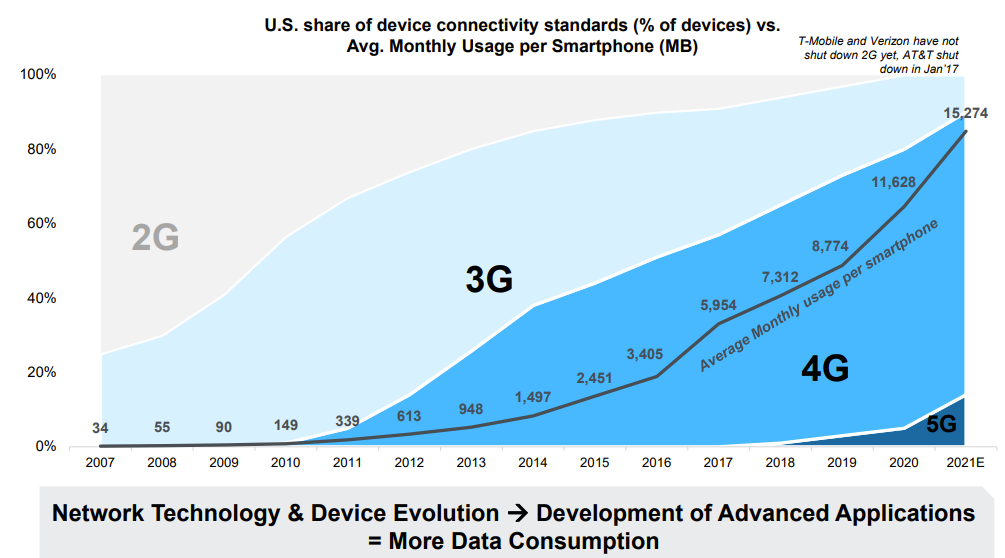
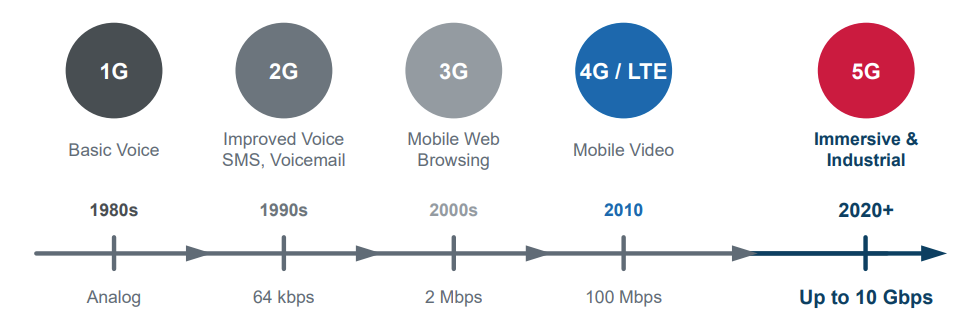
Of course, there are many ways to look at 5G value. Every next-generation mobile network has led to new use cases and revenue drivers. But each next-generation network has succeeded for other reasons: they have allowed mobile operators to satisfying growing customer demand for capacity, bandwidth and data usage. 


source: American Tower 


In other words, ignoring new use cases that will develop over time, 5G is necessary simply to provide lower cost per bit, as 40 percent to 50 percent more data capacity has to be added every year, while retail consumer prices increase only at about the rate of gross domestic product growth, in low single digits. 


The business model is “you get to keep your business,” not mostly “new use cases.” The former is essential, the latter helpful. To be practical, the business value of 5G is that it replaces 4G, with all the revenues 4G represents, while creating a platform for some new use cases and revenue sources, which might take some time to develop fully. 


That “you get to keep your business” value might not seem like such a big deal, but the analogy is the upgrade from copper access media to optical or other broadband platforms. It matters greatly whether an access provider is able to protect its existing business. 


That process has played out in the access business for well over two decades already, as the decision to deploy FTTH or any other higher-performance access platform has been evaluated. Quite often, the business advantage boils down to “staying competitive in the internet access business” more than anything else. 


In that sense, the evolution matches the increase in computing power of our personal devices over the decades. The business model for newer processors is “you get to keep your business.”


Skepticism about 5G is fundamentally misplaced. The slow development of new use cases--some of which might be unforeseen--is normal and typical.


Saturday, November 20, 2021

Verizon Expects Fixed Wireless to Represent 71% of Marketable Home Broadband by 2025

Though the degree of market share gain is yet unknown, Verizon expects fixed wireless to dramatically expand addressable home broadband households. 


By 2025, Verizon Communications expects to be able to market home broadband to 70 million locations. Matthew Ellis, Verizon CFO, says the firm expects 50 million fixed wireless addressable locations and 20 million Fios fiber-to-the-home passings. 


Consider that Verizon FTTH is available in eight U.S. states in the Northeast and Mid-Atlantic regions. But fixed wireless supported by Verizon’s 4G and 5G network will be a national provider. Most expect 4G to be relevant in some rural markets  where Verizon has excess 4G capacity. 


Once Verizon’s new C-band spectrum assets are turned up, the firm expects to be able to market to 15 million more fixed wireless locations. That currently is expected to happen by the end of 2021. 


That expansion of home broadband availability is highly important in terms of potential market share. Up to this point, telcos collectively have been able to really compete with cable Tv operator value propositions in only a portion of their fixed network footprint. 


The reason is that FTTH has been offered in only portions of any telco’s service territory, and digital subscriber line (copper access) has not been competitive with cable home broadband, which offers gigabit access covering about 80 percent of U.S. homes. 


But expansion of FTTH homes passed and fixed wireless will add new supply of home broadband that is competitive with larger portions of the potential buyer base. 


In some cases that will mean gigabit speeds. In other cases speeds of hundreds of megabits per second will be possible, and that is the center of the U.S. market at the moment. In other areas--such as rural areas--service might only be available in the 50 Mbps range, but that still could be competitive for 20 percent of buyers who prefer to buy services operating no faster than 100 Mbps. 


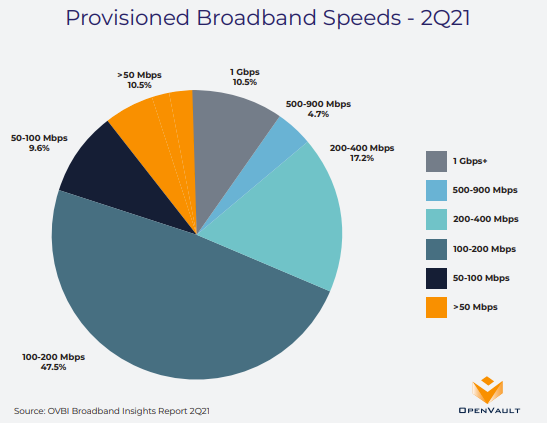
source: Openvault


Nearly half the market presently buys service operating between 100 Mbps and 200 Mbps. And nearly 68 percent of the U.S. market buys service operating no faster than 200 Mbps. 


Also, the U.S. home broadband market is big enough that gaining just a couple of points of the installed base and market share generates substantial revenue. By 2023, fixed wireless might represent about 4.5 percent of all home broadband accounts , some estimate.  


Some believe fixed wireless market share could reach double digits, representing billions in incremental new revenue for some suppliers.

Wednesday, November 17, 2021

5G Might Represent 70% of Global Fixed Wireless by 2026

Forecasts of 5G fixed wireless adoption are a bit trickier than forecasts of a few decades ago for several reasons. The biggest difference is architectural. Traditional fixed wireless systems used point-to-point, line-of-sight radio pairs. 


That was a labor-intensive process, meaning each subscriber had to be connected and disconnected manually, with a required install process taking hours. 


5G fixed wireless uses a different process, leveraging the same network put into place to support mobile phone services and enabling non line-of-sight or near line-of-sight connections. That represents a big change in labor intensity, and therefore business case. 

source: 5G Americas 


There still is a requirement for placing a subscriber site receiving unit, but that increasingly can be done by the customer, mounting in a window, for example, and not requiring a roof-mount antenna. 


Also, globally, the sheer volume of mobile internet access subscriptions, compared to fixed network connections, creates an arguably friendlier consumer receptivity for wireless home broadband, as does the smaller footprint of the customer premises equipment and the ease of installing such gear. 


Also, 5G fixed wireless allows easy bundling and discounts for customers of mobile phone service when fixed wireless also is purchased. 


For such reasons, Ericsson and others estimate that 5G fixed wireless subscriptions will grow as 5G networks are built out. 

source: Ericsson 


Thought he existing base of fixed wireless connections using 4G or other technologies is relatively small, there still are close to 80 million such connections in service globally in 2021, according to Ericsson. By 2026 perhaps 70 percent of all fixed wireless connections will use 5G, Ericsson also estimates. 

source: Ericsson 


Monday, November 15, 2021

Of Course 5G Will Succeed, All Worries Aside

It is not hard to find infrastructure supplier surveys suggesting consumers find 5G appealing and will pay more to get it. Nor is it hard to find stories about mobile service providers worried about the business case for 5G. 


The concerns will prove entirely misplaced. Since the time of 3G, such concerns about the business model have occurred at some level, every time the next-generation network has been launched. Always, it seems, there are concerns about higher capital investment and payback models. 

source: American Tower


But nothing ever has prevented the next-generation mobile platform from becoming the dominant platform. All worries aside, each next-generation platform has successfully become the market standard. 


Some might point to the fate of WiMAX, but that was a marketplace standard, not a mobile industry standard. 


The point is that despite the voiced concern, 5G will succeed. So will 6G, when it comes. And each platform will lead to the creation of new use cases, even if we cannot predict them well, in advance. 


source: American Tower 


The fundamental reason success will happen is that among the key reasons for adopting a next-generation mobile network is the need to keep satisfying end user demand for mobile bandwidth. Though there are a few ways to increase bandwidth, eventually more physical spectrum has to be added. 


Service providers can use small cells, better radios, unlicensed spectrum aggregation and refarming of spectrum from older networks. At some point, however, the drive to supply bandwidth at lower cost per bit requires adding new spectrum, and that in turn requires creating the next-generation network.


Retail prices in telecom tend to increase at the rate of gross domestic product growth, or sometimes faster, for content-related products. Beyond that, mobile service providers also come up with bundling and pricing tactics that allow higher prices. That usually is driven by value propositions deemed to resonate with customers, such as unlimited usage plans, device revenues or multi-product bundles. 


In the U.S. market, Verizon and AT&T are driving customers toward higher-priced unlimited usage plans, with clear success. Multi-user plans earlier had been a driver of higher average revenue per account. The point is that marketing efforts are created to drive higher ARPU, for 5G as for all other mobile generations. 


Also, machine-to-machine sensor connections are steadily becoming a bigger driver of revenue as well. 


Fears about 5G are misplaced.


Australia Mobile Market Shows Almost-Textbook Market Share Pattern

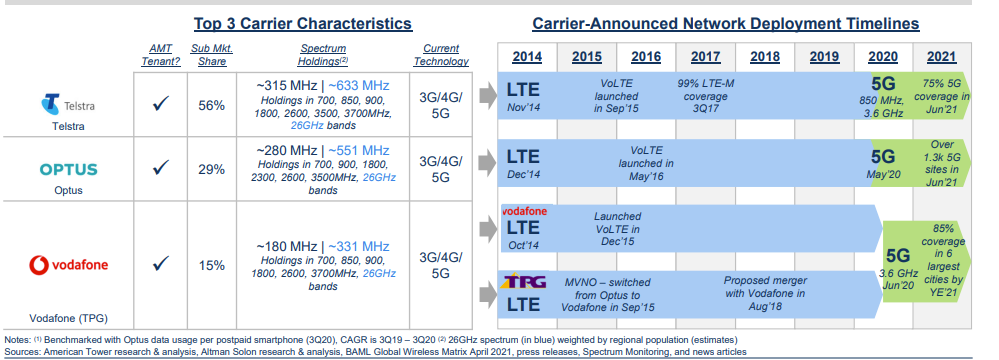
Very few mobile service provider markets yet have the market share (installed base) structure historically associated with mature markets. That traditional stable pattern tends to have a 4:2:1 pattern, where the market leader has twice the share of the second provider. The second provider then has twice the share of the number-three provider. 


Among the salient exceptions is the Australian market, which has the classic mature pattern. 

source: American Tower 


Bruce Henderson, founder of the Boston Consulting Group is credited with a couple of foundational ideas about business.


Among those ideas is mature market structure under conditions of competition.


"A stable competitive market never has more than three significant competitors, the largest of which has no more than four times the market share of the smallest,” Henderson argued.


Sometimes known as “the rule of three,”  he argued that stable and competitive industries will have no more than three significant competitors, with market share ratios around 4:2:1.

including the notion of the experience curve, which explains how the cost of products decreases with volume.


Henderson also popularized a rule of thumb about return on investment and the “experience curve.”


“Costs characteristically decline by 20 percent to 30 percent in real terms each time accumulated experience doubles," Henderson posited in 1968.


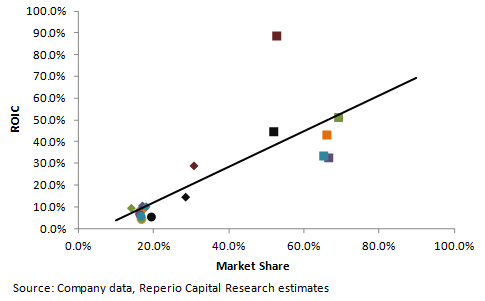
The point is that it is reasonable to expect that profits are directly related to market share, with a pattern where the leading three firms have something like a 40-20-10 share pattern, or perhaps 35-17-8 pattern.


Source: Reperio Capital


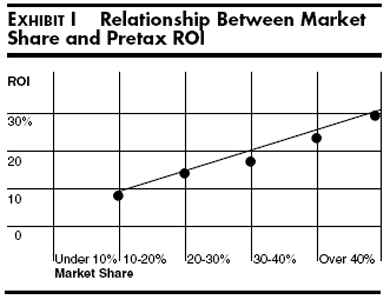
That same pattern tends to hold for return on investment as well. 


source: Marketing Science Institute


All that suggests the retail mobile service provider market is not yet fully mature and stable. 


Sunday, November 14, 2021

C-Band and Aeronautical Safety

 Aeronautical safety concerns about interference from ground-based communications networks are anything but new, as are disputes about interference between satellite and ground-based networks as well. 

Interference mitigation relies on spacing (guard bands), geographic isolation and power limits. The latest issue is possible interference from C-band mobile signals affecting aircraft altitude readings. 


Mobile networks use C-band spectrum in the 3.7-3.98 GHz range. Aircraft altimeters operate at 4.2 GHz to 4.4 GHz. Most radio engineers would say a guard band of more than 200 MHz should be enough to prevent interference, so long as power levels are kept in mind. 


Adjacent frequencies can face interference if transmit power is too high, as there are harmonics that can affect adjacent frequencies and users. 


source: Punchthrough 


As always in the past, studies will be done and mitigation efforts adopted, although guard bands already established might seem to be sufficient.  


source: Punchthrough 


Cable TV operators use a wide swath of radio frequency energy that is contained in a waveguide. Problems can arise if the integrity of the waveguide is imparied, however. Interference with 4G mobile signals is possible. Possible interference with aeronautical systems is another historic concern for cable TV operators. 


Cable TV operators also have faced complaints about interference from amateur radio operators.   


As always, interference issues have been mitigated, using guard bands, controlled power levels or offsetting some key frequencies in ways that reduce interference potential. 


Cable operators also now benefit from better plant integrity and less use of RF active elements in the physical plant. 


Test result validity is likely to play a role in resolving concerns, as has been the case in past disputes. Also, some will note, C-band mobile systems have been operating in other countries long enough that possible similar problems should have arisen, and it does not appear such problems have occurred. 


That noted, U.S. regulators always take such potential threats seriously, even when observers might note some elements of gamesmanship being played by participants who might gain or lose by rivals using scarce or valuable spectrum. 


Such gamesmanship also can be played by bureaucratic rivals as well. Some think that is at work here.


Saturday, November 13, 2021

6G Spectrum Will Lean Heavily on Millimeter Wave Assets

Though it is too early to say precisely which new bands of spectrum are allocated for 6G, new spectrum allocations have been the underpinning of every next-generation mobile network. And most of the potential new spectrum lies in the millimeter wave bands. 

source: Nokia Bell Labs 


There simply is not very much unencumbered spectrum left in the low-band and mid-band regions that can be allocated to support 6G. 

For reasons of signal propagation, the reliance on millimeter wave spectrum virtually ensures 6G will feature lots of small cell support indoors and outdoors. Outdoor transmitter signals will not generally penetrate walls, requiring new indoor cells to maintain mobile device coverage. 


Both of those requirements for dense networks underpin the move to more-dense outdoor backaul networks (front haul, mid haul and what we traditionally call backhaul as radio access networks are virtualized).


There also will be new value for indoor networks such as Wi-Fi that can maintain data services and voice connectivity indoors when 6G indoor small cells are not available. 


Higher millimeter wave signal loss also means smaller cell sizes for the outdoors network.


Is Sora an "iPhone Moment?"

Sora is OpenAI’s new cutting-edge and possibly disruptive AI model that can generate realistic videos based on textual descriptions.  Perhap...