Friday, December 11, 2020

U.S. Mobile, Cloud Computing Markets are "Unstable," in the Sense of "Still Contestable"

Bruce Henderson, founder of the Boston Consulting Group is credited with a couple of foundational ideas about business, including the notion of the experience curve, which explains how the cost of products decreases with volume.


“Costs characteristically decline by 20 percent to 30 percent in real terms each time accumulated experience doubles," Henderson posited in 1968.


But the rule of three perhaps is more important. Other studies also tend to confirm the thesis. Those ratios also have been seen in a wide variety of industries tracked by the Marketing Science Institute and Profit Impact of Market Strategies (PIMS) database, suggesting that the number-two provider in a stable market has market share half that of the leader, while the number-three provider has market share half that of number two. 


Market share in the Kenyan mobile market follows the pattern. The pattern in the U.S. mobile market arguably remains unstable, as it was prior to the merger of T-Mobile with Sprint.  


After the T-Mobile merger with Sprint, we have three suppliers with market shares relatively equal, with Verizon in the lead and T-Mobile just barely nosing ahead of AT&T, which drops to third. That should not last.  A stable market would have one of the three gaining significantly more share and two fo them losing share, with one of them losing a lot of share. 


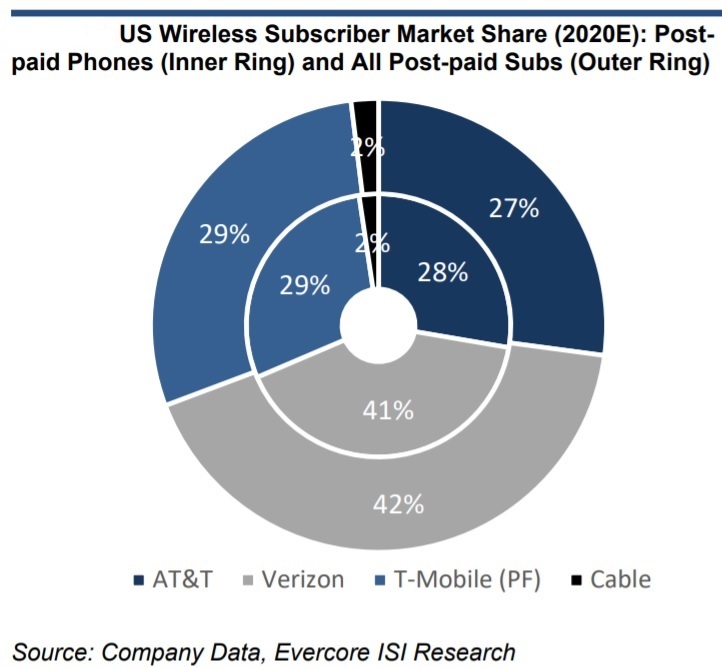
Neither the global cloud computing or U.S. mobile markets are stable, in the sense that a clear market share pattern has settled in, with challengers largely unable to change their share positions. After the merger of T-Mobile and Sprint, Verizon has about 42 percent market share (subscribers). But T-Mobile has 29 percent and AT&T about 27 percent. 

source: Evercore 


We should anticipate eventual changes in share. 


"A stable competitive market never has more than three significant competitors, the largest of which has no more than four times the market share of the smallest,” Bruce Henderson, founder of the Boston Consulting Group has argued.


Sometimes known as “the rule of three,”  he argued that stable and competitive industries will have no more than three significant competitors, with market share ratios around 4:2:1.


If you look at market share in the “cloud computing as a service” industry, one also does not yet see that pattern, suggesting major market share shifts are likely. But most of the activity, all other things being equal, will happen at positions two to four. 


AWS now has 32 percent share. By some estimates Microsoft has 19 percent share. Google Cloud about seven percent share. The rule of three would predict either that AWS eventually would have more share, or that number two would have less share, or both. 


I believe the reported numbers overstate Microsoft’s share and understate Google’s share, however. 
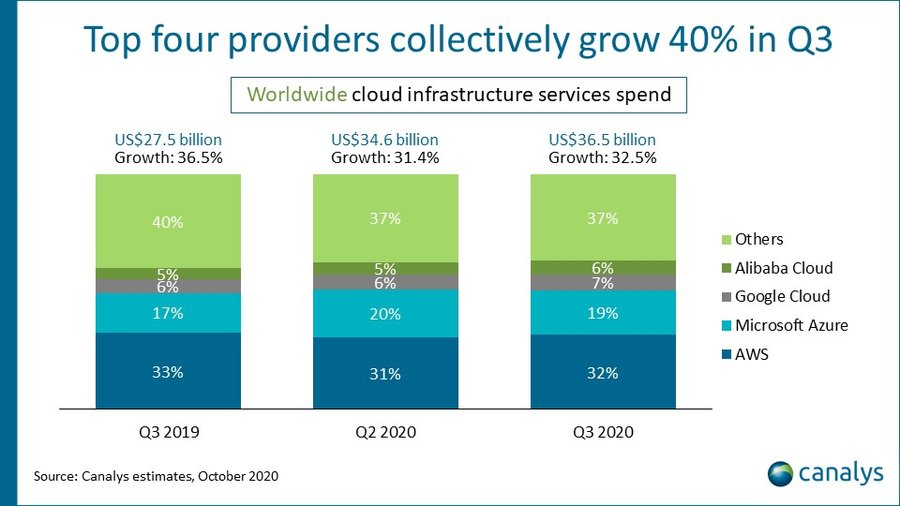

source: Canalys 


If a “like to like” analysis of “computing as a service” revenues are made, Microsoft’s actual cloud revenues are far smaller than reported. 


The problem is that the way Microsoft reports revenue dramatically skews the results. 


Azure, which includes cloud computing revenue, also includes sales of the Windows operating system, productivity suites, Xbox, Surface and advertising. 


Also, keep in  mind that Azure cloud computing also includes server sales, not just “cloud computing as a service” revenues. 


The “intelligent cloud” segment of Azure represents only about 35 percent of total Azure revenue. Another third of Azure revenue comes from productivity suite revenues. Also, 32 percent of Azure revenue comes from operating systems, productivity suites, Xbox, Surface and advertising. 


I personally do not consider those revenue sources a “like to like” comparison with AWS cloud computing as a service revenues. Actual Azure cloud computing revenue. might be as low as $4 billion a quarter. The point is that any analysis of cloud computing market share based on Azure revenue is incorrect. 


Azure cloud computing might be only a bit larger than Google Cloud, which generated about $3.4 billion quarterly revenues recently. 


If so, AWS market share is understated and Microsoft’s share is vastly overstated. At $4 billion quarterly revenue, Microsoft likely has about 11 percent share. Google might have about nine percent share. 


If AWS generated about $11.6 billion in revenue in the third quarter of 2020, then AWS did have about 32 percent of global cloud computing market share. 


A corollary is that, all things being equal, it will be very hard to supplant Amazon Web Services as the market leader. It is unclear at this point which firm emerges as a stronger number-two provider. Many seem to be betting on Microsoft, based on its apparent or reported growth rate. 


In the absence of better data, it is hard to say. 


The larger point is that, to the extent the rule of three applies to mobile operator market share and cloud computing market share, we see contestable markets that are nowhere close to stable.


Thursday, December 10, 2020

FCC C-Band Spectrum Auction is Underway

The Federal Communications Commission auction of C-band spectrum is underway. The auction represents 280 Megahertz of mid-band spectrum in the 3.7-3.98 GHz band, and is the largest mid-band 5G spectrum auction held in the United States to this point.


New performance data from Speedtest shows why the U.S. C-band auctions and Citizens Broadband Radio Service are so important: they provide the mid-band spectrum required to provide order of magnitude higher speeds and coverage at the same time. 


U.S. operators have launched 5G coverage operations with low-band spectrum, which has generally meant speeds not dissimilar to 4G.


Millimeter wave operations provide high capacity, but not coverage. The reliance on low-band spectrum for coverage and millimeter wave for urban high-traffic areas is not so much a choice as a restriction. 


Compared to virtually all other nations, U.S. mobile operators have had very little mid-band spectrum available to use, as most of the spectrum already had been allocated to other uses. 


And that mid-band spectrum is what provides the immediate lift in mobile speeds when 5G is launched. 

source: Speedtest 


Over time, as the new mid-band spectrum is put to use, U.S. 5G speeds will normalize, possibly at the end of 2021 or early in 2022. 


Monday, December 7, 2020

6G Will be the Third Successive Mobile Platform Not Driven by Voice

6G will  not be "about voice", as was the case for 5G and 4G as well. You might recall that when 4G launched, voice was carried on 3G, while 4G was essentially a data network. Voice over LTE developed later, to carry voice natively on the 4G network. 


In the early 5G era, it appears that pattern will continue, with 4G relied upon for voice services, while 5G develops as a data access and computing network. 


According to Ericsson, the 6G “needed capabilities” start with “higher achievable data rates” with no increase in network costs, plus better energy performance and qualitative elements such as trustworthiness. 


source: Ericsson


The point is that all the capabilities speak to 6G functioning as a data network. “6G will bring all physical things into the realm of compute,” Ericsson notes. The network will be designed to support “a fully digitalized, automated and programmable world of connected humans, machines , things and places,” says Ericsson CTO Erik Ekudden,


6G will be the third successive mobile platform whose “purpose” is to connect computing devices used by humans and machines, even though voice communication is a function that must be supported.


Sunday, December 6, 2020

5G Not Yet "Apples to Apples"

Unlike earlier mobile generations, 5G is not based on specific frequencies, as were prior mobile platforms. That being the case, performance hinges on which blocks of spectrum are used. Low-band provides the best coverage; millimeter wave the highest speeds; mid-band a compromise between coverage and speed.


That has to be kept in mind when taking a snapshot of evolving 5G network availability and performance between service providers and between countries: the comparisons are not “like to like” at this point. 


source: RootMetrics


South Korean mobile operators use mid-band spectrum, and therefore show higher speeds than does AT&T at the moment, which uses low-band spectrum. Over time, many operators using low-band or mid-band will add use of millimeter wave spectrum. 


So the blended performance might be more highly disparate than what we have been used to in the 3G and 4G eras. Capacity will be highest in areas where millimeter is available; lowest where only low-band is present. The preference for mid-band is its compromise of coverage and capacity. 


Beyond that are the usual differences between speed of deployment in small city-states and countries compared to very-large countries; the loading of 5G networks (heavier loading implies lower average speeds) and the balance of demand between 4G and 5G (average speeds including both 5G and default to 4G when 5G is not available). 


The point is that it will remain hard to compare deployments, which in turn are constantly changing in the early phases of 5G introduction.


5G Fears Misplaced

5G has so far proven to defy all manner of dire predictions. There was said to be no business case, since nobody needs 5G. 


It was argued 5G infrastructure was too expensive, based on the need for huge numbers of small cells. That proved incorrect, as small cells cost a fraction of what a macrocell cell site costs. 


In many cases, 5G infrastructure will cost no more than 4G, as a result.  

source: CCS Insight 


Others worried about the cost of new spectrum, especially when 4G investments had been recently made. But new and existing methods for using spectrum developed. Wi-Fi for offload, spectrum aggregation of licensed and unlicensed spectrum, spectrum sharing, huge amounts fo new spectrum and a declining cost per MHz for millimeter wave spectrum all helped. 


On the demand side, there is some evidence consumers might pay more for 5G, in part because mobile operators figure out ways to bundle additional value with 5G, such as “unlimited usage.”


It remains to be seen whether the hoped-for enterprise new revenue cases develop. But history suggests 5G will be adopted robustly, as have all prior generations of mobile platforms, through a combination of demand push and supplier pull. 


Simply put, consumers will need the additional capacity features, eventually, while suppliers have every incentive to encourage use of the new network. Device suppliers also will create capabilities based on 5G network availability, increasing the perceived value of 5G. 


The point is that many 5G fears have proven overblown or non-existent.


Friday, December 4, 2020

Will Consumers Pay More for 5G?

A YouGov survey suggests some consumers are willing to pay a premium for 5G service. In the United States about 21 percent of adults say they’re willing to spend extra, along with 12 percent of respondents in the United Kingdom and 11 percent of respondents. In Germany 18 percent say they are willing to spend more. 


source: YouGov 


The caveat is that consumers responding to surveys often say they will do things they do not, or say they will not do things they wind up doing. History suggests the skeptics ultimately have a case to make. 

source: Strategy Analytics 


On the other hand, there could be other drivers. Customers often upgrade their home broadband or mobile internet access plans to more-expensive tiers over time. Phone choices also make a difference, as some consumers might reason that it makes more sense to upgrade to more-costly 5G plans for speed advantages their new devices can take advantage of. 


They might upgrade because the faster upload speeds have value as well. They might spend more because doing so provides “unlimited” usage instead of a bucket of usage. 


All that noted, some 5G features could have value high enough to incentivize enterprises to pay more for 5G, such as private network features available using network slicing. Since that value might also be intertwined with edge computing and support for real-time applications, higher spending for 5G is more likely, and easier to justify.


TIM Shows 26-GHz Reach of 4 Miles on its Commercial Network

Italian service provider TIM, whose network uses Ericsson and Qualcomm Technologies, has demonstrated access speed of 1 Gbps on 26-GHz millimeter wave spectrum at a distance of 6.5 kilometers (four miles) on TIM’s commercial network. 


That suggests fixed wireless using millimeter wave spectrum might be more useful in rural and other deployments than many have expected. The distance limitations of millimeter wave frequencies, compared to mid-band or low-band spectrum, are significant. 


But millimeter wave spectrum supports much-higher capacity than low-band or mid-band spectrum, which is important for many fixed network use cases, such as competing with fixed networks for internet access accounts. 


source: IEEE  


While mid-band spectrum will be commercially viable for many users, millimeter wave capacity will be needed to compete for accounts requiring hundreds of megabits per second to gigabit rate services.


Is Sora an "iPhone Moment?"

Sora is OpenAI’s new cutting-edge and possibly disruptive AI model that can generate realistic videos based on textual descriptions.  Perhap...