Saturday, July 13, 2019

Singapore Mobile Data Prices Possibly Unsustainable

Singapore has very low prices for mobile data usage. Today, a gigabyte of usage costs about Singapore 90 cents. Just five years ago, a gigabyte of usage cost about S$13. Nor is the trend confined to Singapore. Mobile data prices have fallen all over Southeast Asia. 

Granted, comparing prices is tricky, as one has to select a particular type of plan offered by all competitors, and such comparisons are not always based on the plans most people actually buy.  

Low prices might be thought to be a good thing. It also is a bad thing, as competition and price cutting among the 11 providers in Singapore mean some firms are destined to become unsustainable. 


J.P. Morgan equity analyst James Sullivan believes mobile business models are unsustainable across parts of South and Southeast Asia. “Even after accounting for Wi-Fi and new technologies and alternate business models, there will be still significant global wireless data demand that is not economically possible to serve,” says James Sullivan, J.P. Morgan head of Asia equity research. . 

Declining value capture is paired with a significant, and ongoing, increase in capital intensity. In at least some cases, that will mean possible nationalizing of networks. In other cases, competitors might be forced to consider sharing network facilities, to stave off such intervention. 

That would overturn nearly a half century of moves to privatize assets and introduce competition. 

“Emerging market telcos have no choice but to fundamentally change the structure of industry assets through the unification of networks via nationalization, centralization under a regulated return utility, or more aggressive commercial network sharing,” argues James Sullivan, J.P. Morgan Chase Head of Asia Equity Research. 

Simply, between now and 2024, telco capital investment and operating expense will climb, while revenue growth lags. But there also is regulatory risk. India, the Philippines, Thailand, Malaysia, Indonesia and Turkey are countries where capex pressures are the big problem.

Regulatory risks exist in Indonesia, Brazil, South Africa and Malaysia, he argues. 

Markets with the potential for the most extreme margin compression include the Philippines, India and South Africa; while more defensive margin markets are Nigeria and China, says Sullivan. 

On one hand, low prices, enabling everyone to use mobile internet freely, is a social good. On the other hand, prices that do not allow firms to sustain themselves are not good, as consumers cannot buy products not available, from firms that do not exist. 


Thursday, July 11, 2019

U.S. Mobile Operator Spectrum Efficiency Up 42X Since 2010

U.S. wireless providers increased their spectrum efficiency 42 times since 2010, according to a new white paper released by CTIA, the wireless industry association. 

That matters since U.S. mobile service customers consume more data than customers in most other countries. 


U.S. wireless networks handled 948M megabytes (MB) for every one megahertz (MHz) of spectrum in 2010 and now handle 39.9B MBs/MHz thanks to significant industry investment in networks and technology.

Among those advancements are the use of wider channels, which are inherently more efficient than smaller channels. But radio advances, including multiple-input, multiple-output radios and beamforming, also contribute. 

Dynamic spectrum sharing also plays a part, allowing a 5G device to use either 4G or 5G radios and bandwidth. Dynamic spectrum sharing allows reusing 4G assets without refarming. Other forms of spectrum sharing, including the ability to aggregate licensed and unlicensed spectrum, also will help. 


That increased efficiency matters for a few reasons. First, end user demand simply requires that service providers supply more bandwidth. Service providers also must decrease cost of supplied bits, to maintain the business model. Also, as traffic increasingly shifts to entertainment video, connectivity suppliers must supply drastically more capacity, for very-little incremental revenue gain, if any. 


Tuesday, July 9, 2019

As AT&T Takes Number One Spot for Speed, Verizon Drops to 3rd: That is a Problem for Verizon

AT&T now is the fastest U.S. mobile network, a claim I cannot recall being made by AT&T in recent memory. Verizon traditionally has staked its position on being the premier provider, based in part on speed and other measures of quality. But T-Mobile US matched, and appears to have overtaken Verizon in the speed metric.

If AT&T now can hold its lead, Verizon has a worsening brand promise problem that could affect its ability to charge higher prices for its service. 


Monday, July 8, 2019

Early 5G Speeds Do Not Mean Much

Unlike 3G and 4G, 5G networks will use an almost-bewildering range of different frequencies, including low-band, mid-band and millimeter wave spectrum. That also means it will be nearly meaningless to compare 5G speeds, unless one knows both the frequencies and channel sizes supporting 5G. 

Speed hinges on bandwidth; bandwidth hinges on channel width and frequency. Channels are smaller at low frequencies, much wider at high frequencies. Beyond that, the full range of 5G frequencies available to any single service provider  have not yet been deployed. Nor, for that matter, have the full range of new technologies to boost effective bandwidth been deployed. 


It is not that the test procedures are faulty, simply that 5G remains in early launch stage, while the potential bandwidth increases over 4G will vary, from place to place, based on the actual frequencies used to support the 5G networks. 

Sunday, July 7, 2019

Name Any Technology Which Has Only Positive Effects

Virtually all important technologies--fire, the wheel, the nail, the compass, optical lenses, paper, gunpowder, the printing press, the steam engine, the internal combustion engine, the telephone, electricity, automobiles, vaccination, airplanes, rockets, nuclear fission, computers, semiconductors or the internet--can be used for good or ill. 

All have externalities--side effects--of varying impact, good and, or bad. All can be dangerous, even life threatening, to humans, animals, plants, property or the environment. 

In the United States, 100 people die in auto accidents every day. The point is that virtually all technologies pose some risks. They must be used responsibly, carefully and with an understanding of trade offs. 

And our understanding of the risks should be rational. In other words, we should base our understanding, to the extent possible, on science and transparent values (even if we do not agree on all the values, transparency at the very least is necessary to debate values).

Anything else is irrational. Consider the argument around the “safety of 5G.” Some of us, who have been in industries based on the use of radio frequency communications, are familiar with concern over non-ionizing radiation, the property of radio waves that can cause heat in human or other tissue. That is the same sort of radiation represented by sunlight, for example. 

The issue is whether heavy does of non-ionizing radiation have adverse human health effects. Several caveats are in order, as always. To observe in any experiment any effect from non-ionizing radiation requires levels not found in nature, as with many other experiments related to human or animal health. 

The other caveat is that, in addition to exposure levels, we cannot separate out the effects on non-ionizing radiation from all other potential health hazards in modern life. Even if a correlation of some sort were to be found, we could not rule out causation or correlation with some other facet of modern living. 

At levels experienced by humans in real life, non-ionizing radiation has not been shown to cause harm, even minute heating effects. That is important. At sufficiently high power, such as in a microwave, non-ionizing radiation can definitely cause heating. The point is that such levels are not remotely close to anything found in RF communications. 

The exception is worker safety for people who work directly on radio towers, for example. There it is reasonable to limit exposure. At the same time, it also is reasonable to point out that energy decay is logarithmic for non-ionizing radiation. Signals weaken very rapidly. 

“To date, no adverse health effects have been established as being caused by mobile phone use,” says the World Health Organization. That might be worth reiterating, in light of concern in some quarters about whether 5G is “safe.” Keep in mind that power levels for cell phones and even cell towers are low.

Consider that a cell tower radio emits energy 100 to 5,000 times lower than a TV transmitter, for example. Some liken the power level to that of a light bulb.

Still, if you really are concerned about the possible health effects of using mobile phones, use them less. Text instead of holding the phone against your head and talking.

Radio signals weaken (attenuate) logarithmically, by powers of 10, so the power levels decay quite rapidly.

Basically, doubling the distance of a receiver from a transmitter means that the strength of the signal at that new location is 50 percent  of its previous value. Just three meters from the antenna, a cell tower radio’s power density has dropped by an order of magnitude (10 times).

At 10 meters--perhaps to the base of the tower, power density is down two orders of magnitude. At 500 meters, a distance a human is using the signals, power density has dropped six orders of magnitude.

Using the internet on a smartphone, for example, puts the device a much-safer distance away from one’s head, in case your worry is possible health effects to the brain, as the phone is both a transmitter and a receiver.

Workers who climb cell towers, radio or TV transmission towers do have to take precautions against the high power levels emitted by such radios, as do other workers who regularly work around high-power sources.

But RF signals as encountered by consumers using phones, TVs and radios are quite low, as power levels drop sharply with distance, even the distance of your arm.

Physical objects also affect signal decay. Even for the low and middle-frequency radio signals used by cell phones, an office wall can reduce signals by 75 percent. A concrete wall can reduce signals by 94 percent. So physical barriers matter.

To be sure, it might always be impossible to assess long-term effects, as the sources of low level non-ionizing radiation occur naturally, from the sun, as well as from consumer devices. There simply is no way to conduct controlled experiments.

It might be good advice to recall that all technology use carries some risk, and that there always are ways to reduce risk, to obtain benefits. But we still must balance some level of risk. No technology is always and uniformly helpful.

Saturday, July 6, 2019

Mobile Operators Not Monetizing 10X Increase in Data Consumption

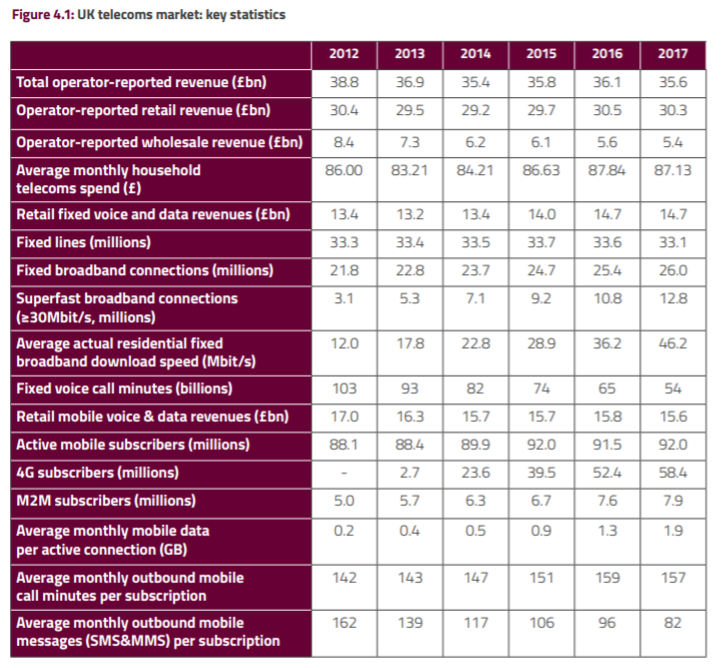
The existential threat to the mobility business is the seeming inability to monetize ever-increasing data consumption. In the United Kingdom, mobile revenues have dropped since 2012 by about eight percent, at a time that mobile data consumption increased by 9.5 times (almost an order of magnitude). 

That should be a clear warning for those who believe increased data consumption means higher revenue. It does not. That inability to monetize ever-higher data consumption also explains why some of us believe there is no long term choice for service providers but to look for big new revenue streams outside the connectivity function. 


Friday, July 5, 2019

Japan Mobile Operator Mid-Band Spectrum Holdings

Here’s a look at mid-band spectrum held by the leading mobile operators in Japan, according to Gaku Nakazato of Japan’s Ministry of Internal Affairs and Communications. As you might guess, KDDI and NTT have the largest allocations. NTT and KDDI have the largest subscriber shares, and therefore arguably require the most spectrum. 


Is Sora an "iPhone Moment?"

Sora is OpenAI’s new cutting-edge and possibly disruptive AI model that can generate realistic videos based on textual descriptions.  Perhap...