Tuesday, October 17, 2017

What Next, After Mobility, and Why?

Mobility has been the primary source of revenue growth in the global telecom business for decades. But all that is about to end, sooner in developed nations than developing regions, but certain, just the same.

Subscriber growth will slow close to zero as markets reach saturation. Mobile internet access revenues will boost growth for a while, after subscription growth ends. But sooner or later, even that growth engine will become exhausted.

That is why many believe a shift into content businesses is coming next.

You might or might not agree that U.S. consumers or global consumers are tapped out and unable to boost their discretionary spending.

What seems clearer is that consumers can only spend so much on any single item in their household budgets, and that communications spending, as a percentage of total household income, does not change much, from year to year.

In the U.S. market, communications spending tends to run between 2.2 percent and 2.5 percent of household income per year (defined as percentage of gross national income).

The big implication for communications service providers is that the “pie is not growing,” so it is not possible, over the longer term, to continue growing revenue by relying on inflation. Some providers might build a strategy on taking market share, but that will not hold for the market as a whole, as the market is not growing.

In fact, there are signs the market is either approaching a top, or is at a top. In other words, we might be nearing, or be at, peak telecom, the period in industry history when revenue is at its highest level.

That has important strategic implications. Communications service providers can only grow their legacy business so much, if they can grow that segment of their business at all. To continue growing, service providers will have to move into adjacencies (other parts of the communications, app and content ecosystems).

Though some might criticize service providers for getting into content production, content networks or advertising related to those assets, some moves of that type now are fundamental, not optional.

If growth in the legacy business is not possible, then growth elsewhere must be found.

Wednesday, October 11, 2017

Small Cells a Threat to Mobile Operator Business Model?

This is the moment when mobile service providers risk being forced back to being simply a utility, as electricity generation or railway networks were before them, Rethink Technology Research now argues.

Such arguments generally have a couple major assumptions. The first is that spectrum abundance will enable new competitors to enter the mobile market at lower costs.

In some markets, that will be particularly true for cable operators, who will leverage their fixed networks for backhaul, creating new mobile networks anchored by small cell coverage.

Source: Rethink Techology

In yet other cases, indoor venue providers will create neutral host facilities that support indoor access for all mobile service providers. That could lead to the rise of new indoor coverage providers whose business model is neutral host support for indoor mobile coverage.

In other cases the impact will largely be indirect, as enterprises build local 4G networks that, like Wi-Fi, remove some demand from the mobile network. The value of “unlimited usage” plans might be affected if the functional equivalent of Wi-Fi access for 4G or 5G is widely available.

In that view, the core value of the mobile network will remain its support for full mobility in outdoor spaces, while a range of other mechanisms are used to support indoor access (Wi-Fi, aggregation of licensed plus unlicensed spectrum; neutral host facilities).

It is not clear how all that shakes out.

Small cell networks built on new and unlicensed spectrum could have complicated effects. Indoor coverage networks could work to lower overall capital investment in mobile networks, as Wi-Fi effectively does. But such networks might also allow creation of new app layer functionality that, at least in part, renders mobile operators dumb pipe providers in new ways.

“Enterprise small cells, particularly those operating in unlicensed spectrum, could be the undoing of mobile network operators, relegating them to “utility” commoditization, and falling revenues, as both license free spectrum and shared are taken up aggressively by new competitors,” says Caroline Gabriel, director of research at Rethink Technology Research.

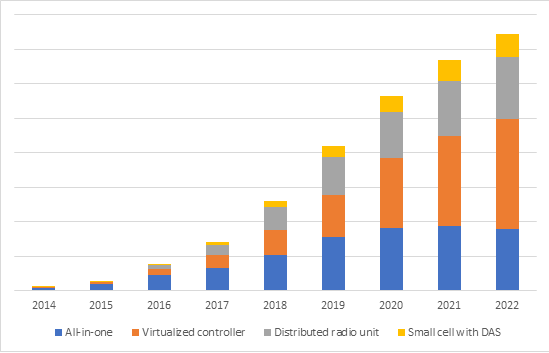
The rising popularity of enterprise small cells will mean that by 2022, enterprise units will account for almost half of all small cell deployments, up from seven percent in 2014.

The installed base will reach 14.8 million in 2022, up from 185,000 in 2014 and owners who invest in enterprise small cells will operate a financial grip on the market in the 2020 time frame.

There will be a rise in the importance of unlicensed spectrum driving enterprise and vertical small cells to scale with LTE-LAA roll-outs starting in 2018 and the more disruptive MulteFire running about nine to 12 months behind. By 2020 these two will account for 25 percent of all new deployments.

Will U.S.Mobile Market Revenue Shrink by $12 Billion This Year?

About $3 billion worth of quarterly revenue has disappeared from the U.S. mobile service provider market in the second quarter of 2017, representing a $12 billion annual loss, if the trend continues.

To be sure, T-Mobile US has taken market share and revenue. But the bigger story is the revenue shrinkage.


Monday, October 9, 2017

CBRS Adds Equivalent of a New National Mobile Operator, in Terms of Capacity

Release of up to 150 MHz of Citizens Broadband Radio Service (CBRS) will provide an early test of how additional spectrum resources might affect market share, profits and revenue in the mobile and fixed internet access business.

By way of comparison, the CBRS could add, in most parts of the country, more spectrum than Verizon or T-Mobile US possess, nearly as much as AT&T has available and 75 percent as much spectrum as Sprint--the mobile operator with the most capacity--commands.

In other words, CBRS arguably creates the equivalent of a new national mobile operator, in terms of capacity, able to operate using unlicensed access in many cases, using likely less-costly licensed spectrum in other cases.

That will enable some enterprises to create their own campus networks, able to run 4G protocols. CBRS also is likely to allow wireless internet access providers to create new fixed wireless networks with more capacity than available at present.

In other cases, neutral host venue networks might be created that offer all service providers better indoor mobile network coverage.

In principle, AT&T and Verizon also could use such spectrum, but they seem to be focusing most on bigger blocks of spectrum in the millimeter band, including 24 GHz, 28 GHz, 31 GHz and higher bands.
The U.S. fixed wireless market is comprised of 2,000 network operators averaging 1,200 customers each, according to the Carmel Group.
The report forecasts strong growth for the U.S. fixed wireless market, which is projected to grow from more than four million subscribers today to eight million by 2021. New lines added by the likes of AT&T will largely drive that growth.
Over that period, it also is possible that Verizon could emerge as a major new provider, using 5G fixed wireless as a substitute for fiber to home access.

Saturday, October 7, 2017

Organic or Acquisition Growth? Up or Down the Stack? Horizontal or Vertical?

Though the need is not yet abundantly apparent in many developing markets, big new revenue sources are going to be required as industry growth based on mobile subscription growth and mobile internet revenues reaches maturity.

In the past five years, the telecom business has entered a period of slow decline, with revenue growth down from 4.5 percent to four percent, EBITDA margins down from 25 percent to 17 percent, and cash-flow margins down from 15.6 percent to 8 percent, according to McKinsey consultants.

Competitive boundaries are shifting as core voice and messaging businesses continue to shrink, partly under regulatory pressures, but also because social media is opening up new communications channels.

Among U.S. telecom companies, for instance, landline and mobile voice now account for less than a third of total access, down from 55 percent in 2010, while data revenue has risen from 25 percent of total revenues in 2010 to 65 percent today.

The issue is what to do. In the near term, horizontal mergers to increase scale are the most likely move by most firms.

In at least some cases, service providers will try to move into other segments of the value chain, either “up the stack” in the direction of applications, in some other cases perhaps “down the stack” (or backwards into the value chain), if one considers devices to be “down the stack” (I would put devices up the stack, but that is a matter of preference).

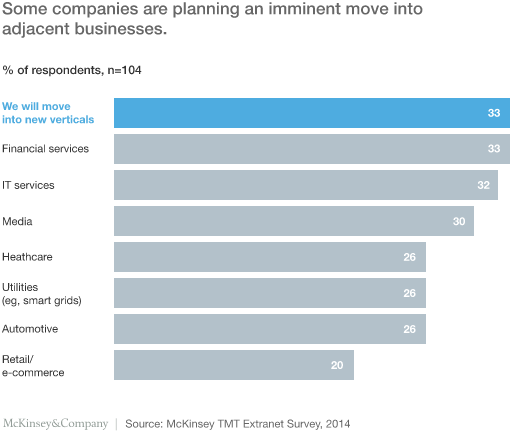
A third of the 104 respondents to a McKinsey survey were preparing to move into adjacent businesses such as financial services, IT services, media that are “up the stack” moves into parts of the ecosystem other than access and communications services.

To be sure, many of those planned initiatives will fail to be launched, in the end. The point is that one long-term solution to industry revenue shrinkage is to get into adjacent businesses elsewhere in the same value chain.


Mobile Cash Flow Swings South a Net 13%

One way of illustrating disruption in the telecom industry is to note that service provider cash flows dropped between 2010 to 2015, swinging 13 percentage points from seven-percent annual growth prior to 2010 to minus six percent growth after 2010.

CenturyLink To Test CBRS for Fixed Wireless

CenturyLink seeks a license to conduct fixed testing in the 3.54 GHz to 3.70 GHz frequency band. The testing seeks to understand the viability of new technologies in this band that may be useful in providing fixed broadband services.

Those frequencies correspond with the Citizens Broadband Radio Service, the new shared spectrum band that could allow CenturyLink and other users to operate with secondary licenses or even on an unlicensed basis.

The CBRS operates in frequencies licensed to government users (Coast Guard and fixed satellite licensees), but will be shared in areas where the primary licensee does not use the spectrum, or uses it only lightly.

That will be helpful for CenturyLink, whose 22-state operating territory includes many areas where spectrum use will be lawful, where there are few other contending users and where it might be possible to operate fixed wireless on an unlicensed basis for internet access services.


The major areas where exclusion zones will not permit usage--or where frequency coordination will be key--are in Florida, the western coasts of Washington and Oregon, as well as North Carolina. That still leaves a huge amount of territory where rural internet access costs have been high, historically, and where fixed wireless using lower-cost or unlicensed spectrum (“free”) can change the business model.


Incumbents have priority rights in all cases. Secondary priority access licenses (PAL) are available on  a licensed basis where there is capacity available. Finally, unlicensed use also is possible using the tertiary general authorized access licensing tier.

Most of the capacity will be found in the broad interior of the United States, away from the coasts.  
source: Qualcomm

Is Sora an "iPhone Moment?"

Sora is OpenAI’s new cutting-edge and possibly disruptive AI model that can generate realistic videos based on textual descriptions.  Perhap...