Sprint advertising now points out that Sprint’s coverage is only one percent less than Verizon, often considered the market leader in that category (and others), while costing far less. But recent tests suggest that Sprint’s network, though being revamped, still lags the other leading carriers in terms of mobile internet access speed.
Tuesday, June 27, 2017
T-Mobile US Tests LAA, Deploys LTE-U
T-Mobile US has tested License Assisted Access (LAA) on its commercial network, allowing T-Mobile to essentially aggregate mobile spectrum with unlicensed 5-GHz spectrum to boost download speeds to 741 Mbps, using 80 MHz of aggregated spectrum.
T-Mobile US also has made commercial use of a similar Long Term Evolution-Unlicensed (LTE-U) platform to serve customers in Bellevue, Wash.; Brooklyn, N.Y.; Dearborn, Mich.; Las Vegas, Nev; Richardson, Texas; and Simi Valley, Calif., with more rolling areas adding the capability in 2017.
The feature requires use of compatible smartphones.
Earlier this year, the FCC cleared the way for LTE in unlicensed spectrum, enabling wireless providers to use unlicensed airwaves in the 5 GHz band.
LTE-U and LAA devices and equipment intelligently tap into and share underutilized unlicensed spectrum without affecting other users on the same band, including those using conventional Wi-Fi.
LAA enables greater carrier aggregation than LTE-U, so T-Mobile US is expected to rely on LAA in the future, equipping its new small cells with the capability.
U.S. Mobile Network Speed Grows Nearly at Moore's Law Rates
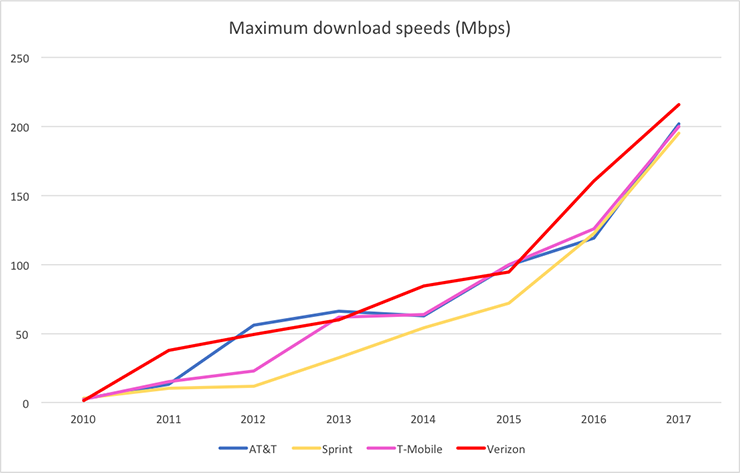
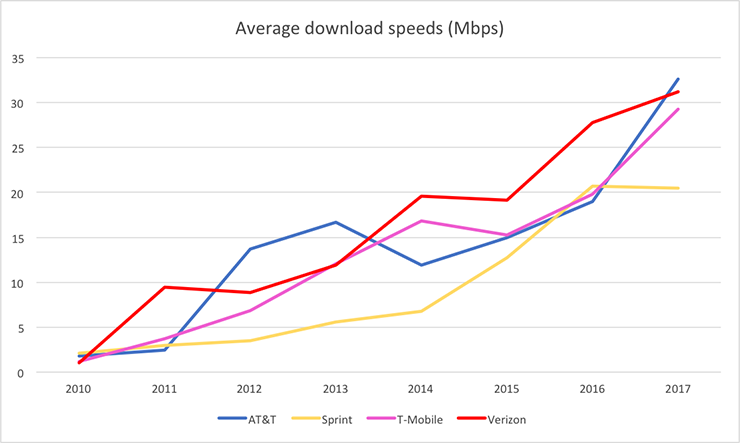
With one exception, you can see that average U.S. mobile internet access speeds have grown by an order of magnitude in about seven years, close to what you would expect from a Moore’s Law rate of increase (doubling about every two years).
“Looking at the maximum download speeds, it looks like there's a 2x jump every two years or so—from 50 to 60Mbps in 2014, to 120 Mbps in 2016, and now to 200 Mbps,” PCmag says.
The results were obtained by drive tests conducted by PCmag.
Average speeds, as you would expect, are lower, but still follow the “close to Moore’s Law” rate of improvement.
That is one of the surprises in the networks business. One would not expect speed or performance increases for physical networks (civil engineering projects) to improve as fast as chips. But that seems to be happening in fixed and mobile networks.
The difference is that cost is not declining as those performance increases happen, as has been the case for computing devices, for example.
Monday, June 26, 2017
Service Providers Need "Qualitative" Distinction, Not "Quantitative"
Quality, in all consumer products or services, ultimately is what the consumer says it is, not what the supplier claims it is.
So it is that mobile voice “quality” (not the high-definition voice that is possible when all endpoints to a connection can take advantage of the high-definition voice) is almost always inferior to fixed network “quality,” but consumers are willing to tolerate the inferior “voice quality” because the total bundle of benefits mobility represents outweigh the disadvantage of “poorer sound quality.”
In other words, people prefer to use mobile voice, in comparison to fixed network voice, not because the “mobile voice” feature actually is “better.” In fact, most would agree the mobile voice experience (in the absence of high-definition voice on each end point) is demonstrably worse.
But overall experience quality is better with mobility because it is personal and ubiquitous, while the device does many other valuable things. So in one clear sense, mobile voice represents higher consumer-perceived quality, even if it also represents worse performance.
That is an issue with some other products, such as internet access. Quality tends to be defined by speeds or coverage; quantitative measures, in other words.
Consultant Martin Geddes has consistently argued that quantity is not substitute for quality, where it comes to internet access services. Geddes also has argued that it is mathematically impossible to implement network neutrality rules when user experience emerges from the total and collective interaction of all users, networks, applications and protocols that are part of unmanaged systems (even when some sub-networks are “sort of” managed).
Basically, Geddes argues, you would require the ability to measure, to determine whether experience is degraded by deliberate actor intent, or simply the congestion or latency that emerges from all the contending and cooperating entities.
But it is precisely quality, not quantity, that matters for user experience or application “performance.” So markets for quality are part of the solution to user experience, Geddes argues.
Up to this point, it has been very hard for ISPs to figure out any way “quality” can be marketed, instead of quantity. Even on the retail offer front, “price” is another quantitative emphasis.
To a large extent, that ability to differentiate on “qualitative” dimensions is what service providers hpe network functions virtualization (NFV) will help them do, at least to some extent.
Virtualized networks might offer “bandwidth on demand” or “latency on demand” features that are qualitative features rather than quantitative differences.
That, you might argue, still is quite some ways from other higher forms of differentiation at the application, content, community and functions level. Bundle offers provide at least some inkling of the “qualitative” differentiation we probably will need to see more of.
Retail mobile bundles of device, service features, content and so forth provide examples.
New Spectrum for 5G Happens First in 3.3-GHz to 4.2 GHz Bands
The 3.3 GHz to 4.2-GHZ spectrum bands are early candidates for early 5G networks globally, while the 5-G New Radio specification means some mobile service providers will be able to move about a year earlier to deploy 5G, assuming they already have access to spectrum in the 3.3-GHz to 4.2-GHz ranges.
Spectrum availability for IMT in the 3300-4200 MHz frequency range is increasing: 3400-3600 MHz is now almost globally available, and a large number of countries in different regions are taking action in order to reach 200-400 MHz of contiguous bandwidth in the 3300- 4200 MHz frequency range for 5G.
In the U.S. market, in addition to the already available 3550-3700 MHz range (the CBRS band), regulators are looking at a number of bands including 3100-3550 MHz and 3700-4200 MHz areas.
The 3400- 3700 MHz band is considered an important candidate in the Republic of Korea for 5G deployments.
A Decade of iPhone
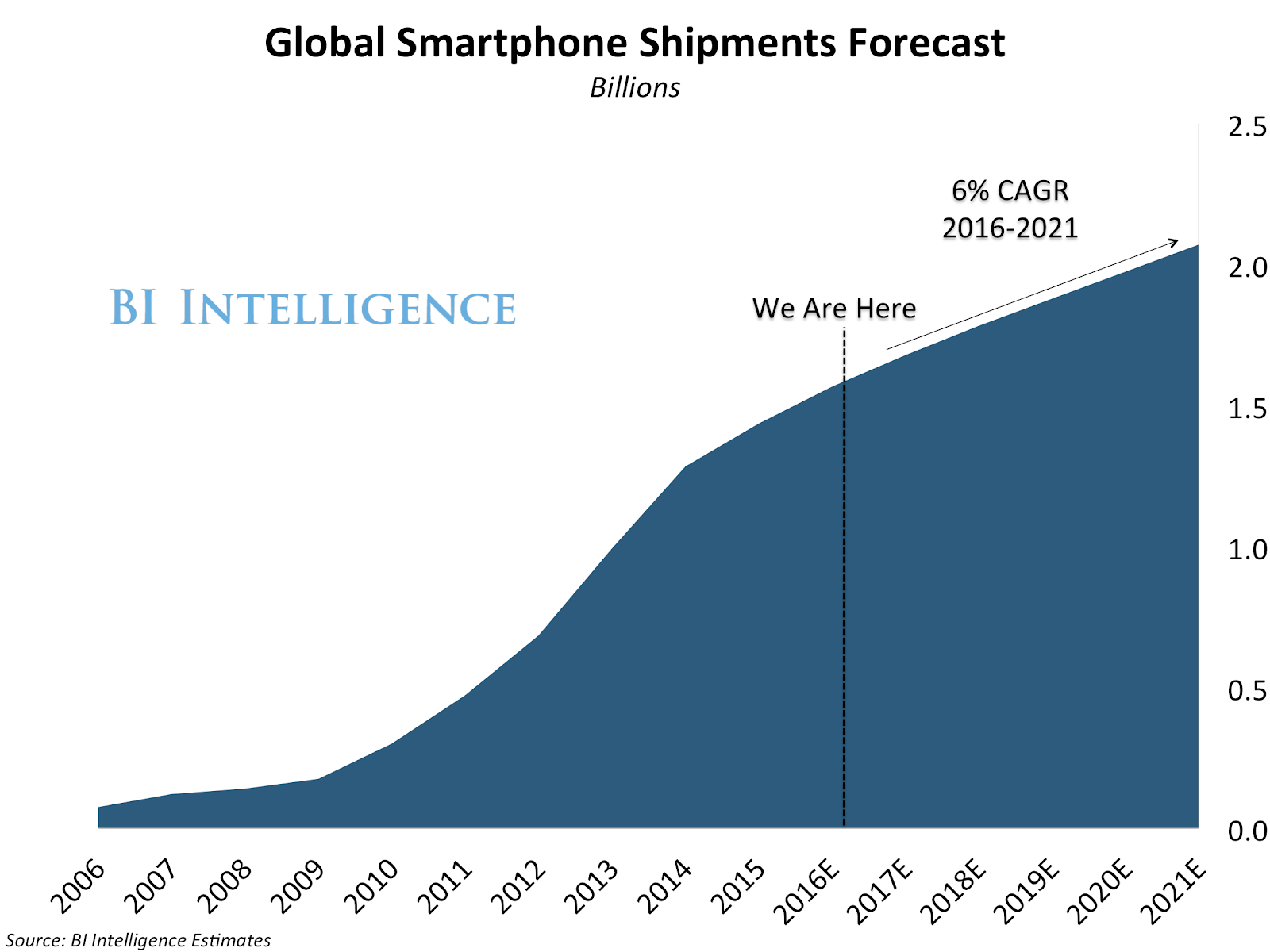
The month of July 2017 marks the 10th anniversary of the launch of the Apple iPhone in 2007. Look at what has happened, in terms of smartphone shipments, since then. Samsung would claim much of the credit for growth, after the iPhone reshaped the “phone” business, as can Android.
The overall importance of the iPhone launch, however, goes far beyond the choice of devices people make. Mobile internet access has driven revenue growth for mobile operators in developed nations, even if new subscribers and voice have continued to drive revenue in developing nations.
Over the last decade, we have seen the rise of what some call the app economy or Over the last decade, we have seen the rise of what some call the app economy, which did not exist in 2007.
That is a bit of a misnomer, but the point is that whole businesses such as Uber are directly enabled by the widespread use of smartphones and faster mobile internet access. , which did not exist in 2007. That is a bit of a misnomer, but the point is that whole businesses such as Uber are directly enabled by the widespread use of smartphones and faster mobile internet access.
Just how much some businesses will be “mobile only” or “mobile first” is a good question. Some might argue that is not presently true, and might never be true, for some activities humans conduct on devices using screens.
Similar questions might be raised about the eventual use cases for internet of things apps (some might be useful only when mobile (connected car), others might be stationary (industrial sensors, light posts, parking spaces), others will be ambient (health and fitness monitors).
The point is that although most human activities have been reshaped by the internet, only some are directly dependent on the use of smartphones and mobility.
To be sure, most shopping activities have been reshaped by people using the internet. And as the advertising business has likewise been refashioned, now mobile-based usage is producing additional changes. But Uber and other ride-sharing services would not have been possible without widespread smartphone use and faster mobile internet.
Some of you might never have owned or used a feature phone. But some of us can remember the moment we realized even our “crackberries” were no longer our own choices: it was the moment the “web” became more important than access to email. That was the moment when the browsing experience on a BlackBerry became so obviously painful that the advantages of email handling could not outweigh a more-pleasant web experience.
All that, and eventually more, were enabled, one could well argue, a decade ago when Apple launched the iPhone.
Friday, June 23, 2017
Shared Spectrum Changes Business Model
A good portion of the business model for AT&T’s new first responder network will come from spectrum sharing.
Spectrum sharing fundamentally is important because it can change the business model for existing and new potential providers of communications services, much as increased availability of unlicensed spectrum likewise allows incumbent and new service providers to create services and revenue streams.
In other words, shared spectrum is important because it changes the value and cost of spectrum rights.
Many would argue that the nationwide first responder network proposed in the wake of the Sept. 11, 2001 attacks on the World Trade Center in New York have gone nowhere for 15 years because the business model was quite questionable.
cThat FirstNet now will be built and operated by AT&T suggests that something significant in the business model has changed, as is true for several other access technologies or approaches.
Subscribe to:
Posts (Atom)
Is Sora an "iPhone Moment?"
Sora is OpenAI’s new cutting-edge and possibly disruptive AI model that can generate realistic videos based on textual descriptions. Perhap...
-
NTT researchers recently demonstrated ability to transmit 100 Gbps at 300 GHz frequencies, far beyond the ranges we have used for freespa...
-
Rich Communications Services was intended to be the multimedia successor to SMS (short message service). It still seems likely to do so, tho...
-
Here’s a look at mid-band spectrum held by the leading mobile operators in Japan, according to Gaku Nakazato of Japan’s Ministry of Intern...