Tuesday, February 28, 2017

40% of AT&T 2017 Capex Targets Enterprises

AT&T says it plans $22 billion in capital investment in 2017, about 40 percent of which might be characterized as supporting enterprise applications and mobility.


AT&T says it 2017 investment targets business platforms and solutions, including SD-WAN, Flexware, cybersecurity, internet of things and collaboration solutions.

In the access area, Mexico investments and Wi-Fi access in both Mexico and Canada are part of the effort.

Communications Capacity "Scarcity" is Substantially Going Away

Moore's Law has much to do with eliminating all sorts of "scarcities" in the physical world, ranging from accessible and ubiquitous computing, to powerful phones; shopping choice; transaction capabilities of all sorts; banking; media and communications.

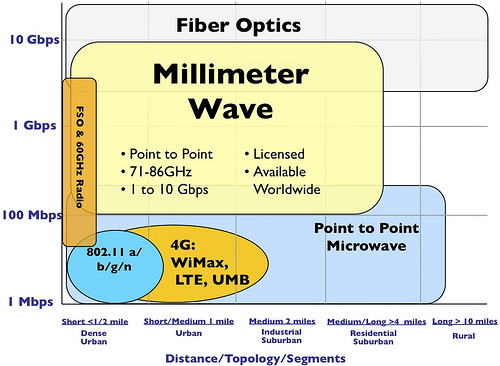
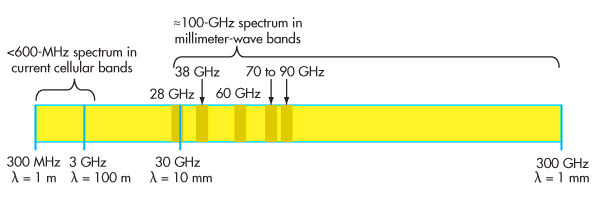
You can credit Moore’s Law for much of what you now see happening in terms of spectrum policy and access. Shared spectrum in 3.5 GHz (Citizens Broadband Radio Service), the ability to run Long Term Evolution 4G in unlicensed spectrum, use of unlicensed 5-GHz Wi-Fi spectrum as though it were part of an operator’s licensed spectrum, and the vast amounts of new 5G spectrum (and also unlicensed spectrum in millimeter ranges), are possible only because continuing advances in signal processing and computation now allow us to do all those things affordably.

Where in the analog domain millimeter waves would have had cost and distance limitations, we now can process signals at low cost, and code and reconstruct signals at distances that are economically useful and realistic.

That is why the Federal Communications Commission is opening up nearly 11 GHz of spectrum (capacity),  in the bands above the 24 GHz frequency range, for mobile use. The FCC also currently considering whether to open up even more spectrum in the millimeter wave bands for 5G and other uses, for perhaps a total of 29 GHz of new spectrum (capacity).

“Within living memory, it was thought that spectrum above 3 GHz (frequency) could not be used for mobile communications,” said FCC Chairman Ajit Pai. “Today, one can use millimeter wave spectrum to produce multi-gigabit speeds.”


Thursday, February 23, 2017

FCC Okays LTE-U, Allowing LTE Spectrum to be Bonded with Wi-Fi

As improbable as agreement likely seemed when the idea of allowing Long Term Evolution mobile networks to use Wi-Fi spectrum (LTE-U), the initially warring mobile and Wi-Fi communities and industries finally reached agreement on interference issues, allowing the Federal Communications Commission to move ahead and authorize LTE-U spectrum sharing between mobile operators (Verizon and T-Mobile US plan to do so) and 5-GHz Wi-Fi networks.

These days, one is as likely to hear Wi-Fi supporters praising “spectrum convergence” and touting Wi-Fi quality of service features, as to hear warnings about interference if LTE devices are allowed to bond licensed spectrum with Wi-Fi assets.

Verizon has been working towards LTE-U since at least 2015. And T-Mobile US has announced deployment of LTE-U  capabilities in its LTE network, following FCC certification of equipment from Ericsson and Nokia.
T-Mobile US expects to begin commercial LTE-U functions in the spring of 2017. Basically, LTE-U gives T-Mobile US customers the ability to bond some Wi-Fi spectrum (20 MHz) with T-Mobile’s licensed spectrum, while maintaining LTE sessions.

“LTE-U allows wireless providers to deliver mobile data traffic using unlicensed spectrum while
sharing the road, so to speak, with Wi-Fi,” said FCC Chairman Ajit Pai.

Wednesday, February 22, 2017

High Spectrum Prices Might be a Problem, But Are Headed Lower

There is more evidence that observers expect spectrum prices to begin trending lower, as already has been seen in recent big spectrum auctions in India and the United States. In the big Indian spectrum auction, the auction proceeds were about 11 percent of government projections.

To be sure, there are several compelling reasons for the caution, including a need to deploy capital elsewhere. But potential bidders also recognize they have many more ways to create and use spectrum resources, ranging from small cell architectures and better radios to huge new allocations of millimeter wave spectrum to support 5G networks, plus use of unlicensed and shared spectrum.

That noted, high prices are an impediment to consumer use of mobile data services and a drag on economic growth, a new study sponsored by GSMA suggests.

High spectrum prices negatively impact consumers, while high spectrum prices also can damage economic growth, say researchers at NERA Economic Consulting, in the report. Those findings should not surprise anybody.

Spectrum costs always are incorporated into retail product prices, so high spectrum prices ultimately are paid for by consumers of those services.

A moving average of prices for mobile spectrum over the 2000 to 2016 period shows a U-shaped path. The beginning of the 3G era coincided with the so-called “tech bubble”, which generated huge enthusiasm regarding the potential of 3G data services, the study says.

This was reflected in the very high prices achieved in some early awards, most notably the United KIngdom and German 3G auctions in 2000, which raised $5.30 and $6.90 per MHz/pop respectively.

Subsequently, there was a sharp drop in prices for 3G spectrum, and most awards for the remainder of the 2000s generated modest prices. Since 2008, however, there has been an upward trend in prices, coinciding with the take-off of 4G services, the researchers note. That might now be changing, as suggested by the Indian and U.S. auctions.

“The era of judging the success of auctions based on headline-generating revenue figures is over,” said Brett Tarnutzer, Head of Spectrum, GSMA. “The damage done to consumers –and the wider digital economy – by policies that artificially inflate spectrum prices has been too great.”

“While auctions remain an effective means of awarding spectrum, regulators should adopt spectrum policies that focus on maximising the benefits for society, rather than simply driving up the cost of spectrum,” said Tarnutzer.

Average final prices paid in auctions were found to have risen 250 per cent1 from 2008 to 2016 with the most exorbitant price tags often influenced by policy decisions.

The report highlights four key pricing policy recommendations:
1. Set modest reserve prices and annual fees and rely on the market to set prices;
2. License spectrum as soon as it is needed, so as to avoid artificial spectrum scarcity;
3. Avoid measures that increase risks for operators (e.g. that put the value of their company in jeopardy); and
4. Publish long-term spectrum award plans that prioritise public welfare benefits over state revenues.

High spectrum prices lead to lower quality and reduced take-up of mobile broadband services, the study argues.

“There was a time when it was believed that the cost of spectrum, no matter how high, would not impact consumers through higher mobile bills or reduced investment in networks,” said  Richard Marsden, Managing Director at NERA Economic Consulting. “The academic and empirical research no longer backs this up.”

Tuesday, February 21, 2017

Gigabit LTE Creates New App Opportunities

Serge Willenegger, Qualcomm SVP of product management, explains how gigabit LTE will enable new use cases for wireless, including consistent cloud connectivity, industrial IoT use cases, virtual reality and augmented reality.

Wi-Fi Business Model Changing?

The Wi-Fi business model historically has been mostly indirect, with a few exceptions, such as business-focused for-fee access services such as Boingo. In most other cases, Wi-Fi has been a feature of in-home or in-office or in-building internet access, or an amenity offered to customers paying for other services (fixed or mobile network internet access, lodging, food and beverage, professional services, events).

It now appears the Wi-Fi business model is largely going to shift in ways that further extend Wi-Fi in the direction of core mobile or fixed network internet access. Up to this point, Wi-Fi has been useful in that regard mainly as a way of offloading mobile network traffic to the fixed network.

Now it will increasingly be possible to bond Wi-Fi and unlicensed spectrum to licensed spectrum with quality of service features, increasingly shifting the business model towards for-fee internet access of various types.

The principle remains “use any available access,” but with an important distinction: it will increasingly be possible to assure quality of service for for-fee access services, even when using any available access.

Monday, February 20, 2017

O2 Predicts Huge 5G Value

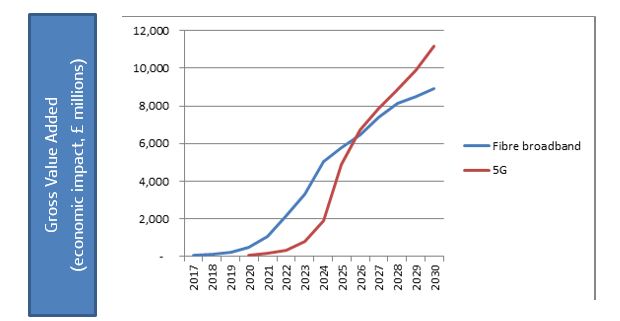
O2 in the United Kingdom now predicts that 5G will have more economic impact than optical-fiber-based fixed internet access by 2026. In addition to £7 billion of direct economic value through businesses using 5G, 5G is expected to indirectly boost the nation’s productivity by an extra £3 billion a year, the study by independent research consultancy Development Economics suggests.

The study predicts the combined value of 4G and 5G connectivity will add £18.5 billion to the economy in less than a decade, compared to just £17.5 billion for broadband overall.

Is Sora an "iPhone Moment?"

Sora is OpenAI’s new cutting-edge and possibly disruptive AI model that can generate realistic videos based on textual descriptions.  Perhap...