Monday, September 26, 2016

Mobile Network Capex Dipping?

Though mobile network capital investments largely have driven global network spending for some years, Dell’Oro Group says investments in fixed networks are growing, while investments in mobile networks are declining, in the first half of 2016.

That is not to say that overall capital investment is dropping. In fact, investment might well continue to grow, in absolute terms. The other important metric is revenue growth that is higher than investment spending.

It probably is not so much the level of investment in networks, but the financial returns from those networks, that is the growing problem.

As much as continual investment in networks is a prerequisite for the access business, especially under competitive conditions, the ability to earn a return on the investments has been getting more difficult.

So there might be very good reasons why tier-one service providers are working so hard to drive down their capital investment and operating costs: they must do so.

In fact, at least one analysis suggests tier-one service providers have not been recovering their cost of borrowed capital for a decade and a half or more.

Researchers at PwC studied the financial performance of 78 fixed-line, mobile and cable operators with a collective annual capex of some $200 billion, nearly 66 percent of the industry’s total spend.

The research found that, over the past decade, the average long-term return on investment (ROI) has been just six percent.

That is three percentage points less than the cost of the capital itself. In other words, operating revenue is not covering the cost of capital.

That might explain negative rates of capital investment growth in recent years, on a global basis.

Fiber to the LIght Pole or Fiber to the Node for Millimeter Wave Small Cells?

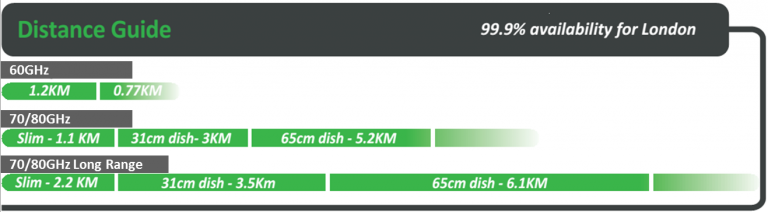
Here’s one illustration of radio propagation in the millimeter wave bands from 60 GHz to 80 GHz. Siklu says that at 60 GHz, 99.9 percent availability can be obtained at a distance of 1.2 km (about 0.7 miles).

Signal propagation at that same level of availability, using 70 GHz or 80 GHz frequencies, is about 1.1 km (about 0.66 miles).

Others might model lower coverage limits, either to boost availability higher (which implies trading distance for signal strength), or to increase the number of potential “line of sight” paths.

If, as some others expect, millimeter wave small cells have a transmission radius of about 50 meters (165 feet) to 200 meters (perhaps a tenth of a mile), it is easy to predict that an unusually-dense backhaul network will have to be built (by mobile network standards).

In the past, mobile operators have only required backhaul to macrocells to towers spaced many miles apart. All that changes with new small cell networks built using millimeter wave spectrum (either for 5G mobile or fixed use, or for ISP fixed access).

Keep in mind that street lights are spaced at distances from 100 feet (30.5 meters) to 400 feet (122 meters) on local roads.

In some urban areas that might imply small cell deployment density of roughly “fiber to every other light pole,” or perhaps a cell every fourth light pole on a road.

source: Siklu

Sunday, September 25, 2016

Autonomous Vehicles Will be Deployed Like Mobile Networks (5G, 4G, 3G)

source: newco
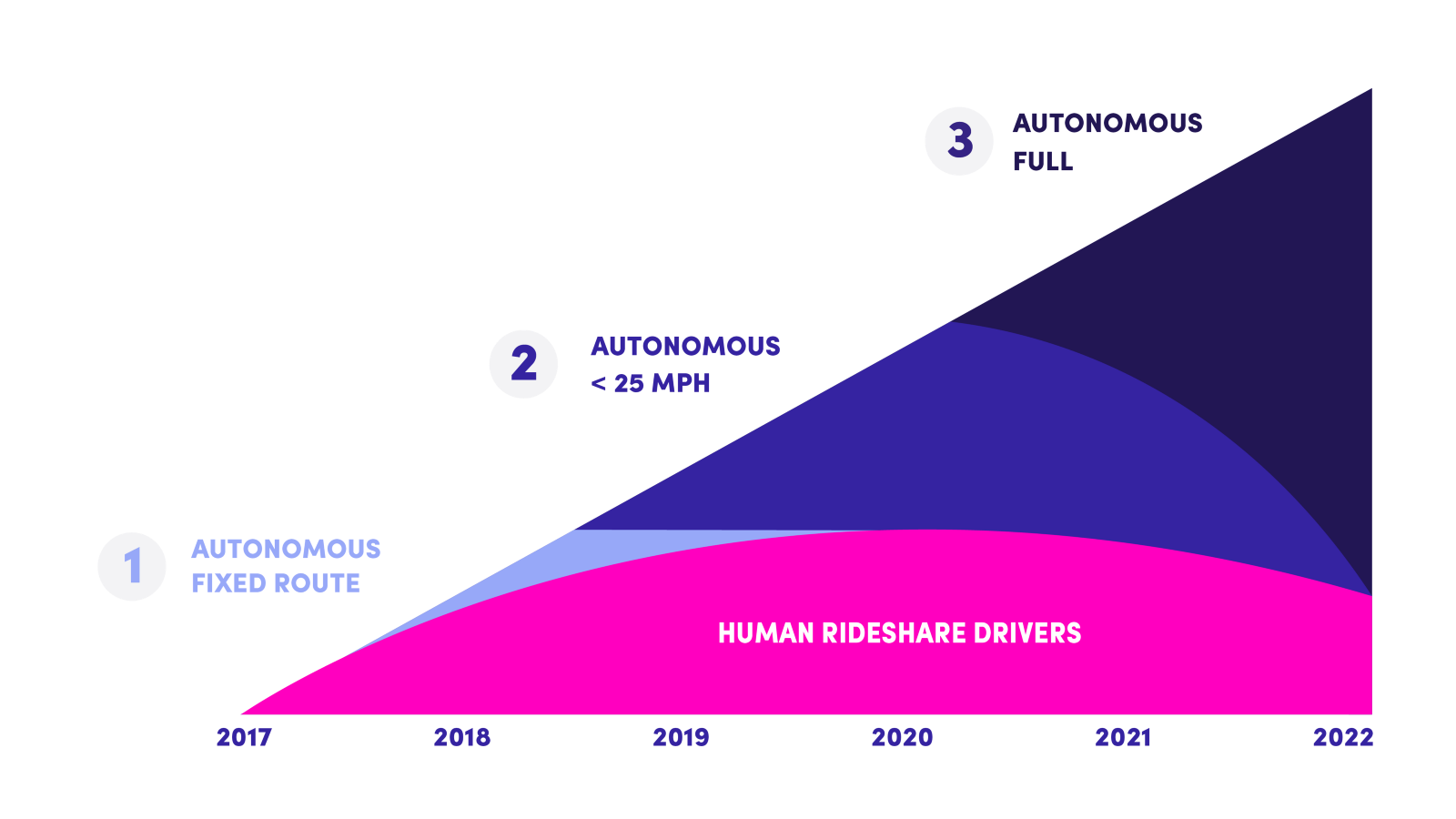
If proponents of autonomous vehicle adoption are correct, we might see an adoption pattern similar to the adoption of next-generation mobile platforms. That is to say, the latest platform (5G, for example) will happen first in the dense urban areas, with older platforms continuing to exist in less-dense areas.

“Ridesharing is just the first phase of the movement to end car ownership,” argues John Zimmer, Lyft co-founder.

“At first, fully autonomous cars will have a long list of restrictions,” he says. “They will only travel at low speeds, they will avoid certain weather conditions, and there will be specific intersections and roads that they will need to navigate around.”

That fits the urban-first deployment model for a next-generation mobile network.

source: newco
“As technology improves, these cars will be able to drive themselves in more and more situations,” says Zimmer. That corresponds to the continued deployment of a new mobile network in small towns and cities.

“Hypothetically, Lyft could initially have a fleet of autonomous cars that completes rides under 25 miles per hour on flat, dry roads,” he says.  “Then, we could upgrade the fleet to handle rides under those same conditions, but at 35 miles per hour.”

Phased deployment, in other words, will make sense. Eventually, every kind of trip can be completed by an autonomous car. That is like the final phase of initial construction, when a new mobile network is built in rural areas.


Saturday, September 24, 2016

Can Fixed Wireless "Save" Telco Fixed Networks Business Model?

Facing new competition from Google Fiber, cable TV and telco executives insisted consumers did not “need” a gigabit Internet access speed. They essentially were right then, and the assessment generally continues to hold for most accounts: nobody really uses apps that need a gigabit.

And yet, 5G standards will include multi-gigabit speeds, and the cable TV industry already envisions 10 Gbps service. Nokia already has demonstrated 10 Gbps symmetrical speeds on hybrid fiber coax, supporting the CableLabs “full duplex” version of DOCSIS 3.1.

Comcast also is going to sell business customers 100-Gbps Ethernet in Annapolis, Md., illustrating once again that it is cable TV operators who now set the standards for much of the U.S. Internet and data communications market, consumer, small business or enterprise.

All that illustrates a principle: advertised Internet speeds are mostly about marketing, at this point, not “need.” The clearest use case for most accounts is that multiple users in a family or household watch lots of high-definition format streaming video simultaneously.

Generously allocating 10 Mbps per stream would mean a need for 70 Mbps for seven simultaneous HDTV streams.

Some users running servers out of their homes plausibly need similar levels of bandwidth. But the average consumer arguably needs nowhere near 100 Mbps.

A reasonable 2015 analysis of functional need, per user, might have looked something like this:
  • 5 Mbps or less: Basic web surfing and email
  • 5-10 Mbps: Web surfing, email, occasional streaming and online gaming with few connected devices
  • 10-25 Mbps: Moderate HD streaming, online gaming and downloading with a moderate number of connected devices
  • 25-40 Mbps: Heavy HD streaming, online gaming and downloading with a lot of connected devices
  • 40+ Mbps: Hardcore streaming, gaming, and downloading with an extreme number of connected devices.

You might reasonably argue it is ultimately dangerous to invest real capital in networks whose capabilities so outstrip demonstrable present need. But it has arguably been the case for some time, in the fixed networks business, that telcos have to invest serious amounts of capital in their fixed networks simply to stay in business.

Those are strategic investment drivers--you get to keep your business--rather than the more-typical business case analysis where incremental capital is invested to gain incremental revenue.

You might argue that tier-one telcos actually are behaving rationally when “underinvesting” in fixed network capabilities--even at the risk of losing market share to cable TV companies--if they believe the future rests in their mobile networks.

In other words, some might have concluded that traditional telco fixed network economics, in competitive markets with high amounts of stranded investment, cannot fundamentally be fixed.

That is a complex matter involving high operating costs and regulatory burdens higher than faced by competitors, heavy amounts of stranded assets, and key and perhaps growing numbers of competitors with capital and operating cost advantages.

That is not to say fixed networks inevitably must lose relevance. But what one contestant can do, with one set of assets, is not necessarily what every other contestant can do. Right now, networks built using cables favor hybrid fiber coax, and cable TV operators.

It is not clear how much mobile or fixed wireless can change the equations enough to level the capital and operating cost parameters. But the effort is going to be made.

Charter Communications Getting into Mobile Business

Though Comcast has gotten most of the attention, Charter Communications also is getting into the mobile business.

Charter Communications says it also plans to wholesale mobile capacity from Verizon Wireless, and like Comcast expects to leverage its Wi-Fi hotspot network to reduce the amount of capacity it buys from Verizon Wireless.

“We’ve told Verizon we’re interested in pursuing that agreement,” said Tom Rutledge, Charter Communications CEO.

Mobile Internet Used by More Than 90% of Australians

More than 90 percent of Australians under 50 go online using a mobile phone. That does not mean that “only” do so using a mobile device, only that the behavior is ubiquitous.

As with many other aspects of Internet behavior, older age cohorts use their mobile devices to use Internet apps at a lower rate.

Some 75 percent of all consumers in Australia access the internet via mobile phone, according to a June 2016 survey by Sensis.

But that figure is because just 61 percent of those ages 50 to 64 do so, and just 33 percent of those ages 65 and up do the same.

For some, the more interesting question is what percentage of people use “only” the mobile device for Internet access.

In earlier 2016, for example, 11.7 percent of U.S. Internet users were going online exclusively using a mobile device mobile device, and do not use personal computers or other devices at all.

In fact, since 2015, according to comScore, there are more “mobile-only” than “desktop only” Internet users.

New Competitors Poised to Shake Up ISP Market Structures

How much potential disruption to market share structures in the global Internet service provider market could happen as new platforms and new competitors enter the market?

There now is lots of platform innovation, and potentially significant new supplier entry as well. In addition to lots of development work in the fixed wireless area by a growing range of firms (including Facebook, Google, AT&T and Verizon), 5G mobile standards already include multi-gigabit data rates as core features of the standards.

CableLabs in the United States is working on symmetrical 10 Gbps hybrid fiber coax networks.

Add the other backhaul developments (unmanned aerial vehicles, balloon fleets, low earth orbit satellites) and there is potential room for disruption.

In the near term, though, it seems as though new supplier market entry will have the bigger impact, as Internet access in many markets is a zero sum game continues to prevail, and one contestant’s gains will come at another’s expense.

In other words, oligopoly in the access market does not appear a condition that could break soon.

Capital-intensive industries tend to produce oligopoly market structures. Even some industries that are scale-intensive or moderately capital intensive also tend to do so, it seems. Look at Apple’s market share , for example.

So one reasonable question in the global access business is to ask whether technology platform advances can reduce capital investment hurdles enough to break the “oligopoly” market structure.

If so, then a wider new competitors might expect to break into the top ranks. If not, then only big firms can hope to do so.

At the moment, in several markets, it appears the latter thesis will be tested. In India, the entry of Reliance Jio already is rearranging market structure, forcing consolidation. In the U.S. market, Comcast and Charter Communications are getting ready to enter the market. In Myanmar and Singapore,  new competitors are being authorized.


Is Sora an "iPhone Moment?"

Sora is OpenAI’s new cutting-edge and possibly disruptive AI model that can generate realistic videos based on textual descriptions.  Perhap...