Friday, June 17, 2016

Can 37 GHz, 39 GHz be Used to Support Both 5G and Satellite Uses?

The argument that existing licensees have essentially been squatting on spectrum that has not been used is a growing complaint of many industry participants, who cite the inefficiency of such non-use when more spectrum is needed for communications purposes.

Also, there are a growing number of instances where satellite and mobile interests clash over the use of spectrum formerly reserved for satellite uses.

Straight Path Communications, which wants to redeploy former satellite spectrum to support 5G, argues that, “in fact, the satellite industry has made no use of the 37/39 GHz band and has done nothing to seek any imagined regulatory changes necessary for additional use.”

Among the issues raised by Boeing and the Satellite Industry Association is that 5G operations will cause a great deal of interference with satellite transmissions.

No TV White Spaces for India

India’s Department of Telecommunications (DoT) has decided against allocating the 470-582 MHz spectrum band for the commercial deployment of TV White Space (TVWS) technology, at least for the moment.


It is possible the spectrum could be made available for such purposes later, but almost certainly as licensed spectrum, sold by auction, not unlicensed, as most of its supporters would prefer.

But the DoT also seems to believe there may be other uses for some of that spectrum in the future, and will not commit to reserving the full band for eventual TVWS operations.

With the decision, India loses one more potentially low-cost option for Internet access in isolated and rural areas, some will argue.

Even if some of the spectrum eventually is made available for TV White Space applications, the spectrum will be sold at auction, like mobile spectrum.

That means the cost to potential end users will have to reflect the costs of acquiring the spectrum. Virtually all TVWS supporters prefer making the spectrum available on a non-licensed basis.


Wednesday, June 15, 2016

Sprint Tests 15 GHz, 73 GHz for Mobile Access

Sprint used 15 GHz spectrum at Lincoln Financial Field to transmit soccer video in 4K format, with speeds to 4 Gbps, during the 2016 Copa América Centenario tournament.

Sprint also showed beam forming techniques at 73 GHz to bend signals around solid objects in Santa Clara on June 3.   

The Philadelphia test at Lincoln Financial Field used a temporary permit from the Federal Communications Commission to test at 15 GHz frequencies.  

How Big a Market for Fixed Wireless?

How big a market might exist for fixed wireless Internet access connections? The number of people asking that question is sure to grow, as more ISPs and platform suppliers explore the use of fixed wireless as a substitute for a fixed network connection for Internet access.

A big potential change could come with the advent of 5G mobile networks that initially offer fixed access as a lead application. Google Fiber, Verizon and AT&T are among the big ISPs publicly saying they are exploring such deployments, while Facebook is developing new transmission technologies and network platforms for access.

We need to be clear about one thing: a switch to wireless already is happening.

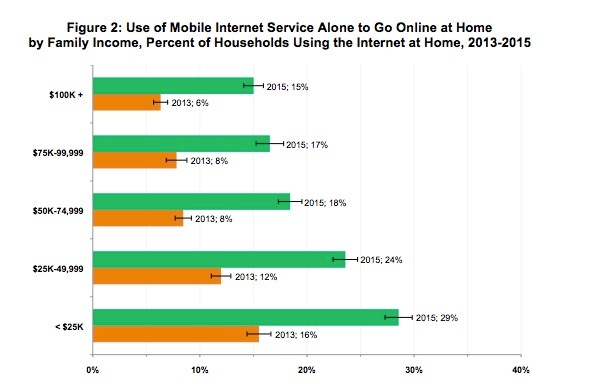
More U.S. households now seem to be abandoning even fixed Internet access in favor of mobile access, as it now is common for households to rely on mobile voice (more than 46 percent of U.S. households now are “mobile only” for voice) , instead of fixed network voice, or over the top video entertainment in place of traditional subscription services.

In fact, because of mobile use, fixed network Internet access rates actually are dropping in the United States, having reached an apparent peak in 2011.

Tuesday, June 14, 2016

Spectrum Futures Confirmed Speakers

The Spectrum Futures conference, to be held 19-21 October 2016 in Singapore, will feature up to 60 experts across a range of disciplines (regulators, ISPs, ISPs, app and infrastructure providers, policy advocates and researchers), talking about the latest in spectrum trends and platforms for Internet access across the region.
Speakers will address a number of key themes:
  • What are the key issues preventing wider access to Internet access, South and SE Asia?
  • What is the status of access in developed, mid-tier and developing nations across South, SE Asia?
  • What are the best practices from “most developed” and “fast developing” nations?
  • How will new platforms for Internet access change what is possible?
  • How can we encourage faster investment?
  • What can be done to create capacity (shared spectrum, millimeter wave, new platforms, small cell, 4G, 5G)?
  • Are there new roles for Wi-Fi and unlicensed spectrum and ISPs?
  • How can we create app provider roles, ISP partnerships to drive Internet value?
  • How can we create more value in the ecosystem?
  • How are successful partnerships built?
Early confirmed speakers include:
Chris Weasler, Facebook, Director of Global Connectivity
Praveen Sharma, Tata Communications, Head of Regulatory Affairs
Rajan S. Mathews, Cellular Operators Association of India, Director General
Mohamed El-Moghazi, National Telecom Regulatory Authority of Egypt, Director of Radio Spectrum Research and Studies
Camilo Alberto Jiménez Santofimio, Comisión de Regulación de Comunicaciones, Colombia, Senior Advisor
Reza Arefi, Intel Corporation, Director of Spectrum Strategy
Bob Horton, Horton Consulting, Director & Principal
Vern Fotheringham, V-Satcast, LLC, Executive Chairman
Josh Gordon, Red Pocket Mobile, President
Narendra K. Saini, Telecommunication Engineering Center (TEC), India, Chair – Smart Governance WG
Rajnesh D. Singh, Internet Society, Regional Bureau Director for Asia-Pacific
Muhammad Rashid Shafi, Multinet Pakistan (PVT.) LTD., CEO Global Business & Chief Strategy Officer
Devid Gubiani, Bolt Super 4G – PT First Media, CEO

Monday, June 13, 2016

AT&T Tests Fixed Wireless at 15 GHz and 28 GHz

It would not be unreasonable to argue that new millimeter spectrum, 5G mobile network platforms and advances in antenna technology and signal processing will make possible a new business case for fixed wireless as an alternative to other forms of Internet access.

AT&T, among others, is testing fixed wireless, using the 15 GHz and 28 GHZ bands. That is important since AT&T has promised the Federal Communications Commission it will add 13 million new high speed access connections using fixed wireless, over about the next four years.

Separately, Verizon also says it is looking at using fixed wireless.

Microsoft, Facebook and Google also are looking at the platform, Microsoft primarily backing TV White Spaces, while Facebook is testing new transmitting arrays and Google is testing use of millimeter waves

Google Executive Chairman Eric Schmidt has confirmed that Alphabet is looking seriously at adding fixed wireless to its arsenal of access platforms, and has been testing 3.5 GHz frequencies and platforms in its Kansas City market.

Facebook’s Project ARIES, presently in test mode, features a base station with 96 antennas, supporting 24 simultaneous streams. It is envisioned as a fixed wireless platform for Internet access.

Facebook so far has achieved 71 bps/Hz, and Facebook engineers are aiming for supplying 100 bps/Hz eventually.

By way of comparison, that would surpass the efficiency of Long Term Evolution and vastly outperform most other interfaces ever commercially deployed.

Frequencies in the millimeter band that once were commercially unusable for communications purposes will be usable to support 5G and other networks, in large part because of advances in network architecture (small cells) and the ability to use sophisticated signal processing and antennas to recover useful signals that would have been quite difficult in an analog environment.

The issue is where the business models will work, taking into account signal loss characteristics of millimeter waves. Of course, we have some commercial experience with use of point-to-point communications. Even earlier-generation radios for point-to-point links could achieve distances of 3 km to 5 km (roughly two to three miles), assuming line of sight is possible.

Keep in mind that the engineering of fixed network local loops in the United States has been to keep access cables at 18,000 feet or less (three miles). Though foliage, buildings and other obstructions, plus typical weather conditions, will impose greater constraints on any single transmitting site, 28 GHz signals reach about as far as the design length for fixed network access lines.

The issue with today’s MIMO (multiple-input and multiple-output) antenna technology is how much better performance generally can be expected, and what per-unit costs for MIMO antenna systems used for 5G and other networks will be, in volume production.


Sunday, June 12, 2016

FCC Asks for Comment on Spectrum Sharing in DSRC Band

The Federal Communications Commission is asking for further comment about spectrum sharing between connected vehicle and Wi-Fi uses in the 5.865 GHz to 5.925 GHz band, illustrating a shift in thinking about spectrum allocation generally, and providing yet one more example of how all spectrum decisions are inherently political and contentious.

In this case, growing demand for additional spectrum for Wi-Fi--in a band logical for Wi-Fi use--clashes with a prior licensing decision intended to support connected vehicles.

Supporters of vehicle-to-vehicle communications generally prefer that Dedicated Short Range Communications (DSRC) operations in the 5.850-5.925 GHz (U-NII-4) band not be shared with “Unlicensed National Information Infrastructure” (U-NII) devices. In other words, the argument is
“no sharing of dedicated DSRC spectrum with Wi-Fi.”

Proponents of Wi-Fi sharing in that band cite growing needs for Wi-Fi bandwidth, the fact that no services yet are provided, after 15 years, as well as advances in sharing technology that allow dual use.

The DSRC spectrum at 5.850-5.925 GHz consists of seven 10-Megahertz channels and a 5 MHz segment of spectrum reserved to accommodate future developments.

The current FCC rules designate two of the seven 10 megahertz channels (5.855-5.865 GHz and 5.915-5.925 GHz) for safety of life and property applications and one of the 10 megahertz channels (5.885-5.895 GHz) is designated as a control channel.

Two sets of the 10 megahertz channels may be combined to create a two 20 megahertz channel (5.865-5.885 GHz and 5.895-5.915 GHz)

Advocates of spectrum sharing often say as little as five to 10 percent of licensed spectrum actually is used, at any given moment, pointing out the value of allowing spectrum sharing, instead of exclusive use that actually means most communications spectrum lies fallow, most of the time.

Communications policy advocates often point out that much allocated spectrum is not in use, years after being awarded. Sometimes that is alleged to be an example of deliberate hoarding, intended mostly to deny its use to rivals.

“The auto industry wants to retain near-exclusive use of the full 75 megahertz, without an auction and at no charge, but most of it would be used for commercial applications unrelated to safety,” said Michael Calabrese, director of the Wireless Future Project at New America think tank. The same functions could be supplied by Wi-Fi apps and devices, he has argued.

There are more benign explanations. The Dedicated Short Range Communications (DSRC) band, featuring 75 MHz, was allocated for vehicle-to-vehicle communications more than a decade ago, but only now are the first commercial applications coming to market. Sometimes it takes that long for an ecosystem to develop.

DSRC was intended to enable short range, wireless links to transfer information between vehicles and roadside systems. But some argue Wi-Fi, in nearby bands, also requires more spectrum, and that sharing mechanisms now are feasible that allow connected car apps and Wi-Fi to coexist, while making more efficient use of available spectrum.

Is Sora an "iPhone Moment?"

Sora is OpenAI’s new cutting-edge and possibly disruptive AI model that can generate realistic videos based on textual descriptions.  Perhap...