Saturday, January 22, 2022

Still Many Unknowns about 5G

Carping about the value of 5G or user experience benefits is not ever hard to find, especially in the United States, where early 5G has had to rely on low-band spectrum (low speeds) and millimeter wave (low coverage) rather than mid-band spectrum, as is the case mostly everywhere else in the world. 


Still, there are some potential long-term changes that have nothing to do with the current state of user experience. 


When a much-hyped new network is under construction, with a full national rollout taking three years or so, impatience is probably inevitable, though 4G seems to have been greeted more favorably, when the primary attraction was speed. 


At least one issue for 5G is that 4G speeds often are quite satisfactory--for the moment--for nearly all the applications people actually want to use on their phones. That makes the siren call of “faster” less useful than in the 3G to 4G transition, when the speed difference was notable since 3G was clearly not fast enough for many apps and use cases. 


Video, for example, was painful on 3G and high-graphics-content web pages also were an issue. 4G fixed those problems pretty quickly. 


It is hard to say the same for early 5G, as low-band speeds are not so different from 4G and millimeter wave access is geographically limited. 


But the 5G rollout also is occurring under unusual circumstances. Because of all the pandemic-related shutdowns, people have not been “out and about” as much as they had before. 


More schooling and work is being conducted from home, which means most users are on Wi-Fi, which also means the benefits of 5G speed would not be so obvious, or so important. 


If, as many expect, the “return to the office” does not return us to pre-Covid levels, there will be a “permanent” reduction of the value of mobile access, simply because there will be less “out and about” needs for connectivity than before. 


We will have to see what happens when mid-band spectrum is universally deployed, and many users--perhaps most--also are on unlimited usage plans. Will the at-home default to Wi-Fi continue at present levels? It is possible it does not. 


Will some percentage of users find “5G all the time” provides a better experience than their home broadband? Possibly, if those users are buying entry-level home broadband service. 


Will price benefits from bundling of mobile and fixed wireless, plus speed that is “good enough” shift demand, and if so, how much?


Will fixed network home broadband providers see share losses? As the U.S. home broadband market is very nearly a zero sum game, it is possible. 


Mobile service provider capex also could be affected. Having historically put more capacity “downtown,” will reduced urban core working time then delay capacity upgrades there, but increase them in suburban areas where people are spending more time?


And how long will it be before new devices for capacity-hungry augmented or virtual reality become popular? How much of that bandwidth will be “5G direct” versus “Wi-Fi” supported? We do not know yet. 


And that is to say nothing of new use cases for network slicing (virtual private networks) that could become important for enterprise users. Edge computing combined with 5G as well as private networks should also become important. But the level of demand is not yet clear. 


The point is that aside from 5G value for consumers, there are other effects for business users that do not necessarily hinge on speed. Latency performance or security could be the key drivers. 


On the network infrastructure front, where capacity needs to be added over the next five years could be different from past patterns. Even if total usage goes up, it might not increase at the cell sites we normally would expect. 


There is much we could yet be surprised about, where it comes to 5G. 


Thursday, January 20, 2022

No Sustainable Advantage Tends to Exist in Mobile Business

Virtually nothing in the connectivity and computing businesses remains unchanged for long, especially touted marketing advantages. Consider mid-band spectrum resources available to the leading U.S. mobile providers and one major challenger. 


By virtue of its acquisition of Sprint, T-Mobile amassed a trove of about 160 MHz of mid-band spectrum, mostly at 2.5 GHz. At a clear disadvantage, AT&T and Verizon both spent heavily to acquire new mid-band spectrum. 


The C-Band spectrum auctions generated $81 billion as the carriers bid to acquire 280 MHz of spectrum in the 3.7 to 3.98 GHz region. 


Verizon won 60 MHz in the A Block that is being deployed early in 2022. Verizon also acquired 80 MHz to 140 MHz of the B Block that requires clearing of current users, something that is expected by late 2023. 


AT&T won about 100 MHz (40 MHz in the A Block and 60 MHz in the B Block. T-Mobile also won about 30 MHz in the B Block. 


The Federal Communications Commission Auction 110 released 100 MHz of national average spectrum in the 3.45 GHz to 3.55 GHz range.


The winners spent $22.5 billion on a total of 4,041 licenses. The average cost was $0.74 per MHz-PoP.


The top five bidders spent $21.3 billion, representing 95 percent of total spending. 


The spending by the top five bidders was:

  1. AT&T: $9.1 billion, or 40.5 percent

  2. DISH Network: $7.3 billion, or nearly 33 percent of the total

  3. T-Mobile: $2.9 billion, or 13 percent

  4. Columbia Capital: $1.4 billion, or six percent

  5. U.S. Cellular: $580 million or 2.6 percent  


Early in 2021 T-Mobile had a commanding lead in mid-band spectrum. After the latest auction, T-Mobile still has the most mid-band spectrum, in the 300-MHz range. But both Verizon and AT&T now have mid-band assets in the 200-MHz range. 

Wednesday, January 19, 2022

Verizon 5G Fixed Wireless Should be Relevant for about Half the U.S. Home Broadband Market


5G fixed wireless remains a somewhat-controversial access platform, but price-performance has really improved. Verizon, for example, now offers speeds up to 300 Mbps for between $50 a month to $70 a month, depending on whether a customer also buys Verizon mobile service. 

Since roughly half the U.S. market currently buys service operating between 100 Mbps and 200 Mbps, the 300 Mbps offer, when available, should appeal to at least half the current market. 

Keep in mind the offer alslo comes with other enticements, such as discounts on streaming services including Disney and AMC, a Wi-Fi 6 router and a Google Nest device. 

Saturday, January 15, 2022

Verizon to Cover 33% of the U.S. Population With Initial C-Band Spectrum in January 2022

Verizon Wireless expects to cover about 33 percent of the U.S. population in January 2022 with the first 60 MHz of new C-band spectrum. Altogether, Verizon has licenses representing 161 MHz of spectrum nationwide. 


As always is the case, Verizon has been preparing the dense portions of its coverage areas for C-band use first, and then will gradually add coverage across the rest of its network. 


Verizon has previously said that C-band coverage initially would be  available to 100 million people in 46 urban markets. By 2023, coverage is expected to increase to more than 175 million people in the 46 markets. 


By 2024 and beyond, when the remaining C-Band is cleared, more than 250 million people are expected to have access to Verizon’s C-band spectrum.


Wednesday, January 12, 2022

TeraHertz for Future Mobile Networks Will Require Ultra-Dense Fiber Backhaul

Given a choice, executives in the mobile business would prefer to use lower-frequency spectrum than high-frequency assets. Lower frequencies propagate better, so are easier to manage when coverage is really important. But executives do not have unlimited choice. 


Lower-frequency assets are largely allocated to various other users and even when low-frequency assets can be reclaimed, bandwidth necessarily is limited, as frequency and capacity are directly related. As optical fiber inherently supports higher bandwidth, so higher wireless frequencies support higher capacity. 


That means  teraHertz communicaitons are going to be part of the future mix of mobile communications, even though we have only begun to use millimeter wave frequencies. 


source: Mi-Wave 


Ultra-dense optical fiber networks will be necessary, as teraHertz signals dissipate after a score or two meters, using currently-available radio technology. So coverage will likely continue to be dominated by low-band and mid-band frequencies, with millimeter increasingly used for high-demand areas where optical fiber backhaul is prevalent. 


Commercial teraHertz coverage might well resemble Wi-Fi distances, if even more challenging as signal propagation is line of sight. That suggests optical fiber density very close to fiber-to-home deployments.


Global Progess on Broadband is Clear, If Poblems Remain

By 2025, entry-level broadband services should be made affordable in developing countries at less than two percent of monthly gross national income per capita, the International Telecommunications Union predicts. 


source: ITU 


That is worth noting as we are making progress. In 2020, 56 developing economies achieved the two percent affordability target for entry level mobile broadband basket (1.5 GB of usage). 


Internet access remained unaffordable in 84 of the economies around the world (45 percent), and the fixed broadband basket (5 GB usage) was unaffordable in 111 (56 percent) of countries. 


Some 23 developing economies have reached the minimum fixed broadband performance levels. 


Since 2016, the cost of 1 GB of data as a share of monthly GDP per capita in low- and middle-income countries has fallen by more than 40 percent. Still,  more than half of LMICs still fall short of the Broadband Commission’s two  percent target.


For LMICs, prices on average have dropped from seven percent of monthly income in 2015 to 3.1 percent in 2019. 


Some countries, such as Ecuador, India and Rwanda, have witnessed a decline of more than 60 percent in prices over this time, the ITU says. 


However, there are still at least one billion people living in 57 countries across the world where 1 GB of mobile data does not meet the ITU standard for affordable Internet.


In 18 of the LDCs, the price of 5 GB of fixed broadband is


How Relevant is Fixed Wireless?

It might be fair to say that mobile phone access, fixed wireless, low earth orbit satellite constellations and, to some extent, hybrid fiber coax have been viewed as niches compared to fiber to the home and digital subscriber line platforms in the global fixed network internet access business. 


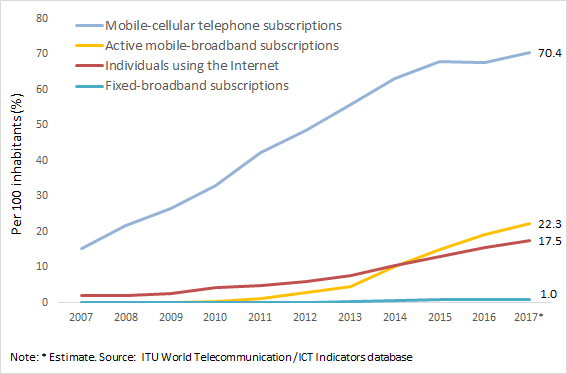
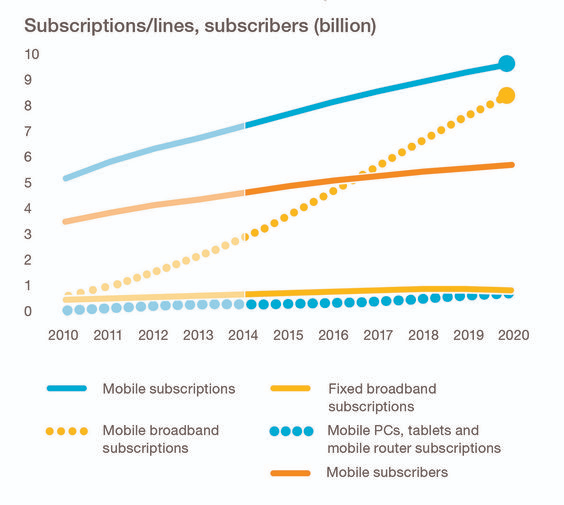
It also is clear that mobile internet access is the way most people get access to the internet, especially in lesser-developed countries. 


source: ITU


source: Ericsson  


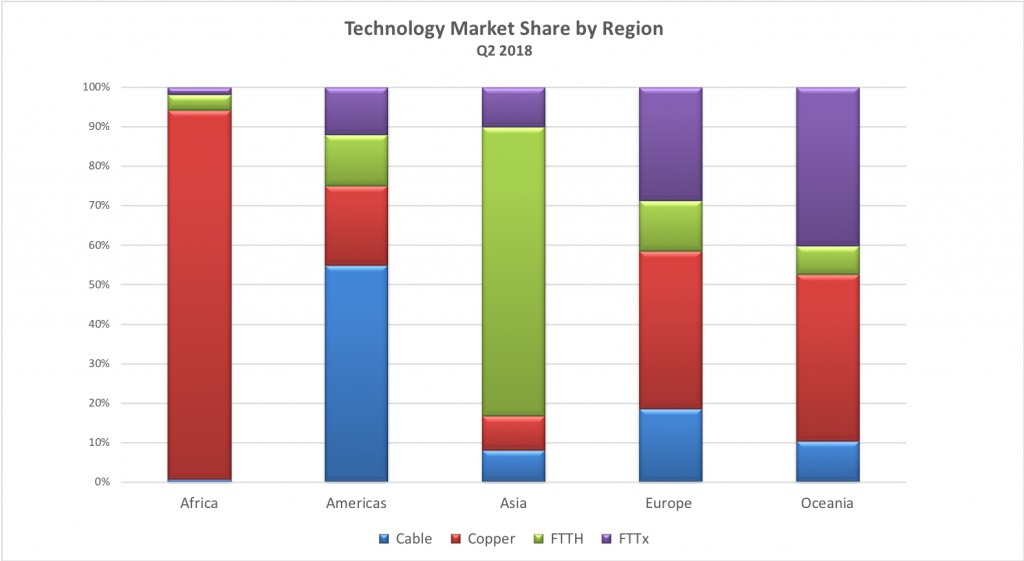
It might also be fair to say that niche access platforms represent a significant share of total fixed network subscriptions and revenue. But such niche platforms can be significant in some markets, in some segments of the market and geographies. They are perhaps even more significant for some internet service providers in some geographies. 


source: Point Topic


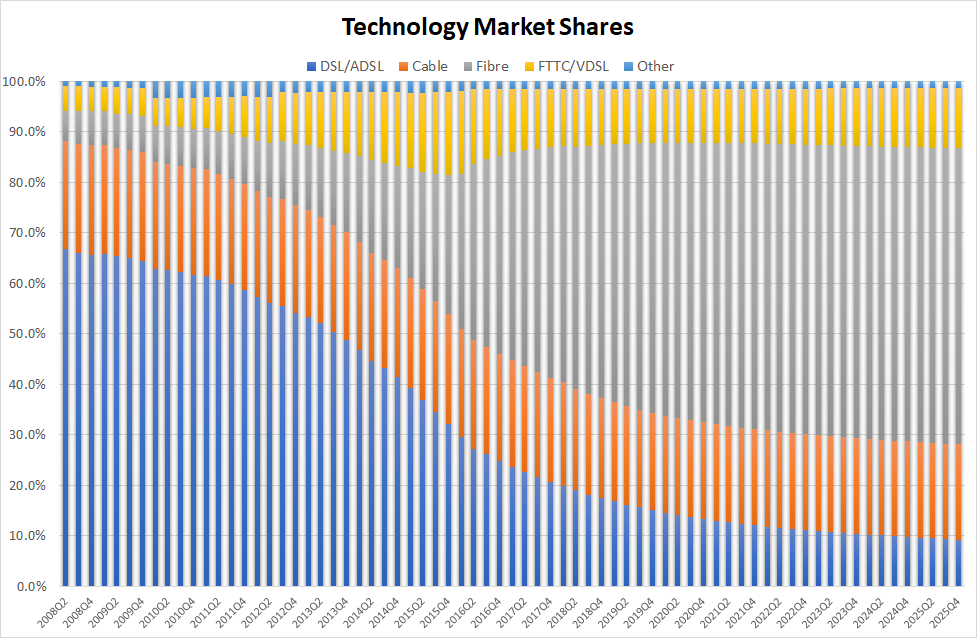
Even if fiber to the home represents the future, some observers still predict that significant shares of the market will be served by HFC and some form of fiber-deep with copper access media. 


source: Point Topic 


Virtually all forecasts suggest that satellite broadband (geosynchronous and low earth orbit) will have installed base share in the low single digits. Expectations for fixed wireless might range a bit higher, in the five-percent range, perhaps, as a share of global fixed network subscriptions. 


For as much as 80 percent of global users, mobile internet access will be the mainstay, and for many of those users,  the only way the internet is accessed. Keep in mind that access platform market share will vary from country to country. 


The total number of fixed wireless subscriptions arguably is less important than the financial upside fixed wireless might have for some particular competitors. Assume that a particular competitor cannot--for reasons of capital, for example, afford to build FTTH facilities too broadly.


Or assume a particular contestant has to build a 5G mobile network that could be leveraged to provide fixed wireless. In other cases, an ISP might use fixed wireless as an “edge out” strategy around its fixed network holdings. 


The point is that fixed wireless can be an incrementally-relevant access platform, even when the dominant network is FTTH, digital subscriber line, hybrid fiber coax or a 5G mobility network. Such alternatives rarely, if ever, make sense for a satellite provider, whose mainstay remains highly-isolated locations or “moving vehicle” use cases (ships, trucks, autos). 


That might remain true even when typical fixed wireless speeds are less than available on HFC or FTTH platforms. Not every customer actually will buy the top-speed offer from an ISP. Fixed wireless might well be relevant for 20 percent of the market that is willing to buy lower-speed services at lower prices. 


Is Sora an "iPhone Moment?"

Sora is OpenAI’s new cutting-edge and possibly disruptive AI model that can generate realistic videos based on textual descriptions.  Perhap...