Friday, January 15, 2021

5G "Plus" Might be the Best Way to Evaluate Upside from 5G

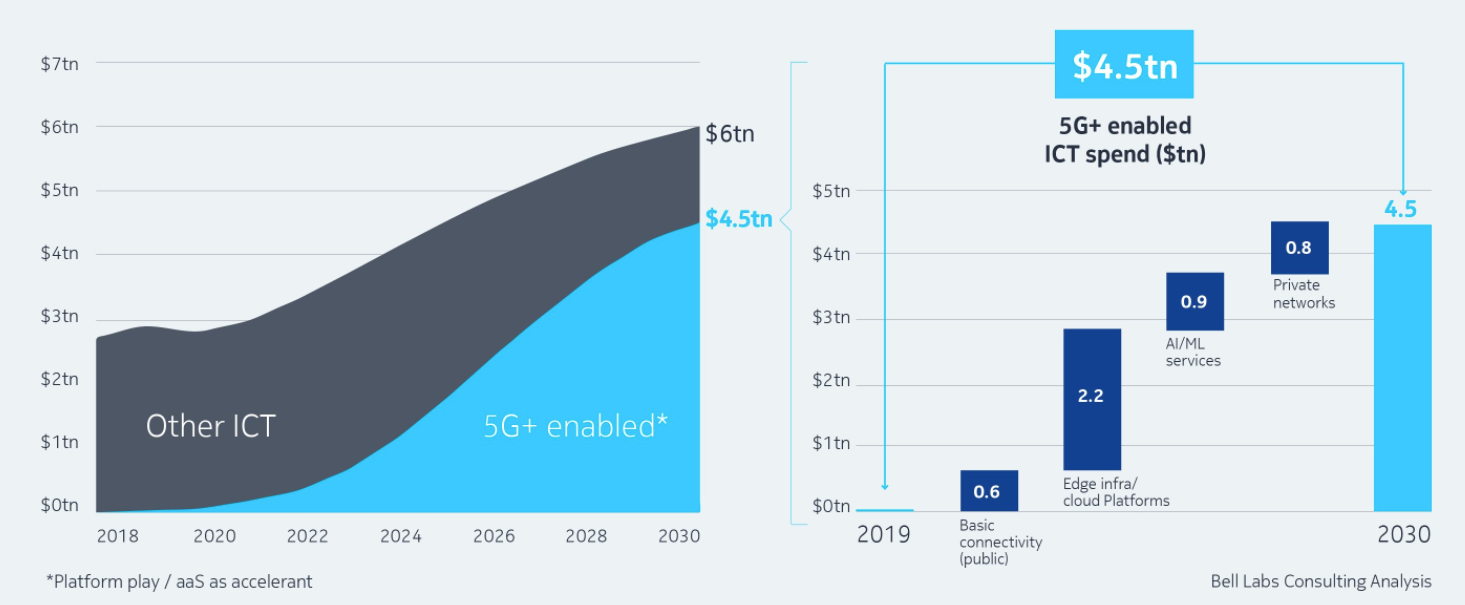
5G+ is as good a way as any to assess the value 5G might produce. Bell Labs Consulting uses “5G+” as an umbrella term for a broad ecosystem of technologies that will unlock the future economic potential of industry.


And that makes sense for observers who argue that 5G is but part of a complex of emerging technologies including edge cloud infrastructure, private networks, augmented intelligence, automation, sensing and robotics, as well as platform and as-a-service business models that will have a collective impact. 


As a corollary, assessment of the economic value of that complex of technologies produces big numbers, as would be the case if one tried to quantify the impact of value created by all uses of computing or electricity in a modern economy. 


But even infrastructure spending can reach lofty levels when looking at the full complex of 5G+ technologies. 


Bell Labs Consulting estimates spending of up to $4.5 trillion in 2030 for the 5G+ enablers and about $8 trillion in new economic value in 2030 from the 5G+ complex. 


source: Nokia Bell Labs Consulting 


Perhaps most significantly, Bell Labs Consulting notes that early 5G+ adopters report the number-one and number-two benefits as being “incremental revenue growth” and the “ability to enter new or adjacent markets.


For those who believe long-term connectivity provider strategy has to be based on movement into new roles in the internet ecosystem and value chain, those are suggestive findings. Indeed, though incremental revenue growth always is important, the enabling of moves into adjacent markets might be the most important. 


The caveat might be that it will remain hard to quantify the various contributions of 5G+ capabilities. It might also be argued that 5G is so new that it is likely other parts of the technology complex--such as computing as a service--have been the actual value drivers and enablers, not 5G connectivity as such.


Thursday, January 14, 2021

More Uncertainty Than Typical as 5G Rolls Out

Some possible fluidity is possible in the mobile operator business in the wake of the Covid-19 pandemic and the cost of 5G networks. There are relatively prosaic unknowns, but also some bigger challenges related to strategy. 


Network architects face a greater degree of uncertainty around usage patterns. After the pandemic, will downtown area traffic return to former levels, or remain permanently lower? Will more capacity be needed in residential areas? Will millimeter wave support be as important in high-traffic areas right away, or will the reinforcement demand now be more gradual?


Conversely, will residential tower sites need to be reinforced if more people use their mobile devices for group video calling, at a higher rate than originally forecast before the pandemic? Some permanent increase in demand seems most likely, but how much of an increase will be seen near term, as work and education patterns resume a pre-pandemic form?


Will network virtualization prove its value as traffic patterns assume new forms, or continue changing?


And if 4G performance gets better, even as 5G launches and also gets better, how will consumers evaluate the experiences? Where mobile operators require more-expensive 5G plans, will that be an inhibitor? Will more churn happen if rivals do not charge a premium? 


Aside from the immediate post-pandemic issues, longer-term challenges also will have to be met, ranging from debt reduction to new product development to earning a return commensurate with higher spending to acquire new 5G spectrum. 


As a practical matter, capital invested to acquire spectrum and build the network cannot be spent to acquire or build new revenue-generating assets and create new lines of business. As a practical matter, will mobile operator efforts to create new lines of business slow down as capital has to be deployed into the core connectivity function?


At a high level, new capex to boost capacity or performance is bumping up against relatively low financial returns from doing so. 


In many markets, subscription growth is quite low, as nearly everybody who wants to use a mobile phone already does so. For many customers, 4G might meet their needs, making an upgrade to 5G more challenging.


Since competition has not diminished and markets are saturated, gross revenues and profit margins from legacy connectivity services are falling. 


That implies a few key challenges: optimizing the cost of the legacy business and finding additional new and substantially-sized new revenue streams. 


So what if much invested 5G capital produces modest revenue upside, initially? And what if new revenue sources do develop over time, but are of relatively low magnitudes? At a high level, if a typical mobile operator must expect about five percent erosion of revenue every year from legacy services, new sources must generate five percent a year, simply to prevent revenues from falling, to say nothing of growth. 


What happens to consumer behavior after the pandemic ends is one set of issues. How to reap a reasonable return from 5G investments is the bigger concern.


C-Band Spectrum: "You Pays Your Money and You Takes Your Choice"

Most of the worry some have had about investments in 5G networks deals with the business model, and not the least of the worries is that 5G networks will prove too expensive. The original fear was that infrastructure capital investment would be too high. That actually has not proven to be a huge barrier.


But some worry more about the cost of investments in huge amounts of new spectrum, especially if licenses are not essentially perpetual, meaning operators are renting their spectrum, and have to keep buying it, over and over again. 


It would not be the first time, as the cost of 3G licenses nearly bankrupted many of the leading European mobile operators. Since then, operator bidding on spectrum has been decidedly more rational or careful. But spending for the U.S. C-band spectrum is causing some new concern. 


The issue is not so much the price per MHz-POP. C-band prices--arguably foundational for U.S. 5G, are not yet at AWS-3 prices, considered foundational for 4G, for example. The C-band auction offers the largest amount of licensed mobile spectrum ever made available in one process. So the total amount bid will be large as well. 


The AWS-3 auction made available a total of 65 MHz of capacity. The C-band auction is offering 280 MHz of capacity, about four times as much as the AWS-3 auction. All other things being equal--the AWS-3 auction being central for U.S. 4G and C-band being central for U.S. 5G--the total amount of assets at stake in the C-band auction is four times the amount of AWS-3 assets. 


So one would expect, based simply on volume, to see C-band proceeds four times greater than was bid for AWS-3. That auction raised $45 billion. So four times more spectrum, with the same strategic value--would in principle not be out of line in costing $180 billion. 


Nobody believes that will happen. In other words, on a cost per MHz basis, C-band prices should, on average, be less expensive than was the AWS-3 4G spectrum. But buyers will be acquiring four times the amount of real estate, so gross value will be higher. 


It is a bit like buying beachfront property in the same location, but one purchase is for a lot four times the size of the other. All other things being equal, you’d expect the larger lot to cost four times the smaller lot. And C-band and mid-band spectrum are beachfront properties for 5G. 


Still, one might still have to consider the financial outlay for buying the larger lot, if it is deemed necessary for some reason. 


At least in principle, the C-band outlay for spectrum licenses is virtually existential, for AT&T and Verizon, who lag T-Mobile in owning licenses for crucial mid-band 5G spectrum. One might have said the same for AWS-3 spectrum to support 4G. 


The C-band assets might be highly important--though perhaps not a matter of survival--for other participants who need to augment mid-band holdings to build out their own facilities. 


The point is that there are arguments for and against the notion that 5G is “too expensive” and will break the mobile business model. Radio transmission infrastructure will not be the crushing problem many feared, though some operators will find the optical backhaul more challenging than some others. 


Spectrum acquisition is likely going to be the bigger issue, simply because mobile networks are constantly called upon to deliver so much more capacity over time. Smaller cells really do help, but new spectrum--and lots of it--now are essential. 


The business models will have to be tweaked, if larger amounts of capital must be deployed to acquire spectrum. That means less spending on other inputs, all things being equal. “You pays your money and you takes your choice,” the old aphorism states. 


The phrase is said to have been used for the first time in 1846. The connotation was essentially that the buyer of an asset makes the choices about how the asset is used. The modern connotation is a bit different, implying one must live with the consequences of the choice. 


Either way, the notion is that buyers make choices and then must live with the consequences of the choices. Where it comes to 5G, all the facilities-based mobile operators “need” mid-band spectrum. Many other choices will come with the requirement to invest capital to acquire such spectrum.

Wednesday, January 13, 2021

What are We Getting Wrong about 5G?

What are we getting wrong about 5G? Are we unclear about the value of other advanced technologies in the connectivity business and internet ecosystem? An experienced panel of industry analysts will tackle those subjects head on at the PTC'21 conference closing session on Jan. 20, 2021. You can register here. 

Among the big topics certain to be discussed: is the global industry investing too much on 5G, without hope of return? How much capital can service providers really afford to invest in a mature business?


How big is the threat of service provider displacement from private 4G or 5G networks? What is the value proposition that might drive substantial numbers of enterprises to do so? 


Is there really serious hope of 5G revenue growth, or must we look at 5G capital investment as maintenance spending? 


As Matt Bramson, Cloud Strategy Solutions founder puts it: “what are the implications of these new technologies? What do you need to know when a board member asks you about them?”


When do you need to move; start investing; and why? What chasm has to be crossed?


image1

Matt Bramson


Panelist Benoit Felten, Diffraction Analysis founder asks: “What 5G dangers lie ahead for regulators? What are they not seeing?” What are the possible impacts on market structures, need for consolidation or even ownership? And is there really significant revenue upside from new services?


image1

BenoƮt Felten


In a mature business, how much capital can service providers actually afford to invest, asks Dan Hays, Strategy& principal. “What are the business and financial implications of huge amounts of capital invested in some 5G auctions?” 


“Can you afford to invest so much if there is no top-line growth?” Hays will discuss. 


image1

Daniel Hays


Do big mobile service providers such as Verizon actually have a choice to invest heavily in mid-band mobile spectrum? Mark Lutkowitz, FibeReality principal, is not so sure. It fundamentally is an existential question. “Do you want to stay in business or not?”


What are the longer term implications of an inability to wring more revenue from such capital investments? Can the industry actually support multiple facilities-based competitors? 


Some of us remember roughly similar questions and answers asked about fiber to the home investments as well, back before the turn of the 21st century. 


image1

Mark Lutkowitz


One CEO, asked about the magnitude of FTTH investments, said the upside was “we get to keep our business.” Note: the argument was not “we will make more top-line revenue.” The justification was existential: “we get to stay in business.”


Is that why service providers are looking at as they invest huge sums for mid-band spectrum? 


The large U.S. telcos invest about $10 billion in capex every year, Hays notes. The U.S. C-band auctions already exceed $80 billion in commitments. How big a burden might that be, even if the spectrum is essentially existential? After 82 rounds, about $81 billion has been committed by bidders in the C-band auction. 


In addition to those sums, roughly 16 percent to 22 percent more has to be added as the cost of clearing existing licensed users from the bands. In other words, existing bidders already are pledging between $94 billion and $99 billion for C-band spectrum, and the auction is not yet over. 


Many would argue that acquiring a trove of mid-band spectrum is existential for Verizon and AT&T, in the same way that fiber to the home was existential for some telcos. But that is quite a different rationale from arguing that the investments will drive top-line revenue, substantially reduce operating costs, significantly reduce churn or elevate marketing effectiveness. 


Those are among the weighty issues the panel will discuss.


How Much Service Provider IoT Revenue by 2025?

Global internet of things revenues will be about $906 billion in 2025, with connectivity accounting for less than five percent of total revenues, according to GSMA Intelligence. Mobile networks will earn less than that, as other networks will capture some connectivity share. 


Applications, platforms and services are due to account for 67 percent of the overall market, while professional services will make up the remaining 28 percent.

source: GSMA 


This might be a strategic problem for observers hoping that the internet of things might become a big enough revenue source to replace other lost revenues. At least near term, it does not appear IoT connectivity represents enough revenue volume to matter. 


One might make the same argument about edge computing revenues earned directly by connectivity providers. By 2025, various estimates of connectivity provider edge computing revenue put the global total between $1 billion and $4 billion.


Again, that is helpful, but does not move the revenue needle much, if one assumes the global industry has to generate about $400 billion in new revenue over the next 10 years. 


Very few connectivity services have had the ability to drive core revenues. Fixed network voice, internet access and entertainment video, plus mobile subscriptions, voice and internet access have been the staples.


So far, none of the coming new services--IoT, edge computing, network slicing--seem to have upside big enough to affect the $400 billion revenue target. 


Almost by definition, then, it will require something else for the global connectivity industry to replace $400 billion in existing revenue it will lose over the next 10 years. 


The disquieting possibility exists that the industry might not be able to do so, and will simply shrink. That would be a disruptive shock to an industry that has grown for over a century.


Tuesday, January 12, 2021

C-Band Prices After Round 80 Average 94 cents per MHz-POP

Average overall prices for C-band spectrum after round 80 are $0.94 per MHz-POP (about $1.09 including the additional costs of clearing existing users from the spectrum). But prices in local markets can vary significantly from the national average. 


source: Sasha Javid 


Some markets already have hit prices above $2.80 per MHz-POP. 


Hans Vestberg, Verizon CEO, on 5G Use Cases

Is Sora an "iPhone Moment?"

Sora is OpenAI’s new cutting-edge and possibly disruptive AI model that can generate realistic videos based on textual descriptions.  Perhap...