Friday, July 5, 2019

Japan Mobile Operator Mid-Band Spectrum Holdings

Here’s a look at mid-band spectrum held by the leading mobile operators in Japan, according to Gaku Nakazato of Japan’s Ministry of Internal Affairs and Communications. As you might guess, KDDI and NTT have the largest allocations. NTT and KDDI have the largest subscriber shares, and therefore arguably require the most spectrum. 


Yes, 5G is Overhyped. So What?

Yes, 5G is overhyped. Virtually all new important technologies are overhyped, at some point. But 5G will be similar to earlier digital generations in some ways, novel and possibly transformational in other ways. 

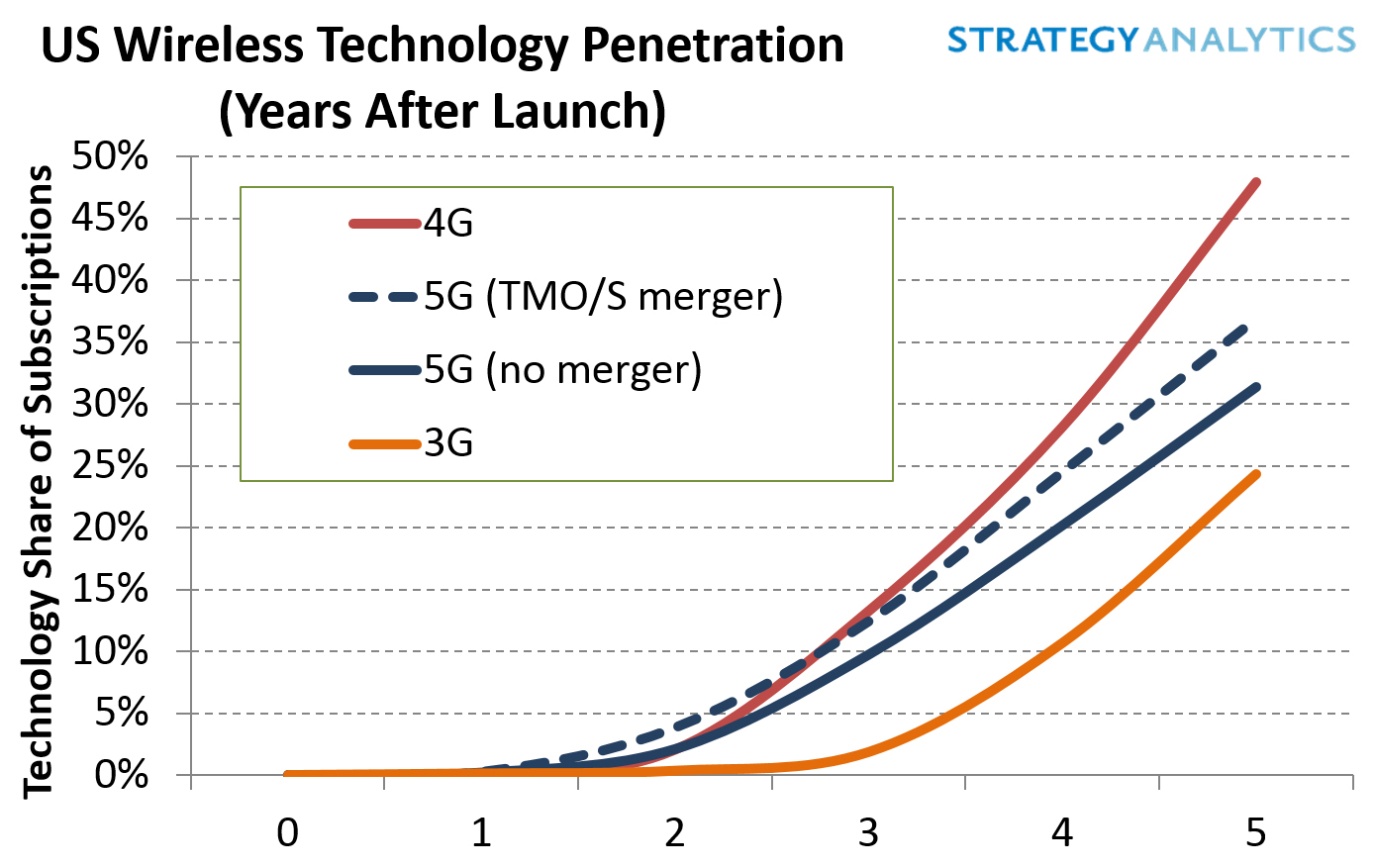
The continuities are many. Adoption will occur in a range resembling earlier digital generations, replacing 4G sometime after five years of commercial promotion. New use cases will emerge, as every mobile generation has had a different set of lead apps and end-user values. 

The first digital generation (2G) brought text messaging. 3G brought mobile internet and mobile email. 4G brought mobile video. The 5G era is likely to produce similar distinctive use cases not possible on earlier platforms.


But 5G might also be transformational in some ways. The 3G and 4G eras saw mobile devices become the most-used consumer computing platform, changing consumer app opportunities and business models. 

Some of us believe 5G will be the first platform where incremental new use cases and revenue are likely to develop from enterprise applications, not consumer apps or use cases. Not since the first generation has that been true. 

But 5G should be the first mobile generation where virtually all the expected enterprise new use cases will involve machines communicating with machines, not people communicating with people or people communicating with machines. That is not hype, but a shift of the primary purpose of much of mobile and wireless communications. 


Wednesday, July 3, 2019

Vodafone UK 5G Will Feature Plans Differentiated by Speed

The 5G launch by Vodafone UK contains at least a couple of novel developments. For starters, Vodafone’s 5G will come in speed tiers. Vodafone Unlimited Max features unlimited mobile data usage at speeds as fast as the device and the network will allow. 

Vodafone Unlimited offers speeds of up to 10 Mbps. Vodafone Unlimited Lite supports speeds up to 2 Mbps.


For customers accustomed to buying their data usage as a variable cost, the new Vodafone approach shifts offer differentiation to speed, much as fixed network offers do. Pricing is differentiated by maximum downstream speed, not usage buckets. 

The other development is that usage is unlimited for all plans, removing the usage allowance as the key difference between plans. 

Vodafone has not specifically said how it is creating the tiers, but network slicing network slicing is one conceivable approach, where customers are different plans essentially use different network slices, some of us would guess. 


Latest German 5G Spectrum Auction: Prices in Line with 4G

Germany’s recently-completed 5G spectrum auction of mid-band spectrum seems to have produced prices about what one would expect: a bit higher than for many other recent mid-band spectrum auctions in Europe, but far below 3G prices, and arguably about the same cost as 4G spectrum. 

That might come as quite a relief for some who had feared high prices. But supply and demand does matter: increase supply and prices fall; decrease supply and prices climb. The same happens with demand. It does not matter whether the commodity is mobile spectrum or college tuition.

If ways to multiply the use of any discrete amount of spectrum multiply; if ways to use fair amounts of spectrum without a license become possible; if the physical supply of spectrum grows substantially and the cost of using small cell architectures grows, we should expect
lower spectrum prices, over time. 

To make an analogy, spectrum is beachfront property, but we are making more beach. Over the past few years, some have worried about the cost of 5G spectrum, although spectrum prices are dropping, generally speaking, in part because there is a huge increase in supply, and because mobile operators must now more carefully weigh the cost of new spectrum against expected financial return.  

Also, firm strategies now vary. Some firms believe use of unlicensed spectrum will be more important. Others substitute small cells for additional spectrum. Some need additional spectrum more urgently than others, based on present holdings.

On the demand front, if it becomes clear that revenue per bit continues to decrease, then the ability to wring revenue out of any fixed amount of spectrum decreases as well.

Mobile and fixed network internet data consumption is unlike that of voice in one key respect: revenue and usage are not linear. In the past, consumer and business usage tended to be priced “by the minute of use.” Use more; pay more.

Internet access tends to be priced less linearly: either a fixed price for unlimited usage; or a fixed price for some amount of usage. In the former case, the correlation between usage and revenue is quite imprecise; in the latter case is a statistical matter. Customers buy the right to use a certain amount of access, but the actual revenue per byte for the supplier depends on actual behavior.

Demand also is affected by the fact that early adopters tend to spend more than later adopters. That applies to whole regions and countries as well as between regions and countries. Later adopters are lighter users, either for behavioral reasons (they use the internet less) or for cost reasons (they have less money to spend on internet access).

The big takeaway is that we should expect spectrum prices to fall, as demand increases dramatically. 

Germany 3.6-GHz Band Spectrum Prices
Operator
Amount (MHz)
Fee (€ '000)
Fee per MHz pop ($)
1&1 Drillisch
50
735,190
0.20
Telefónica
70
1,043,728
0.20
Deutsche Telekom
90
1,323,423
0.20
Vodafone
90
1,073,188
0.16
Total
300
4,175,529
0.19
Source: Bundesnetzagentur

Germany 2-GHz Band Auction Spectrum Prices
Operator
Amount (MHz)
Fee (€ '000)
Fee per MHz pop ($)
1&1 Drillisch
20
334,997
0.23
Telefónica
20
381,104
0.26
Deutsche Telekom
40
851,520
0.29
Vodafone
40
806,501
0.28
Total
120
2,374,122
0.27
Source: Bundesnetzagentur

Germany Finishes 5G Spectrum Auction: Supply and Demand Mattered

The government of Germany has completed an auction of 5G spectrum in the 3.6-GHz and 2-GHz bands, and prices per potential customer (price per MegaHertz POP), while not as high as in the Italian auction, are higher than prices in other countries that have recently auctioned mid-band 5G spectrum. 

Some critics argue a restriction on supply drove prices higher.

Still, spectrum prices seem to be falling, in large part because of a vast expansion of supply.
Millimeter wave spectrum for 5G represents so much more new spectrum that per-unit prices have been dropping. Other ways of wringing more value out of any amount of spectrum also act to increase virtual supply. 

Willingness to spend also is shaped by perceived scarcity: what any bidder has, needs and wants, compared to the resources available to purchase. 

And scarcity is at least in part a decision by regulators. Minimum prices can be set at high levels, for example, as typically has been the case in India. 

High spectrum prices have been a problem in the global telecom industry, nearly bankrupting some major service providers who overpaid for 3G spectrum. That has been a rather frequent problem in India, for example. 

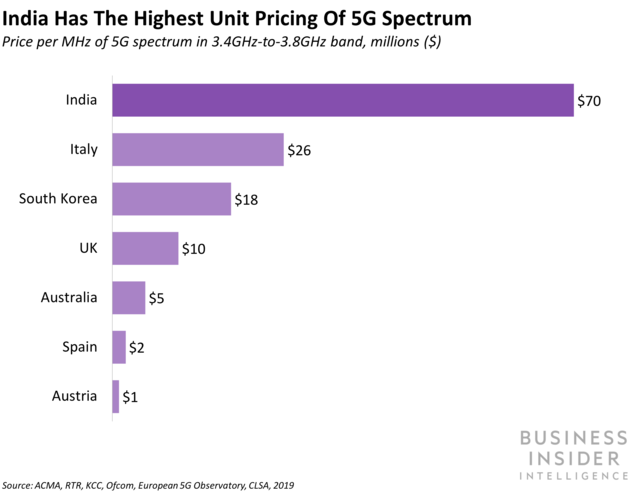
It looks like high prices still are an issue for India. India has the highest unit pricing of 5G spectrum in the 3.4GHz-to-3.8GHz band, for example. 

Indian operators might have to pay close to four times more than South Korean operators for 100 MHz of spectrum. 

As always, there are conflicting interests. Government officials see spectrum sales as an important revenue source. For mobile operators it is a necessary cost of doing business.

The Indian government expects to raise as much as 5.83 trillion rupees ($83.8 billion) from the 5G spectrum sale. That is way more than the $48 billion spent by all operators on spectrum since 2010.

Aggressive new competitors seem to have the result you would expect in any spectrum auction: prices are driven higher. That was the case in Italy, for example, where prices were in the 40 cents per MHz Pop range. 


Monday, July 1, 2019

High 5G Spectrum Prices an Issue for India Mobile

High spectrum prices have been a problem in the global telecom industry, nearly bankrupting some major service providers who overpaid for 3G spectrum. That has been a rather frequent problem in India, for example. 

It looks like high prices still are an issue for India. India has the highest unit pricing of 5G spectrum in the 3.4GHz-to-3.8GHz band, for example. 

Indian operators might have to pay close to four times more than South Korean operators for 100MHz of spectrum. 

As always, there are conflicting interests. Government officials see spectrum sales as an important revenue source. For mobile operators it is a necessary cost of doing business.

The Indian government expects to raise as much as 5.83 trillion rupees ($83.8 billion) from the 5G spectrum sale. That is way more than the $48 billion spent by all operators on spectrum since 2010.


2019 Should be the Peak Year for 4G Device Sales

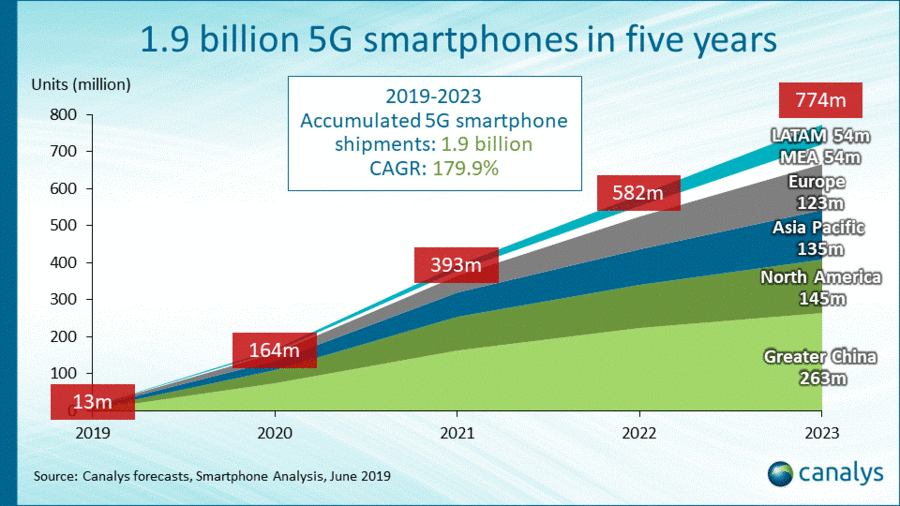
This year looks to be the peak year for sales of 4G phones, as well as the start of the sales cycle for 5G devices, according to Canalys projections. 


Is Sora an "iPhone Moment?"

Sora is OpenAI’s new cutting-edge and possibly disruptive AI model that can generate realistic videos based on textual descriptions.  Perhap...