Monday, November 5, 2018

5G Revenue: How Big, What Does it Mean?

Service provider revenues from 5G connections will approach $300 billion by 2025, rising from $894 million in 2019, a new study from Juniper Research predicts. That also implies a growth rate of about 163 percent over the first six years.  

If correct, then 5G service revenues would reach 38 percent of total operator billed revenues by 2025.

It always is difficult, though, to make sense of such forecasts, in large part because revenue earned by the next generation platform tends to displace revenue earned from existing platform.


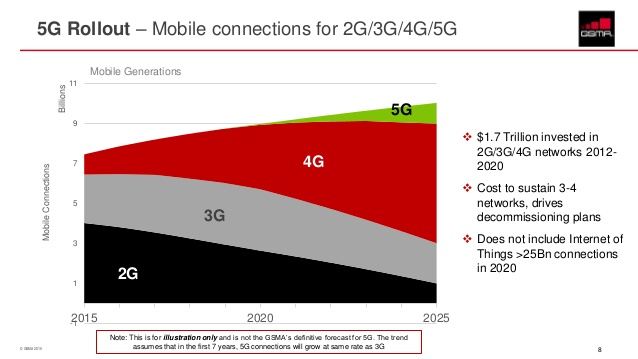
In 2025, the 1.5 billion 5G connections will be 14 percent of total cellular connections in the same year, Juniper Research suggests.

Sunday, November 4, 2018

Most U.S. Consumers Might Buy Advanced LTE, Not 5G, Early On

For most consumer users, the primary benefit of 5G deployment is going to be that 4G gets more attractive. Very few consumer users will benefit from the ultra-low-latency features of standards-based 5G, and while the headline speeds for mobile 5G will have the same marketing value as gigabit fixed network internet access, virtually no consumer apps require that much speed.

As a practical matter, in 2019, most consumers will have to replace handsets to take advantage of several advancements in 4G performance, or buy new devices capable of 5G, or get devices that support all the changes.

On AT&T’s network, for example, several paths to better performance are coming: Citizens Broadband Radio Service (CBRS), licensed assisted access for LTE (LTE-LAA), 5G New Radio and 5G Evolution (LTE-Advanced).


Some of those advances actually help 4G run faster (up to 400 Mbps), and for many, if not most consumers, that will be the logical choice, if new devices must be purchased. The reason is greater handset choice and lower prices, as innovations such as “5G Evolution” are really extensions of 4G, as is LTE-LAA.

CBRS initially will run LTE protocols, but likely will require a 5G-capable device. However, if AT&T uses CBRS only to support its fixed wireless service, then the “device” initially will be a stand-alone internet access device, not a phone.

5G-NR uses the full 5G air interface and also requires new 5G-capable devices.

In principle, every facilities-based mobile service provider has access to those same tools, though a particular strategy might not require use of all of them. T-Mobile US now believes it can rely on its lower-band and mid-band spectrum rather than use millimeter waves to the same extent as Verizon and AT&T, for example.

The point is that in the interim period between advanced 4G and early 5G, consumers will have to make new handset choices under conditions where choice might be greater for advanced 4G than for 5G devices, and where the actual obtainable benefits for 5G are quite unclear.

That will make upgrade choices harder than in the transition from 3G to 4G. If you can recall, many who pondered upgrades to 4G in the early going did buy pucks or dongles useful only for internet access, and used because 4G access speeds were significantly faster than 3G. Only later were 4G phones purchased.

In the case of 4G and 5G, 4G speeds are increasing so significantly that 5G will offer few actual advantages, in terms of usable bandwidth. So decisions might be based on other elements of service.

In some cases, price plans and usage allowances for 5G fixed service might encourage some to weigh a shift from a cabled network to a wireless network for access. In perhaps a greater number of cases, users might upgrade to an advanced 4G service first, then wait a couple to a few years to upgrade to standards-based 5G.

But we might find that most consumers are mostly content to rely on advanced 4G for quite some time. If today’s “typical” LTE access speed ranges between 11 Mbps to 14 Mbps, then typical LTE-A might range between 30 Mbps and 40 Mbps.

For any single phone, that is likely to be enough to handle any application a typical person wants to use.
Saturday, November 3, 2018

Will 5G be a Substitute for Australia Fixed Line Services?

“Mobile broadband services may become more of a viable substitute for fixed broadband,” said Rod Sims, Australian Competition and Consumer Commission chair, speaking of the potential impact of 5G, though it is not hard to find skeptics who argue 5G is not a substitute for fixed network access.

Cost per bit has been one historic barrier to such substitution, as the cost of fixed network gigabytes of usage has been an order of magnitude lower than using mobile gigabytes.  

But all of the above is a likely outcome. In other words, there are likely to be use cases where 5G (fixed or mobile) actually is a substitute for fixed network access and also other scenarios where 5G is not a substitute.

Even in the 4G era, 15 percent to 20 percent of U.S. households have become mobile-only for internet access.

That might take the form of either fixed or mobile 5G. Telenor, for example, envisions using 5G to connect consumers where fiber to the home is not feasible. T-Mobile US likewise has argued fixed or mobile versions of 5G will be a full substitute for fixed network access.   

Much will hinge on the degree to which mobile suppliers can dramatically slash their cost to deliver bandwidth, allowing them to price their packages comparably to fixed network offers.

The Battle for Indoor Space

Indoor space has been a big coverage issue for mobile operators, and has created space for Wi-Fi to become a key part of access infrastructure. But some argue 5G will start to shift access back towards mobile networks. In the 3G era, users switched to Wi-Fi at times because it did not apply against their usage allowances, and in part because Wi-Fi tended to offer faster access than did the 3G network.

That changed in the 4G era, when Wi-Fi generally became slower than the mobile network.

In the 5G era, there is likely to be more use of the mobile network, in part because of spectrum aggregation. Tariffs and usage allowances also will make a difference.

In the 5G era, it is conceivable that Wi-Fi offload will happen less than it did in the 3G and 4G eras.


That might be aided by a number of other changes, beyond 5G usage allowances and tariffs. Indoor coverage by small cell might include access to virtual networks that offer consumers of business users network features not available on the Wi-Fi network, and enabled by network slicing, for example.

If, for example, network slicing is used to create differentiated speed tiers (gold, silver, bronze) plans, mobile customers will lose the advantage of their premium plans when switching to Wi-Fi.

If one assumes outdoor space will be the place where mobile coverage is most valuable, indoor space will remain a more-contested arena where access options will be more diverse, where third parties will have a greater role, where the ability to support private network features at the indoor edge will open up new possibilities for end users, mobile operators and third parties.

India's TRAI Recommends 43% Cut in Minimum Spectrum Prices for Big Spectrum Auction

India's Telecom Regulatory Authority of India (TRAI) has recommended a steep cut of 43 percent in the minimum prices for 700 MHz spectrum to be auctioned in the near future. That recommendation comes after no bidders emerged for such spectrum in 2016.

The recommendation, if approved, will lead to auctions representing as much as 8.3 GHz of new spectrum, including capacity at 700 MHz, 800 MHz, 1,800 MHz, 2,100 MHz, 2,300 MHz, 2,500 MHz and 3,300-3,600 MHz.

If the recommendations are accepted, mobile operators will face starting prices as much as 33 percent of the level set for 2G (1800 MHz) frequencies in 2012. But some believe minimum prices might have be adjusted lower again.

Spectrum prices in India in the past have been quite high by global standards. That has lead the Indian government to propose lower starting prices for spectrum to be auctioned in support of 4G and 5G operations in India. When the government attempted to auction 700-MHz spectrum in 2016, there were no bidders and the auction was cancelled.

Spectrum prices that were deemed way too high are the reason. The government’s minimum prices would have cost the mobile industry bidders a sum more than twice total annual industry revenues, and a minimum of 22 years worth of free cash flow, analysts at Coleago have noted.


And that is based strictly on the release of all spectrum at the minimum reserve price. Past auction prices moved far beyond the minimum prices.


Thursday, November 1, 2018

Will AT&T, Verizon Build Some of Their Own Cell Sites?

There are good reasons for predicting that tier-one service providers will have to reduce operating costs by a significant amount, some say as much as 33 percent by about 2025.

One might well argue that initiatives to virtualize networks, automate functions, reduce headcount and change capital investment profiles are parts of that effort. Tier-one carriers have sold their tower portfolios, in many cases, to reduce capital intensity and free up cash.

But such moves come at a cost, namely higher than desired rental costs.

“It is imperative to reduce operating costs,” said Nicola Palmer, Verizon Wireless chief network officer.

“We need more alternatives to the traditional tower leasing model with the large incumbents,” said Susan Johnson, AT&T SVP. “It’s not cost-effective or sustainable.”

So the investment in Tillman Infrastructure is specifically intended to create additional competition in the tower leasing market and therefore lead to lower prices.

What is not so clear is what role tier-one mobile service providers might take in building small cell infrastructure themselves, rather than hiring contractors. So far, there seems little appetite to do so. On the other hand, it always is possible that either AT&T or Verizon could conclude that for some small cell placements, it is cost effectively to build rather than buy.


Also, there are reasons for suggesting mobile service providers--even as 5G is launched--really cannot boost long-term capital investment in networks beyond present levels.  

There are many reasons, ranging from declining legacy revenues to a need to invest in growth initiatives outside the connectivity core. Pressure on gross revenues and profit margins also are key.

So small cell rentals might still make sense, compared to renting such sites from third parties. Still, the drive to reduce opex and capex could lead to direct efforts in the small cell area.

AT&T Has 24 Million Connected Car Accounts

Though it gets relatively little attention, AT&T in the 3rd quarter of 2018 added more than two million connected car accounts, reaching a total of nearly 24 million with connectivity on AT&T’s  network.

AT&T says it has added more than a million connected cars in each of the past 14 consecutive quarters.  

AT&T says it also connects more than three million fleet vehicles as of the 3rd quarter of 2018.

source: AT&T

Is Sora an "iPhone Moment?"

Sora is OpenAI’s new cutting-edge and possibly disruptive AI model that can generate realistic videos based on textual descriptions.  Perhap...