Monday, August 13, 2018

Why 5G Might Not Change Consumer Mobile Spending Very Much

With one key caveat--that internet of things revenues generated by services sold to enterprises are quite another matter--trends in the U.K. telecom business between 2012 and 2017 suggest how minimal actual incremental consumer segment 5G revenue might be.

In 2012, “average” U.K. household spending on telecom services was about £86 per month, on a consumer price index adjusted basis. By 2017 household spending had climbed to about £87 per month.

In other words, despite growth of smartphone, mobile data and faster internet access speeds, household spend was nearly flat, while industry revenue fell about 1.7 percent per year.

That might suggest a trend you would likely recognize. People will only spend so much on communication services per month. They make substitutions as some products get used more, others less. But total spend tends to be very consistent.


In the U.S. market, one saw the same trend between 1990 and 2008: households spent about the same percentage of disposable income, year after year, and slightly less, in all developed nations, between 2008 and 2012, according to International Telecommunications Union data.


If you think about it, that stands to reason. People tend to spend about the same percentage of income every year on most categories of discretionary products.

Value of Infrastructure Sharing Hinges on Your Assumptions about Business Model

If asked, most observers would likely guess that 5G, with its many new small cells, will cost more than 4G did. The only key differences might be the magnitude of the increases.

That might not be the case. Morgan Stanley estimates that the industry will spend $225 billion on 5G between 2019 and 2025, with the biggest outlays coming later. But the global mobile industry “spent about $275 billion on 4G,” analysts at Morgan Stanley have said.  In other words, the industry will likely spend less on 5G than it spent on 4G, according to analysts at Morgan Stanley.

That might seem counterintuitive.

Korea Telecom, for example,  estimates that 5G networks need four times the amount of cell sites for any given area compared to 4G networks, with a corresponding increase in the amount of backhaul to those sites. So the Korean Ministry of Information therefore has said that SK Telecom, KT Corp, LG U+ and SK Broadband can share the cost of building a 5G network, saving an estimated $1 billion in capital and operating expenditures over 10 years.

Xona Partners estimates that 5G will require six times the investment to deliver comparable coverage to existing 4G/LTE networks, in part because so many more cells will be necessary, and because some suburban small cells will need at least 32 accounts to sustain profitability .

But there are other concerns possibly at work, in addition to capex expectations. Time to market should be faster, in a four-provider scenario, than if each provider separately built its own radio access network and backhaul.

Also, such sharing should reduce upfront costs enough to compensate for a possibly-minimal increase in revenues. The Korean mobile market is characterized by relatively low retail prices, so capex cost control matters.

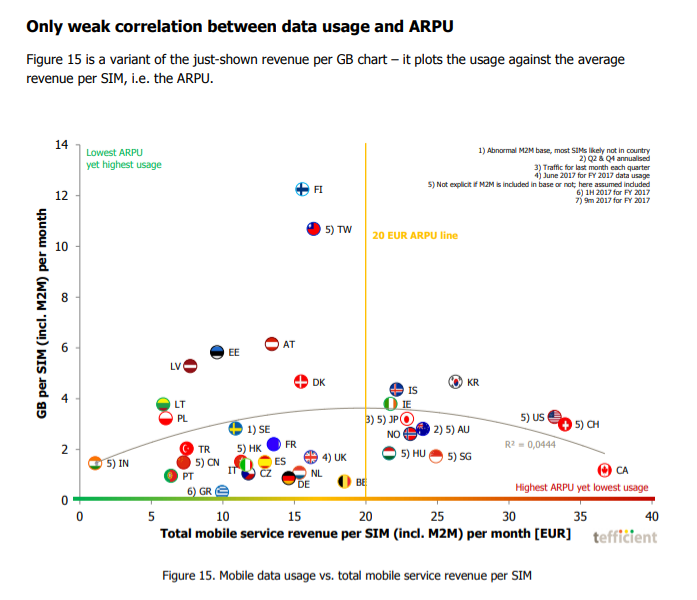
Capex concern, though it exists, might not have the same intensity in other markets. U.S., Swiss and Canadian service providers, for example, have gross revenue per account levels that are far above those in Korea and many other countries. Service providers in such countries might worry less about 5G capex, in relation to expected revenue upside, in part because relative revenue per Gbyte is more robust.


The point is that costs to deploy 5G might be less than 4G, not greater than 4G. Incentives to build 5G also will be higher in more-mature 4G markets, much less so in markets where 4G has been introduced relatively recently. On that score, the United States is among the most-mature 4G markets globally, so the network has been amortized.

The other issue is operator expectations about where revenue upside and profit might lie. With differentiation shifting away from the expensive radio infrastructure to the to the software and service layer, some service providers might conclude that spending as little as possible on the physical layer infrastructure makes sense.

The strongest such case, in a continental-sized market such as the United States or Australia, is to be found in rural areas, where a payback on facilities is nil to non-existent. Service providers might also be relatively indifferent in many cell areas where traffic is relatively light.

But U.S. service providers are unlikely to want to rely on others for infrastructure in the 10 percent to 15 percent of their networks that handle most traffic.

So space division is one reason some U.S. mobile service providers might be reluctant to embrace widespread infrastructure sharing (towers, yes; other facilities in rural areas, yes; large venues, maybe; busiest 10 percent of sites, probably not). There are places where sharing does not harm the business case; other places where it might; and some places where most of the actual customer interactions occur.

Sunday, August 12, 2018

In Australia, Fixed Network Bypass Opportunity is Growing

For mobile operators in Australia and elsewhere, “bypass is the ultimate prize,” allowing mobile operators to take market share away from fixed network operators. And mobile substitution for the fixed network might take on huge proportions in Australia, analysts at S&P Global argue.

Australia's National Broadband Network might be  reshaping the competitive landscape in unexpected ways. Designed in large part to eliminate differences between service levels in rural and urban areas, as well as to break the Telstra dominance of fixed network services, the NBN arguably is succeeding. Many observers are less sure about the business model, as high wholesale costs might be retarding adoption.

On the other hand, that presents an opportunity for mobile operators not reliant on the NBN and its “high access charges, opaque service offerings, and inferior technology mix,” an analysis by S&P Global argues. In other words, the business advantage of mobile substitution is helped by NBN challenges.

Among those challenges are “a retrograde technology mix, political involvement, rollout miscalculations, cross-subsidization of unprofitable regions, as well as a convoluted pricing structure that puts the onus on RSPs to adequately provision bandwidth,” says S&P Global. “It is a contrived market shaped by heavy government intervention” and “the economics of reselling NBN broadband services are extremely challenging.”

Almost ironically, then, mobile substitution will be that much more prevalent. “Australia will likely be a global leader in mobile broadband adoption,” as a result, S&P says.

In part, that is because the design of all networks is converging: the idea being to get access traffic moved as quickly as possible to the optical backbone.

“Taken to its logical conclusion, fixed and mobile networks might only be distinguishable by the "last 100 meters," S&P argues. “Both will require fiber deep into the network.

In fact, assuming a small cell network has access to lots of unlicensed spectrum and millimeter wave assets, the actual architecture resembles a fixed network access architecture: fiber close to the customer and then final connection using some non-fiber means.

Even fiber-to-home networks convert signals from optical to electrical, with actual delivery using copper media (to a Wi-Fi router, perhaps), with direct links using wireless.

Fiber-to-curb and hybrid fiber coax networks are more directly analogous, terminating the optical network someplace close to the end user, and then using some other media (copper cabling, copper wire, fixed wireless or mobile access) for final delivery.

So as small cell networks are deployed, using either fixed wireless or mobile access, they will resemble HFC and FTTH very closely.

In all cases, the design objective is to get traffic off the access network (wired or wireless) and onto the optical backbone as quickly as possible.

Image result for small cell network radius


Saturday, August 11, 2018

If 5G Performance is So Good, Where is the Demand for Network Slices?

What is the business value of a 5G network slice, the ability to create an end-to-end virtual network with features optimized to fit particular use cases on a number of dimensions? To be sure, mobile operators are optimistic. But the very flexibility and quality of virtualized networks supporting 5G might mean potential customers have less incentive to buy network slices.

As you would guess, mobile operators see lots of upside, allowing them to create new products and services to sell to business customers. It is possible a single enterprise might require multiple custom networks. A vehicle may simultaneously require a high bandwidth slice for infotainment and an ultra-reliable slice for telemetry and assisted driving, for example.

On the other hand, it would be fair to note that past efforts to sell differentiated service levels to different customers (DiffServ, IntServ, QCI) have mostly failed. “There is no evidence of widespread commercial use of any of these solutions in the industry,” GSMA says.

Among the issues is the fact that 5G network performance at the edge will be so good, compared to prior networks, with latencies in milliseconds and bandwidth in gigabits per second.

Sure, the core network matters, but core fiber networks already feature low latency and high capacity. The big other variable is going to be how cloud computing operations are structured (at the edge or far end).

The point is that the normal operation of networks supporting 5G is likely to be so good, in terms of latency performance and bandwidth, that it will be difficult to sell latency-assured or bandwidth-assured services.

Network slicing, the logical partitioning of a physical network into independent virtual mobile networks, providing end-to-end logical networks, capable of providing an agreed service quality, might matter in other areas than latency and bandwidth, though.  

The customizable network capabilities include data speed, quality, latency, reliability, security, and perhaps other services such as geographic coverage.

A network slice could span multiple parts of a single network (access network, core network and transport network) and could be deployed across multiple operators as well, the GSMA notes.

More controversial are potential uses of slices to support MVNOs or other wholesale customers.

So the issue is what value various mobile operators will see to creating a multi-tenant capability. Should that extend only to the operator’s enterprise customers, or should multi-tenancy also extend to enabling rivals (as traditionally is the case for network operators selling capacity to third party competitors who want to operate mobile virtual network businesses?

The easiest case, for a network operator, is using network slicing to better support its own retail customers.

For starters, network slicing implies the ability to tune the core network features to match different use cases.

An automated vehicle control network might emphasize ultra-low latency. An industrial internet of things network might emphasize low-bandwidth and infrequent communications.


A high-end consumer internet access use case might focus most on bandwidth. Health applications might value reliability and predictability above all else.

Existing consumer mobile and fixed network services are “one-size-fits-all.” That has operating and capital cost implications since most use cases arguably result in network resources being underused (stranded).

On the other hand, some use cases might require either high-bandwidth or low-latency, but not both. Some use cases benefit from higher levels of security; others are less stringent.

So network slicing offers the hope of more efficient networks that also can be customized, to an extent, to fit specific use cases.

Each network slice can be optimized to provide the required resources and class or service or quality of service to meet the diverse set of requirements for different use cases.

The issue is how much demand might exist for customized virtual networks on the part of enterprises, when 5G and core network performance already will be so good, on latency and bandwidth metrics.

Friday, August 10, 2018

How Much Bandwidth Do Users Really Need?

In the 5G era, we might finally discover that we have enough bandwidth to do anything we want, and other issues will become more important. That is not to say aggregate data consumption will stop growing, or that new apps will develop to use the capabilities of the new networks.

It is to say that where bandwidth (internet access speeds as a proxy) have been the main concern for policymakers and users, we will within the next decade probably discover, as we did with personal computer clock speeds, that it does not much matter so much, as all processors work well enough to get the job done.

That might seem far fetched, but we arguably already have reached the point, for many consumers, where additional speed simply does not improve user experience at all. The reason is that the speed of access links on both ends of any transaction (mobile device on one end, server on the other) are fast enough not to be the bottleneck.

In many cases, it is processing time at the far-end server that matters. In my own case, I routinely work on networks whose speed tends to run between 6 Mbps (Wi-Fi or 4G, at times) on the low end up to 200 Mbps for the fixed network, with mobile access at about 12 Mbps to 14 Mbps.

And since nearly 100 percent of all the apps I run are cloud based, speed only helps up to a point. Sure, below 6 Mbps is a problem. But anything faster than about 15 Mbps seems not to help much. In fact, Ofcom studies have suggested that above 10 Mbps on the end use access line, there is no improvement in user experience that speed alone can remedy.

“Access speed, although necessary, is not sufficient to guarantee a high quality Internet service,” Ofcom found. “In fact, with access above around eight to 10 Mbps, speed generally ceases to become the dominant factor in determining service quality.”

The caveats are that streaming 4K video might well require 25 Mbps per stream.

So a reasonable conclusion might be that minimum bandwidth per user will reach something on the order of 30 Mbps per user when consumption of 4K video is common. In a three-user household that might suggest a need for 90 Mbps.

The point is that internet access speed, in the U.S. market, for many users, is far below the gigabit standard that now is becoming available. Barring something unexpected, gigabit speeds will be fast enough, long enough, that attention will turn elsewhere, in terms of improving user experience.

The same should be true of eventual 6G concerns. Speed probably is not going to be the focus, even if each succeeding mobile generation has featured faster speeds. At some point, users simply cannot take advantage of the additional speed to wring experience improvements from those increases.

Thursday, August 9, 2018

Where Will 5G Fixed Wireless Make Sense?

As 5G networks come online, more executives are going to evaluate 5G fixed wireless, both in from a mobile service provider and a fixed network service provider perspective. United States Cellular, for example, already offers a fixed wireless service using 4G.

“We have a 4G fixed wireless product out there today that is really aimed at the more rural areas where you don't have cable or any other competitive product,” says Kenneth Meyers, United States Cellular CEO.

That might not be the case for 5G fixed wireless, which is viewed as a product suitable for consumers in densely populated areas, compared to 4G, which is aimed at rural users.

“For a 5G, that's one of the use cases we're looking at, and it would be something we'd look at in much more densely populated areas than the current one,” says Meyers. “That's under the theory that it's more of a millimeter wave product in terms of getting enough speed, you need more spectrum.”

The issue is simply capacity: 4G bandwidth is not capacious enough to be a full substitute for fixed network usage. “The average usage per month per user (on the fixed network) in many of our markets is typically 10 times that of wireless and that demand curve keeps increasing,” says Vicki Villacrez, CFO for TDS Telecommunications Corporation, which owns US Cellular. The lightest users (bottom two deciles in terms of usage) might be the most-logical candidates for a fixed wireless solution, she says.

Is 5G a Race? For Whom, and Why?

Virtually all observers believe that there is a causal relationship between ubiquitous high-quality internet access and economic growth, even if nobody can prove the relationship is causal. So it is not surprising that some believe 5G will "cause" economic growth as well. Many have argued that mobile service adoption also causes growth.  

In other words, policymakers always assert--explicitly or implicitly--that faster internet access, affordably priced and supplied at scale, leads to higher economic growth and higher household income.  

That there is correlation between economic growth and results, and quality high speed internet access is hard to refute. The economies and countries with ubiquitous and higher-speed internet connections always are the economies and countries with higher gross domestic product and often GDP growth rates as well.

The problem is that causation might actually be the other way around. In other words, high economic growth, high GDP and high household incomes drive demand for quality broadband and mobility services. Put simply, people with lots of money buy more broadband, and will pay more for broadband, than poor people.

That argument, and the counter argument, cannot be proved, though there is universal agreement that better broadband is necessary to support economic growth.

But there are new and related arguments, namely that “5G is a race,” and that those countries and service providers that deploy earlier will reap benefits for a decade. The precedent often cited is “leadership” in 4G. Policymakers and analysts often say that U.S. “leadership” in 4G access lead to--or enabled--leadership in other areas, such as platforms, apps and services.

This is subtle. Is there is a general or universal correlation between early and ubiquitous deployment of 4G and leadership in platforms, apps and services? For example, nobody refutes the notion that the biggest global brands in internet platforms, apps and services are based in China and the United States.

But was 4G--or something else--responsible for that development? To be sure, 4G was the first mobile air interface whose “killer app” was mobile internet. So 4G enabled app development. But, though, necessary (you need the platform to enable the apps), was 4G sufficient?

Globally, 4G has not enabled similar levels of growth, something European policymakers directly or indirectly worry about.  If 4G really was the catalyst for economic growth, such growth should be heightened on a broader basis, and that has not clearly happened.

So one might argue the opposite position: fast 4G deployment allowed firms in some countries to move faster because they already were positioned to lead in mobile applications and services. To make the crude argument, Shenzen and Silicon Valley already existed, and already were best placed to lead in mobile internet apps, services and platforms.

So to the extent there is a race, it is not about 5G deployment as such, but the ability of innovators to use that platform. Are there network effects? Yes. But the network effects that matter are not so much the 4G or 5G platform, but the ability of app, platform and service innovators to capitalize on mobile broadband platforms.

In other words, what matters most is “first mover advantage” for “up the stack” suppliers of platforms, devices, apps and services able to maximize innovation based on the existence of 4G or 5G.

That is not to say 4G or 5G are unimportant. The platforms clearly are required, in the same sense that internet access is the requirement for any internet-based app, device, service or platform business to grow. But internet access availability only provides the opportunity to do something; it does not automatically lead to “leadership” in any “up the stack” area.

That is why firms such as Google and Facebook want everyone to have quality internet access at affordable prices: that is the precondition for their business models.

To the extent 5G is a “race,” it is a qualified race. Early deployment should benefit mobile service providers who move early, compared to competitors in their core markets. In other words, it is unhelpful to be a mobile service provider selling 4G, if major competitors sell 5G.

And yes, 5G is expected to be the enabler for many new use cases based on ultra-low latency, ultra-low cost sensors or edge computing enabled by 5G. But demand for such new use cases will not be uniform. China will be the single biggest IoT market, many predict. Others predict North America, and the United States likely in particular, will be the largest IoT revenue region.  

But IoT connectivity revenue might represent as little as five percent of the total value and total revenue for IoT apps and services.

So the big issue is not the race to deploy 5G but the ability to monetize IoT overall, and that will include 4G alternatives, Wi-Fi and other local connectivity substitutes, at the connection level. Still, most of the upside from IoT is in platforms, devices, apps and services, not connectivity.

In that sense, 5G is not so much a race between regions, nations or service providers, and more a race by platform, app, device and IoT service providers.

Is Sora an "iPhone Moment?"

Sora is OpenAI’s new cutting-edge and possibly disruptive AI model that can generate realistic videos based on textual descriptions.  Perhap...