Thursday, February 4, 2016

Comcast Will Bid in 600-MHz Auction

Comcast plans to file as a bidder in the 600-MHz spectrum auction, perhaps seeking to acquire spectrum in areas where it already operates fixed network assets.

That is unlikely to be a final or long-term strategy, as the mobile business largely is a business that requires national scale. In other words, to paraphrase a sports analogy, Comcast will have to “go national, or go home.”

If Comcast wants to be a player in the mobile business, and some of us believe it long has planned to do so, it will have to be a national provider.

But that will require something of an adjustment in behavior. Cable TV businesses always have been “local” businesses, even as ownership created “national” brands. And part of the unique culture of the U.S. cable TV business is that cable companies have refrained from competing against each other.

To be sure, that has largely been the pattern in the fixed network “telephone” business as well. But the tier one U.S. telcos long have become accustomed to direct competition in mobility, in enterprise services, long distance services and now in entertainment video.

Mobility will require that Comcast operate in geographies where it does not have local access assets, and which are served by other cable TV companies.

To be sure, that opens the door to cooperation with other firms.

But that has proven a difficult task in the past. Some do not recall that U.S. cable TV companies once partnered with Sprint in ownership of spectrum assets, and also tried to create a nationally-branded mobility offering, working with Sprint.

At various times, U.S. cable TV companies also have acquired spectrum in their local operating areas. Aside from selling the assets eventually, the strategy has never worked.

One reason might be that a national mobile business is difficult to create on multiple joint operating agreements, with independent owners with their own interests.

“Wireless is a national market, and it’s the nature of mobility services that customers don’t only use them in their home markets.  Eventually, if Comcast is going to be a player, they will need to have a national solution,” said Craig Moffett, analyst at MoffettNathanson.

That virtually certainly means Comcast eventually will have to get a big national footprint of its own, and control that entity on its own.

How that happens is the only issue.

Wednesday, February 3, 2016

Malaysia Mobile Company Spectrum Licenses to be Renewed

The Malaysian Communications and Multimedia Commission (MCMC) plans to re-authorize use of  frequencies in the 900MHz and 1800MHz bands for Axiata Celcom, Digi, Maxis and U Mobile for a period of 15 years.  by August of 2016, granting licenses running for 15 years.

The MCMC did not specify which blocks of spectrum would be re-authorized, but the logical patterns would be that each firm keeps the spectrum assets it already uses.


90% of Internet Accounts Will be Mobile by 2020

As much time as policymakers and advocates spend promoting high speed access capacity on fixed networks, one might suggest that concern is largely misplaced. That is not to say we should not narrow disparities. It is to suggest that the problem is not as intractable, or as bad, as we often hear, in developed economies.

There are disparities, but  consumer-available bandwidth has been growing at nearly Moore's Law rates for decades since the advent of dial-up Internet access.

The more-important development is that in developing regions, where availability and costs are a huge issue, the same platform that “solved” the problem of voice communications substantially will “solve” the problem of Internet access, even as new platforms make their own contributions.

Any analysis of what is happening throughout the developing world would show the clear trend: mobile access is the way most people are going to use communications and the Internet. By 2020, untethered and mobile platforms might represent 90 percent of the access instances, where fixed networks represent just 10 percent.


Broadband : fixed and mobile
Percent market shares ¹
Date
Fixed (wired) broadband
Active mobile broadband
Actual %
Forecast %
Actual %
Forecast %
2005
100
100
2006
100
100
2007
56.4
54.2
43.6
45.8
2008
49.3
49.6
50.7
50.4
2009
43.2
44.6
56.8
55.4
2010
40.4
39.4
59.6
60.6
2011
33.7
34.2
66.3
65.8
2012
29.1
29.2
70.9
70.8
2013
24.9
24.8
75.1
75.2
2014
20.9
79.1
2015
17.8
82.2
2016
15.4
84.6
2017
13.5
86.5
2018
12.1
87.9
2019
11.1
88.9
2020
10.4
89.6
Annual average growth rate
-12.7%
-11.9%
9.5%
5.3%
Revenue will track the account base, as well. 


Tuesday, February 2, 2016

EC Wants to Clear 700-MHz Spectrum for Mobille Broadband by 2020

The European Commission wants to clear the 700-MHz band (694-790 MHz), presently allocated for over the air TV broadcasting,  by 2020.

Frequencies in the sub-700 MHz area (470-694 MHz) will remain available, as a priority, for audiovisual services.

The move was not unexpected, after the International Telecommunications Union World Radiocommunications Conference meeting, where the 700 MHz band was allocated for mobile broadband services in ITU Region 1, which includes Europe, Africa, the Middle east and Central Asia.

The Commission proposes that the 700 MHz band should be assigned to wireless broadband by 30 June 2020 at the latest in all EU countries.

Spectrum Minimum Prices in India are Too High, Says GSMA

Every single cost in any telecommunications or other ecosystem ultimately is paid for by customers or business partners, it goes without saying.

That is true of all infrastructure costs, including the cost of spectrum, which is why many observers favor increased use of shared spectrum and unlicensed spectrum as a way of expanding capabilities while minimizing end user cost.

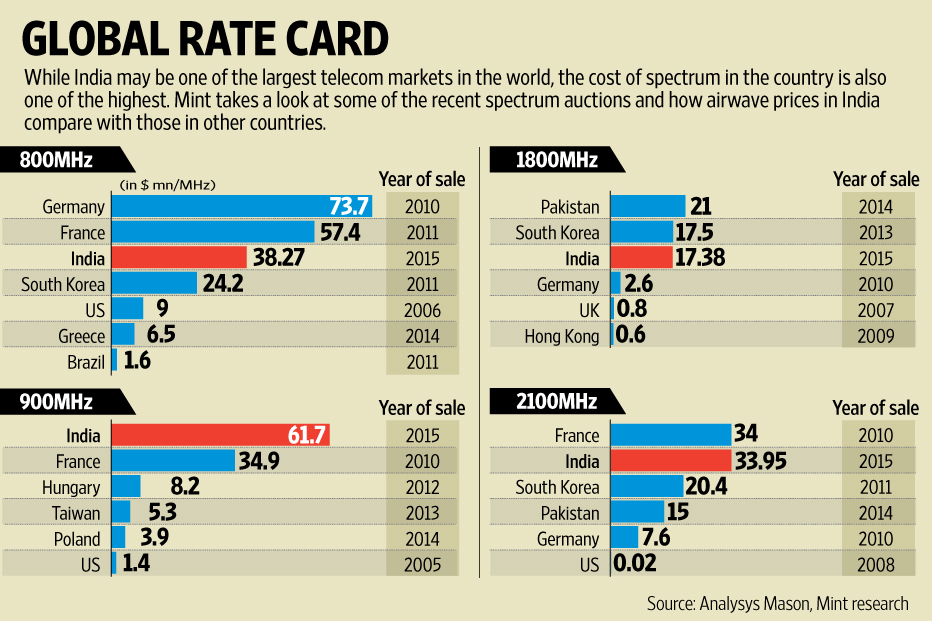
The cost of licensed spectrum, typically a major expense, now is an issue in India, which is preparing to issue licenses for 700-MHz spectrum. High costs were an issue in earlier spectrum auctions as well.

After a massive auction where incumbents essentially had to pay whatever was required to retain use of frequencies they already were using, “the industry simply does not earn enough to support the bids,” some have argued.  

In that spring 2015 auction, India’s mobile companies bid Rs 1,10,000 crore for spectrum across four bands that were substantially above the reserve (minimum) prices.

Buyers paid 1.79 times the reserve price for 800MHz spectrum and 1.95 times the reserve prices for  900 MHz.

Operators paid less of a premium for higher-frequency spectrum, just 1.16 times the reserve price for 1800 MHz spectrum and 1.05 times the minimum for 2100 MHz spectrum.

John Giusti, Chief Regulatory Officer, GSMA, is among observers urging the Indian government to lower minimum prices for the 700-MHz auction.

“The GSMA is very concerned by TRAI’s recommendation to set a starting price of US $1.7 billion per MHz for pan-Indian 700MHz spectrum,” said Giusti.


India has one of the lowest average revenue per user (ARPU) metrics globally (US $2.45 at the end of 2015).

High spectrum costs, combined with limited revenue contribution from data services, new competitive pressures and high capital investments to upgrade to 4G, mean it will be difficult to sustain business models, if high spectrum prices hold, Giusti argued.

“The more mobile operators have to pay for a spectrum licence, the less capital is available to roll out new mobile networks,” Giusti said. “We encourage greater focus on the long-term benefits of connecting more people in India to affordable mobile broadband, rather than on short-term financial gain.”

“High reserve prices and an unrealistic predetermination of spectrum value could also reduce the willingness of potential bidders to buy the spectrum,” he noted. “For example, in Australia, an unrealistically high reserve price resulted in a valuable portion of the 700MHz spectrum left unsold and unused.”

“Setting reserve prices at reasonable levels will be key to achieving the Digital India objectives, allowing operators to focus their resources on building the necessary infrastructure to deliver high-quality mobile services for Indian citizens,” Giusti said.

India Mobile Phone Sales Fall 9% in 2015

India mobile phone shipments dipped nine percent in 2015, as smartphone units grew 18 percent, offset by a 27 percent decline in featurephone shipments, according to CMR.

Overall device shipments of  235.6 million units were below the 257.2 million units shipped in 2014.

Figure1-CMR Release CY 2015


T-Mobile US 4G Speed, Coverage are Top of Market

According to the OpenSignal State of LTE report, U.S. Long Term Evolution 4G network coverage is extensive, but capacity is not. The report also notes strides made by the T-Mobile US network, which now leads, in terms of capacity, on both its 3G and 4G networks.

As many other countries start providing consistent 20 Mbps or greater connections, the U.S. market average is 9.9 Mbps. There is a simple explanation. Bandwidth equals capacity.

And most U.S. mobile service providers do not have enough spectrum to create the bigger channels required to support LTE-Advanced, for example.

That is one reason why Voice over LTE (VoLTE) could be crucial. It might allow mobile operators to reclaim 2G spectrum that can be used to support 4G operations. T-Mobile US has been able to take huge advantage of that capability.

In the fourth quarter of 2015, T-Mobile US had an LTE time-coverage metric of 81%, which means its 4G customers were able to see an LTE signal 81% of the time in OpenSignal tests.

In past reports, T-Mobile US has bested all operators in speed, but in the fourth quarter T-Mobile US and Verizon were almost evenly matched.

T-Mobile's 12.3 Mbps LTE average just barely edged out Verizon’s average of 12 Mbps, making it a statistical tie, but Verizon still has the advantage in coverage and reliability, OpenSignal says.

U.S. mobile service providers will not be able to deploy LTE-Advanced simply by redeploying 2G spectrum, OpenSignal argues. Additional spectrum will be needed. That is one reason why the upcoming 600-MHz incentive auctions could be important.

Also, high use of 4G by U.S. consumers also means networks are heavily loaded, which further restricts speed.

Is Sora an "iPhone Moment?"

Sora is OpenAI’s new cutting-edge and possibly disruptive AI model that can generate realistic videos based on textual descriptions.  Perhap...