Thursday, October 27, 2022

Sometimes Obvious Churn Drivers are Not the Mobile Operator's Fault

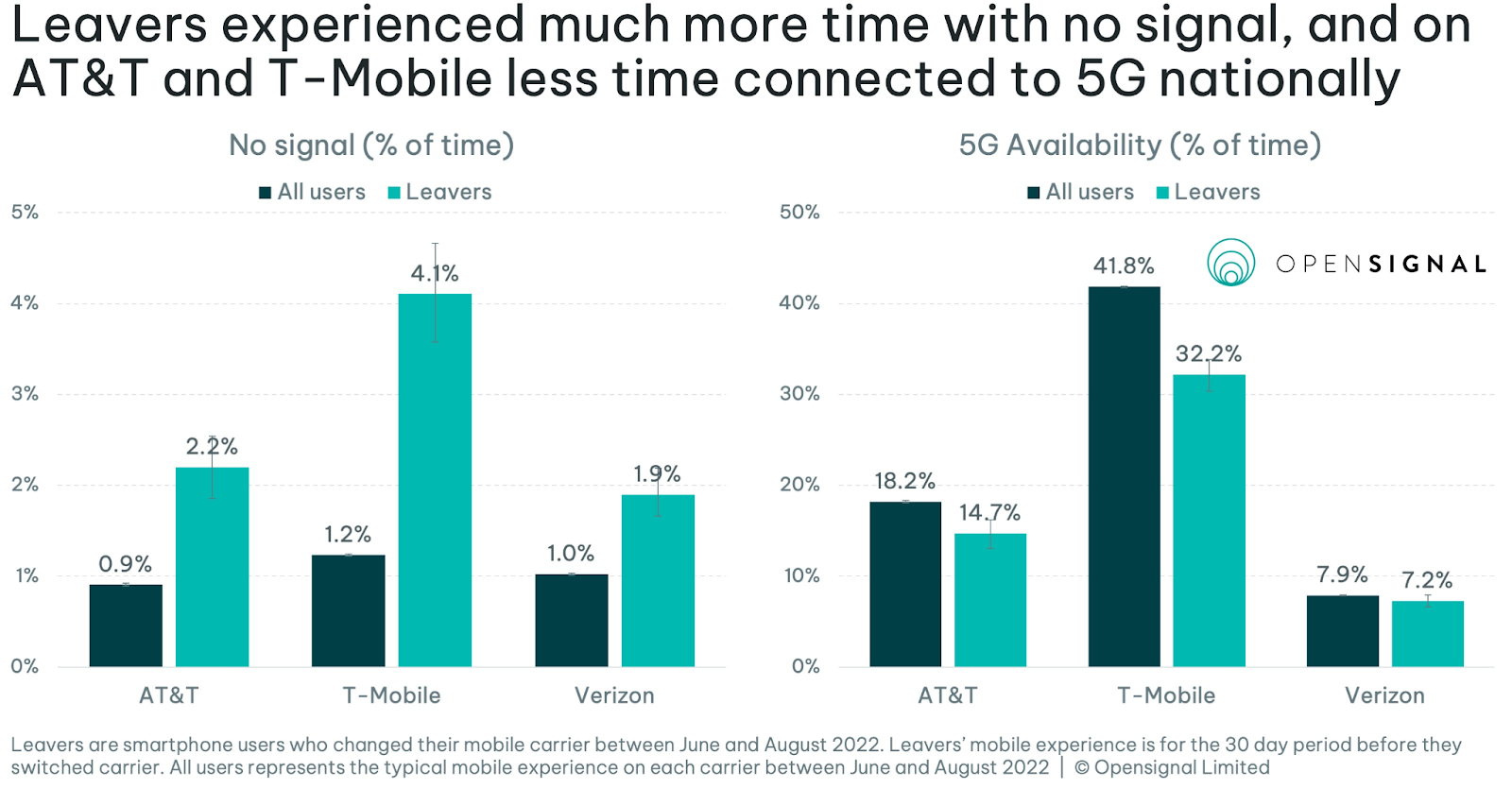
Some customer experiences are almost-sure indicators of churn. When customers make repeated calls about service quality, churn danger exists. Opensignal, for example, says that customers who left a service provider spent more time unable to get a network signal than customers who did not leave.  


Departing customers also spent less time connected to 5G than “more-loyal” customers who did not leave. It is worth noting that “satisfied” or “happy” customers are not necessarily loyal. They simply have not left. Especially in consumer markets, even satisfied customers will churn for a better offer.  


Accounts with large numbers of trouble tickets are potential churn candidates. 


When usage of any service stops growing, or starts dropping, churn danger exists. Churn also happens early in a customer relationship when the solution is not a good fit  for the customer. 


When customers are changing geographic locations, churn danger exists. When customers reduce service plan levels, churn danger exists. Churn danger is always higher for new customer accounts than for those a firm has had for five or more years. 


Changes in management or client decision-maker behavior can signal there is higher churn risk. Low engagement can be a warning sign.  Lack of engagement by the customer also is a warning sign. 


So network experience shortfalls almost always are indicators of possible customer churn. Of course, sometimes service providers get blamed for issues caused by devices or user error. 

Those of you with Pixel 6 phones know what I mean. Someiimes the Pixel 6 issues relate to data connectivity. 


For me, the bigger problem is simply voice connections. Sometimes a phone has to act like a phone. And in this case, it is not a mobile operator problem. It is a phone problem. But some amount of service provider churn is going to happen until each user figures out it really is the device that causing the issues, not the service provider.


Where's the Money From 5G?

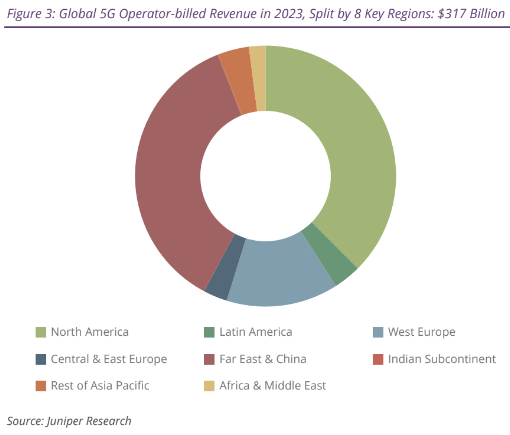
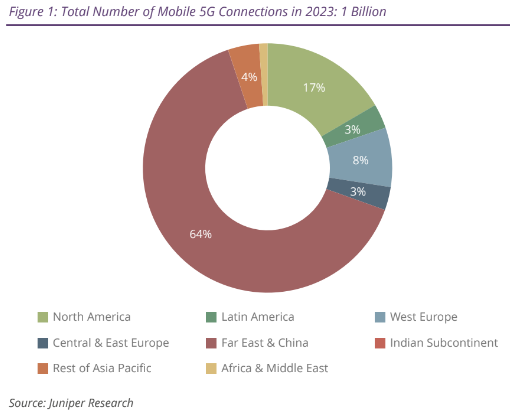
Though mobile operators might not like the frank answer to the question “where is the 5G revenue?,” the answer, for the most part, right now, is “right where it already is.” Which is simply to say that the bulk of “5G” revenue, with one exception, comes from existing or new customers switching from 4G to 5G.


The one exception is fixed wireless, which is the first new revenue source possible with 5G than was not so common with 4G, though that source did exist. Eventually, new sources will develop. The likely candidates include network slices, private networks, edge computing or some involvement in internet of things ecosystems. 


But all that will take time. 


source: Juniper Research


The other issue is that some markets have more revenue potential because average revenue per account is higher than the global average. The U.S. market and likely Canada are in that category. As Juniper Research argues, 5G revenue, as a proportion of the global total, is greater than 5G accounts might suggest. The other region where 5G revenue should exceed global norms is Western Europe, according to Juniper Research estimates. 

source: Juniper Research


What is Your "Core Competence?" Maybe it Is Not "Knowing How to Run Big Networks"

Liberty Global is looking at selling its Belgian tower network. Separately, Liberty and Telefonica are investigating selling  U.K. towers as well. Both deals illustrate the changing value of asset infrastructure in the mobility business. Where once tower ownership was considered essential, it now is considered optional. 


That in turn raises logical questions about the value of towers as business moats. As it turns out, ownership of radios on towers, and not the towers, is considered important. Ownership of spectrum licenses also remains strategic. 


In a tactical sense, mobile operators have found they can raise capital to reduce debt or increase investments by selling tower assets. In a strategic sense, the move to divest towers, create joint ventures or wholesale-only access in the fixed networks business raises questions about the business moats formerly provided by ownership of scarce access networks. 


Many of the same questions could be raised about digital infrastructure assets of other types, including data centers and optical fiber assets. To the extent that owners are willing to sell off all or parts of their infra assets, that suggests a business decision that such actions preserve what is essential to the business while creating greater liquidity. 


But the corollary is that those assets might not be sources of business advantage they once were thought to be, in whole or in part. 


As the asset light business model gains more traction, issues about structural separation, once thought to be a regulatory issue, not become matters of business strategy. In a growing number of cases, access providers are choosing to deemphasize asset ownership in favor of a more asset-light approach. 


Often forced by necessity, such moves still show a belief that some parts of the digital infra asset base can be shed without loss of too much competitive advantage. 


There are other corollaries. Telco executives once claimed that their core competence was “knowing how to run networks.” That makes less sense once ownership of the networks is given up, in part or in whole. 


So “running networks” turns out not to be the core competence. That might come as a shock to many who work in the industry, but is an inescapable conclusion. The ability to shape the regulatory process might arguably be closer to “core competence” than the ability to run networks.


Wednesday, October 26, 2022

Differentiation is a Good Thing IF Customers Will Pay for It

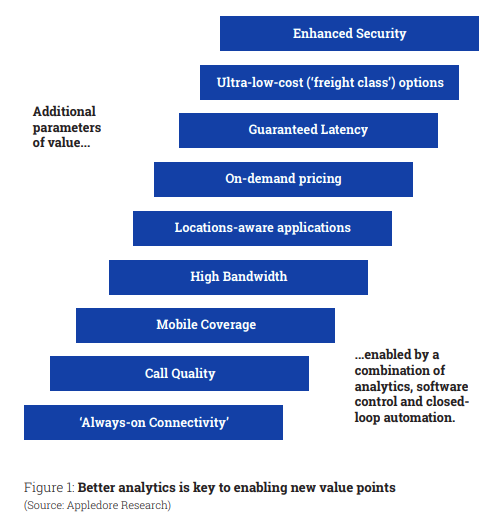
Most of us would agree that differentiated products with additional value attributes are more likely to command a retail price premium than other products without such features. In the case of connectivity service products, that might include security features, quality of service mechanisms, pricing innovations, location awareness or other features. 

source: Appledore Research 


The trick always is “monetization.” or customer willingness to pay. How can providers of such additional or enhanced features generate incremental revenue? Direct pricing for use of such features is the direct method. But customers might refuse to pay extra for coverage or voice quality or even service continuity, in most cases. 


To be sure, the claim that “our network is better” or “only available from us” are logical or sometimes  strong marketing platforms. Both claims are hard to substantiate in highly-competitive markets with competent competitors all using the same technology platforms and suppliers. 


So, as always, the issue for marketers is that potential buyers have to be convinced there is “something here of additional value” that is worth paying for. Price always matters. But how much value buyers place on various other features is less clear.


Past industry experience suggests most mobile service customers will not pay extra for voice quality on calls or coverage, in a direct fashion. People only expect the ability to make and receive calls, send and receive messages and use the network mostly everywhere they are. Up to this point consumers have not been offered service at varying data speeds, dynamic pricing of usage or other quality of service metrics. 


In practice, there can be service level differences based on whether service is purchased from a provider that owns its own network, compared to service from mobile virtual network operators who do not own their own networks. 


And there are additional ways to showcase differentiated value among service plans. Perhaps lower-priced plans have limitations on hotspot data usage while higher-priced plans do not have such limitations. 


More common ways of differentiating consumer mobility plans are the use of other non-network-related values and features, such as bundling video streaming service access. 


Even so, it sometimes is hard to measure the direct impact of any specific feature on new account gains, reduced account churn or higher average revenue per account. Sometimes 5G access is bundled with higher-priced service plans that also feature unlimited usage. 


In such cases, it will be hard to unravel whether it was the unlimited usage or the 5G that drove incremental growth.


Lower ARPU, Product Obsolescence Illustrate Need for Constant Mobile Operator Innovation

This graph of mobile termination rates--the fee a mobile network charges another network for completing an inbound call--illustrates a couple of principles relevant to the connectivity and computing industries. To the extent that computing costs are driven by chip-level capabilities that double about every 18 months, cost-per-operation drops over time. 


source: iconnectiv 


In other words, the cost of executing a single instruction or operation will fall rather sharply every decade, as they essentially fall by half every two years. In this example of mobile termination rates, costs fell from seven cents per minute to less than two cents per minute over a decade, or more than half--and close to three times--in 10 years. 


All other things being equal--such as holding traffic volumes steady--that means termination revenue would have fallen by close to three times, and clearly more than half, over that decade. In practice, since call volumes rose, the decline was likely less, in absolute terms. 


For example, the global number of mobile subscriptions grew about 52 percent between 2010 and 2019, so there were more people making mobile phone calls. But per-minute charges dropped faster, close to 100 percent lower in some countries. 


Other charges also declined. Between 1997 and 2022, for example, the cost of U.S. mobile 41phone subscriptions dropped by 50 percent. So the actual rate of decline for recurring service was not as fast as the decline of calling costs per minute. 


The actual change in revenue sources was complicated. Revenue was boosted by additional subscribers, replacement services (mobile internet access in place of voice and messaging) and higher possible usage in some cases. But revenue was diminished by lower average unit rates for subscriptions, calls and text messaging. 


That illustrates a second point about revenues in the connectivity business: about half of all current revenue earned by a service provider will be gone, every decade. That might sound like an exaggeration. It is not. How many service providers sell ISDN, X.25, frame relay or ATM anymore? At one time, each of those services was, or was supposed to be, a key driver of wide area network data revenues. 


How many access providers sell dial-up internet access anymore? And, over time, what is the typical downstream package purchased by half of all customers? At one point it might have been 1 Mbps or less. At some point that changed to perhaps 10 Mbps, then 100 Mbps, then higher. The point is that in each generation, the “product” changed. 


International and national  long distance calling rates show the same pattern. 

source: FCC 


source: U.S. Department of Justice 


The general point is that revenue sources changed over that decade, as they tend to do every decade. 


In fact, calling revenues now are minor enough that it is difficult to find statistics on calling volume or revenue, as internet access now drives revenue models. 

Does Wholesale Raise or Lower Business Moats?

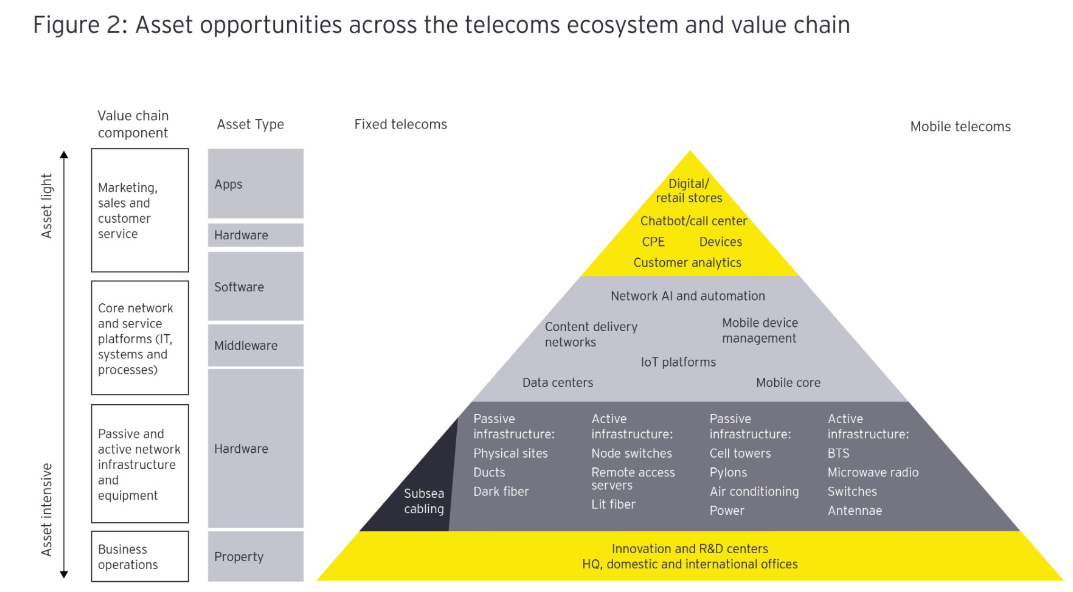
To the extent that high capital investment essentially creates a business moat against competition, any lowering of capex barriers opens the access business to further competition. So while any particular access provider might welcome lower capex, such as giving up infrastructure ownership in favor of wholesale access, there are trade offs. 


On the other hand, if a single entity manages to maintain itself as the sole network infrastructure provider, that provides a moat for the facilities owner, if not for the retail service providers.


That is the bargain mobile operators in Malaysia are making, as 5G infrastructure becomes a wholesale-only access proposition. On one hand, operators can avoid some of the capital investment to build their own networks. On the other hand, some degree of commoditization also results, as every competitor will have the same services, sold at the same price, with the same features. 


And since the wholesale price sets a floor under retail price, there will be additional constraints on both pricing and packaging of the basic access product. 


One has to wonder whether an asset-light business model is emerging in many parts of the connectivity business on a wider scale.  In addition to operating as would a mobile virtual network operator, more access providers might choose to specialize, narrow the scope of their services or radically reshape their customer-facing marketing, sales and support processes to achieve lower costs. 

source: EY 


Telcos using public hyperscale cloud computing services instead of managing their own private clouds provides another example of this trend. To a degree once unthinkable, access providers are reshaping, in some instances, their roles as infrastructure owners. 


In part, that is because open access fiber-to-home networks enable operating modes that cost less, while still offering required levels of network performance. The trade off is a loss of pricing flexibility, as retail prices have to reflect the wholesale costs of securing access. 


Since all competitors have the ability to purchase the same services, wholesale customers also lose some amount of ability to differentiate service levels. If every ISP offers symmetrical gigabit per second or multi-gigabit-per-second access, that ceases to be an area where competitive differentiation is possible.


So the bad news for access providers going asset light is that their products might become more commoditized than they are today. The “plus” of lower capital investment is accompanied by the “minus” of higher degrees of commoditization. 


But such trade offs have been happening for a while. Access providers have been selling physical infrastructure assets to raise cash to reduce debt, for example. Were debt not a problem, would they sell? Perhaps not. 


But most access providers struggle with the economics of building the next generations of mobile and fixed networks. Getting out of substantial parts of the digital infra ownership business seems the lesser of several evils. 


It is happening to fixed network providers as well. 


On*Net Fibra, the Chilean digital infrastructure company 60 percent owned by KKR and 40 percent by Telefonica, is buying rival service provider Entel’s fiber to home network for US$358, and will continue to operate as an open access wholesale network. 


Entel’s FTTH network passes 1.2 million homes and businesses. On*Net Fibra will, after the deal closes, pass 3.9 million premises. The goal is to grow home and business passings to 4.3 million by 2024.


Telefonica had sold “non-core” Central America network assets in 2021, selling 40 percent of its towers business Telxius to KKR in 2017 before agreeing to flip the whole business to American Tower for €7.7 billion in 2021. Entel also sold its data centers to Equinix. 

Tuesday, October 25, 2022

Service Providers Have to Replace Half Their Current Revenues Every 10 Years

This graph of mobile termination rates--the fee a mobile network charges another network for completing an inbound call--illustrates a couple of principles relevant to the connectivity and computing industries. To the extent that computing costs are driven by chip-level capabilities that double about every 18 months, cost-per-operation drops over time. 


source: iconnectiv 


In other words, the cost of executing a single instruction or operation will fall rather sharply every decade, as they essentially fall by half every two years. In this example of mobile termination rates, costs fell from seven cents per minute to less than two cents per minute over a decade, or more than half--and close to three times--in 10 years. 


All other things being equal--such as holding traffic volumes steady--that means termination revenue would have fallen by close to three times, and clearly more than half, over that decade. In practice, since call volumes rose, the decline was likely less, in absolute terms. 


For example, the global number of mobile subscriptions grew about 52 percent between 2010 and 2019, so there were more people making mobile phone calls. But per-minute charges dropped faster, close to 100 percent lower in some countries. 


Other charges also declined. Between 1997 and 2022, for example, the cost of U.S. mobile 41phone subscriptions dropped by 50 percent. So the actual rate of decline for recurring service was not as fast as the decline of calling costs per minute. 


The actual change in revenue sources was complicated. Revenue was boosted by additional subscribers, replacement services (mobile internet access in place of voice and messaging) and higher possible usage in some cases. But revenue was diminished by lower average unit rates for subscriptions, calls and text messaging. 


That illustrates a second point about revenues in the connectivity business: about half of all current revenue earned by a service provider will be gone, every decade. That might sound like an exaggeration. It is not. How many service providers sell ISDN, X.25, frame relay or ATM anymore? At one time, each of those services was, or was supposed to be, a key driver of wide area network data revenues. 


How many access providers sell dial-up internet access anymore? And, over time, what is the typical downstream package purchased by half of all customers? At one point it might have been 1 Mbps or less. At some point that changed to perhaps 10 Mbps, then 100 Mbps, then higher. The point is that in each generation, the “product” changed. 


International and national  long distance calling rates show the same pattern. 

source: FCC 


source: U.S. Department of Justice 


The general point is that revenue sources changed over that decade, as they tend to do every decade. 


In fact, calling revenues now are minor enough that it is difficult to find statistics on calling volume or revenue, as internet access now drives revenue models. 

Is Sora an "iPhone Moment?"

Sora is OpenAI’s new cutting-edge and possibly disruptive AI model that can generate realistic videos based on textual descriptions.  Perhap...