Saturday, April 4, 2020


EU Proximity Tracking Platform Launched
The Pan European Privacy Protecting Proximity Tracing initiative aims to create a platform enabling governments or health agencies to harness mobile location data to identify people exposed to pandemic agents such as Covid-19, while observing European Union data protection laws.
The initiative includes 130 data scientists from eight countries, led by Germany’s Fraunhofer Heinrich Hertz Institute for telecoms.
The project has developed source code that can be used to build applications that notify people when they have been exposed to a person known to have Covid-19.
It might be worth noting that health officials and governments in Europe have sought help from telcos and app providers for ways of using location data to help with pandemic response, including tracking movement, in key ways. Prior to the pandemic, such tracking might have seemed quite an invasion of privacy, at the very least.
The Trace Together app in Singapore is a related example of such proximity trading. The U.S. federal government is working with the Centers for Disease Control and Prevention to create a portal including phone geolocation data to help predict outbreaks.
Google Maps now is being used to produce Community Mobility Reports, using anonymized data, showing how busy retail locations are, in the wake of pandemic-driven stay-at-home policies. Many health-related apps have been developed to help track, test or treat Covid-19 patients.
All that should raise one obvious question: what is the value of mobile operator location data? Though location data has been touted as a key advantage for mobile operators offering advertising, for example, it also now is quite clear that device suppliers and app suppliers also can supply such data, enriched in many cases by detail on the types of locations visited.
In the coming era where artificial intelligence is applied to most processes, ownership of data stores will be directly linked to creation of value. In that regard, location data owned by mobile service providers should be valuable. But just how valuable is not yet clear, especially since other entities, especially device and app providers, also have location knowledge.
Thursday, April 2, 2020
Wednesday, April 1, 2020
FCC Proposes Unlicensed Spectrum Sharing Across the 6-GHz Band
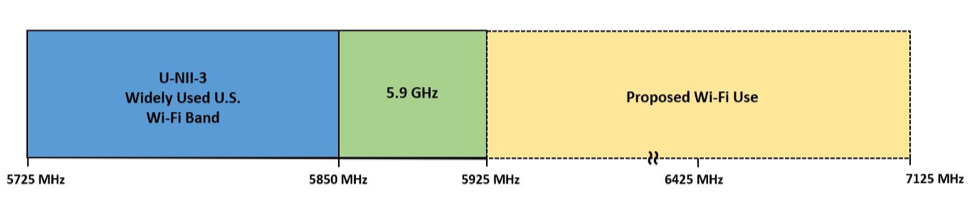
The Federal Communications Commission will consider new draft rules permitting unlicensed devices to operate in the 6 GHz band, making 1,200 megahertz of spectrum available for unlicensed use. Key to the plan is spectrum sharing.
An automated frequency coordination system would prevent standard power access points from operating where they could cause interference to incumbent services, the FCC says.
Part of the 6-GHz band is used by satellite operators, utility companies or TV broadcasters for electronic news gathering. So the new spectrum sharing mechanisms pioneered by Citizens Broadband Radio Services would also be used by users of the whole 6-GHz frequencies, without the need to move existing licensed users.
The draft rules will be voted on by the Commission at the FCC’s Open Meeting on April 23, 2020.
The plan would authorize two different types of unlicensed operations: standard-power in 850-megahertz of the band and indoor low-power operations over the full 1,200-megahertz available in the 6 GHz band.
A further rulemaking proposes to permit very low-power devices to operate across the 6 GHz band, to support high data rate applications including high performance, wearable, augmented-reality and virtual-reality devices.
Tuesday, March 31, 2020
OneWeb Heading for Bankruptcy
AT&T 5G Might Deliver 3 Gbps in Some Cases
AT&T says it now has more than 1,040 MHz of nationwide millimeter wave spectrum after adding 786 MHz of 39-GHz spectrum in Federal Communications Commission Auction 103. Prior to Auction 103, AT&T acquired 379 MHz of 39-GHz spectrum when it purchased FiberTower for $207 million in early 2018.
That means AT&T will have 800 MHz of 5G bandwidth in some markets, enough for eight 100-MHz channels. AT&T says it can deliver up to 400 Mbps of download speed per 100-MHz channel, reaching 1.5 Gbps across four channels.
So 3 Gbps should be possible, using all eight channels. Moreover, if a 5G device can simultaneously access AT&T’s 39-GHz and 24-GHz spectrums, or the 39-GHz spectrum plus low-band or mid-band channels, the speeds could be even higher, some believe.
Monday, March 30, 2020
Comcast Peak Traffic up 32%

-
NTT researchers recently demonstrated ability to transmit 100 Gbps at 300 GHz frequencies, far beyond the ranges we have used for freespa...
-
Rich Communications Services was intended to be the multimedia successor to SMS (short message service). It still seems likely to do so, tho...
-
Here’s a look at mid-band spectrum held by the leading mobile operators in Japan, according to Gaku Nakazato of Japan’s Ministry of Intern...

