Tuesday, August 13, 2019

Why 5G spectrum for Coverage is Not Going to be a Problem

Many discussions of 5G spectrum seem to center on where all the capacity will come from. The confusion is understandable. If every area where 5G is made available has to support the sorts of speeds millimeter wave small cells will support, there are serious questions.

But 5G capacity will not have to be evenly supplied. In fact, it will be highly uneven, or unequal, as has been the case for 3G and 4G. It is likely that, in terms of coverage, 5G speeds will resemble good 4G, and will not rely very much on the more-exotic millimeter wave assets.

Rather, lower-frequency and mid-band frequency will be more common for coverage purposes in rural areas.


There are several reasons. Coverage 5G spectrum will tend to be in lower frequency ranges simply because lower frequencies--while not best for capacity--are best for covering distances. Millimeter wave is optimal for bandwidth, but not distance covered.


In some cases, 5G devices actually will use a combination of new 5G spectrum and 4G spectrum, depending on where each connection takes place. In dense urban areas connections might often use new millimeter wave capacity. In rural areas 5G devices often will default to 4G. 


The point is the demand for mobile capacity is quite unevenly distributed. T-Mobile has noted in the past that 20 percent of 3G cells carry 60 percent of all 3G traffic. About half of all cell sites support 95 percent of 3G traffic. 
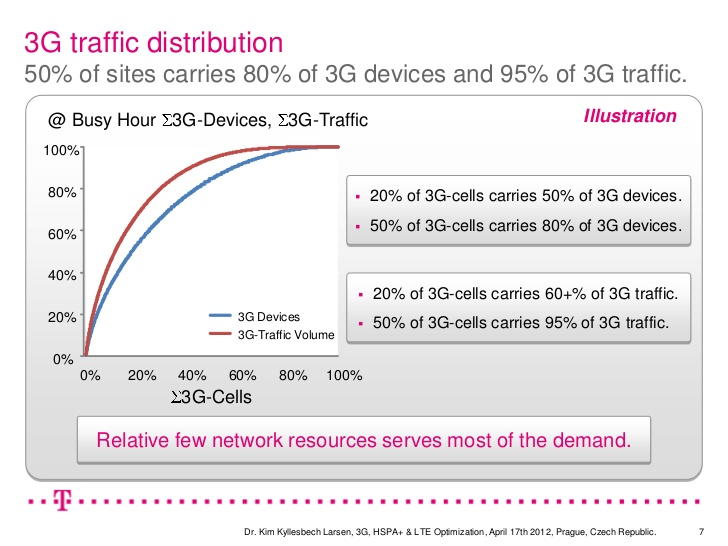

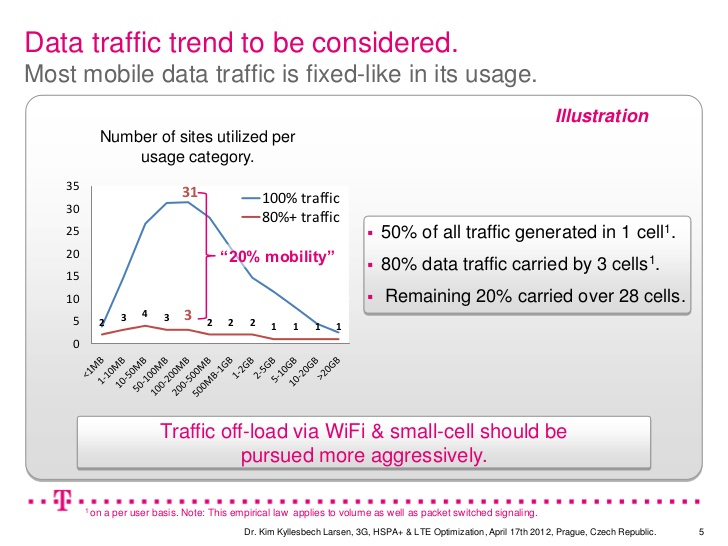
That pattern was true of 4G networks and undoubtedly be true of 5G networks as well. T-Mobile also has noted that, for any typical user, half of all data traffic is consumed from just one cell tower. About 80 percent of any typical user’s data consumption happens on just three cell sites. 

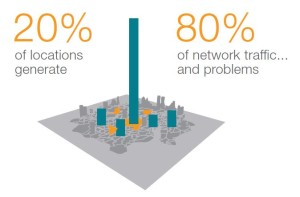
Studies conducted by Amdocs have suggested that 20 percent of mobile network locations support about 80 percent of network data demand. 

Data consumption might also be related somewhat directly to revenue generation, if one assumes that where a customer uses most of his or her data is where the value of the subscription lies. Though coverage is “nice” where one does not need to use the network, it is a “must” where any particular user uses mobile networks daily. 


Some estimates suggest that as much as half the total revenue (value or usage) happens when users communicate on about 10 percent of total cell sites. Perhaps 80 percent of usage or revenue is generated on about 30 percent of cell sites.


It is worth noting that the half of all cell sites generating about 10 percent of service provider revenue are in rural areas. There simply are not that many people in rural areas. And lots of people mean lots of usage. 
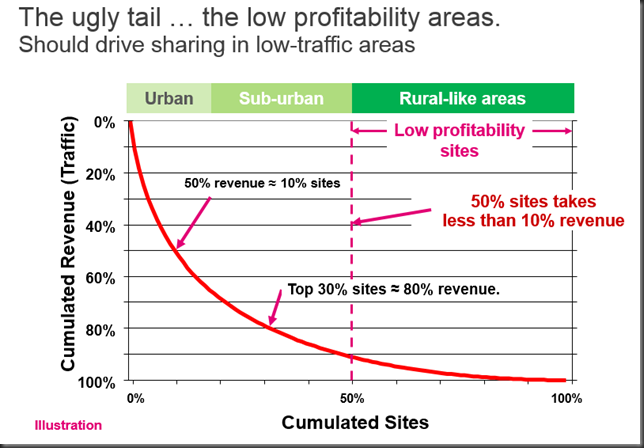


So part of the answer to the question of “where will all the 5G spectrum come from?” requires understanding that demand is highly unequally distributed. Rural areas might have half of all cell sites, but support only 10 percent of data demand. 


Urban sites might be only about 10 percent of total sites, but support as much as half of all data demand, simply because that is where most of the people are. 


Spectrum resources will come from new low band capacity, repurposing legacy capacity, new mid-band capacity, millimeter wave assets, spectrum sharing, spectrum aggregation, offload mechanisms and use of smaller cells. 


But the supply is highly unequal: lots of new capacity in urban areas, some new supply in suburban areas and relatively light capacity needs in rural areas. The new 5G networks will not have to support urban small cell capacities “everywhere” across the whole network.

Australian Consumers Aware of 5G, 29% Ready to Switch Now

Australians who were aware of 5G technology seem clear on the advantages, according to a survey by Roy Morgan. About 72 percent said, in response to an open-ended question, that faster internet speed was a value. Another seven percent cited “better bandwidth” or “capacity.”

So roughly 79 percent identify faster speed as the key advantage. Some 16 percent believe higher reliability is a key attribute. 

The survey also suggests high awareness of 5G, as more than 90 percent of respondents suggested they are familiar with the concept. About 29 percent say they are ready to switch to 5G now.

About 57 percent also say they “would consider using 5G as an alternative to the NBN.”  

“At present the Australians most likely to consider buying a 5G phone tend to be aged 25 to 34 years old, with a personal income of over $50,000 per annum and be living in a capital city while those more likely to switch providers to get 5G are more likely to be with Optus or TPG,” Roy Morgan says. 

About 29 percent of respondents say they would switch mobile phone or internet provider to get 5G. Some 28 percent indicate they are willing to pay more for a faster mobile internet connection. 


Friday, August 9, 2019

Docomo Price Cuts Will Reduce Revenue, but Not as Much as "Up to 40%" Claims Suggest

When a market-leading tier-one service provider (NTT Docomo) says it is going to reduce mobile service plan pricing as much as 40 percent, and does not see a mass consumer response, that probably means other forces are at work. 

Other cost elements might work to lessen the impact of lower recurring fees. Terms and conditions of service might be a negative. In other cases the new, cheaper plans might be complex and hard to understand. The net advantages for many consumers might therefore be less than advertised. 

Granted, a shift of three million customer accounts (it is not clear whether that is a gross additions or net additions figure) not insignificant, in a market of about 177 million total accounts. Docomo might have experienced a gain of about 1.6 percent (if all the accounts were shifted from another provider). 

In 2014, when Docomo says it last adjusted prices in a big way, some five million new accounts were added in 30 days. 

Handset bundling might be an issue, as the new discounted rates do not include device discounts, where some rival plans did offer such inducements. 

The other issue is market entry by Rakuten, about to enter the facilities-based mobile business in the fall of 2019. Rakuten already is a mobile virtual network operator. 

Some customers might be waiting for what they expect will be even-better deals from Rakuten, the Japanese e-commerce and retailing giant that has been in the Japan mobile market since 2014. 

KDDI, the second-largest mobile service provider in Japan, believes the next wave of growth will have to come from services beyond connectivity. 

The bottom line here is that although the price reductions will shave revenue, it does not appear that the impact will be as big as some had feared. As often is the case, big price cuts come with conditions that actually limit the appeal of the plans, while allowing a service provider to trumpet big cuts.

Wednesday, August 7, 2019

High-End Devices Work Better on 4G Networks

User experience on any internet connection is affected by devices, in addition to all other features of a specific access link. According to a recent study by Opensignal, “Samsung users experienced faster download speeds than Apple and Huawei users in 35 percent of countries, across 40 countries analyzed.”


High-end devices seem to be more able to take advantage of network improvements, including bandwidth across more frequency bands, for example. “Because high-tier models include more network technologies, they are more sensitive to mobile network improvements and are, in effect, a leading indicator of what the mobile network experience will be in the future,” says Opensignal. 

“High-tier smartphone users experienced latencies 18 percent--or 11.1 milliseconds--faster than low-tier smartphone users and 14 percent faster even than mid-tier smartphone users,” Opensignal says. 


“Notably, in Thailand speeds measured on hightier smartphones were 4.3 times as fast as those measured on low-tier smartphones; in Canada and the U.A.E, 2.9 times; and in Australia, Singapore and Switzerland, 2.6, 2.5 and 2.5 times respectively,” says Opensignal. 

In the U.S. market, for example, Samsung users experienced download speeds 8.2 Mbps faster than iPhone users. In Norway, Samsung users saw speeds 12 Mbps faster than Huawei users, and 14 Mbps faster than Apple iPhone users, Opensignal says.

Smartphones Gain Share of Gaming Platform Market

Smartphones continue to gain importance as the gaming platform of choice, where once consoles and PCs were the dominant platforms, according to forecasts by newzoo. 


Tuesday, August 6, 2019

5G is Required for Bandwidth Support, All Else is Gravy

I admit to a bit of 5G fatigue: I am not worried about the 5G value proposition, the revenue models, technology roadblocks or capital requirements. So looking at 5G strictly from a bandwidth point of view, it simply is a tool to support every-growing bandwidth consumption. 

For technological reasons, 4G simply will not support what is required. Everything else--new use cases, new revenue streams--is gravy. 


Monday, August 5, 2019

India Mobile Revene and Cash Flow Improving, Generally

At least some key India mobile operators seem to be experiencing an improvement of revenue and profit performance, according to Fitch Ratings.  

Bharti's India mobile cash flow (EBITDA), after operating lease payments, improved by seven percent, quarter over quarter. Bharti's first quarter consolidated revenue rose by five percent, year over year, while EBITDA increased by two percent.

Vodafone-Idea's EBITDA declined by 22 percent. 

Reliance Jio continued to gain market share, keeping its ARPU flat. 

Bharti revenue and cash flow  improvements were driven by continued growth in Africa, where revenue grew seven percent and EBITDA increased 13 percent, on subscriber growth of nine percent.

Bharti mobile service EBITDA in India rose by seven percent, quarter over quarter in the quarter.
Average revenue per unit growth of five percent was driven by an increase in 4G subscribers of 10percent. Average data consumption rose by eight percent as well. 

Vodafone-Idea's first quarter declined four percent, while dipped by 22 percent. However, ARPU improved by four percent. 

Is Sora an "iPhone Moment?"

Sora is OpenAI’s new cutting-edge and possibly disruptive AI model that can generate realistic videos based on textual descriptions.  Perhap...