Wednesday, October 24, 2018

Comparing Verizon and AT&T Strategies

Inevitably, some will compare Verizon and AT&T third quarter 2018 results and conclude something broader about each company’s long term strategy. Both firms showed growth in mobile revenues, with declines in the fixed networks segments.

Perhaps the single biggest amount of change was the revenue dip in AT&T’s entertainment segment. AT&T points out the loss was affected by one-time items.

If one assumes that both firms will have to replace half of current revenues within a decade, then despite a worrisome debt load, AT&T has begun to make clear changes beyond connectivity services. Verizon remains convinced it can grow, at least near term, by focusing on connectivity services.

Each firm’s strategy fits its correct assessment of assets and opportunities. Verizon has room to grow in the “fixed network” segment by virtual of its much-smaller geographic footprint. AT&T has room to grow as a content and media company. Each strategy carries risk as well as a path to growth.

Strategically, most tier-one firms in communications or computing also must replace half their revenues about every decade. One can argue that is true in the chip business as well.
 

One quarter is not enough to assess how well each firm’s chosen strategy will drive creation of big new sources of revenue over the next decade.

The only certainty is that each firm might lose half its current revenue over the next decade, and each will have to find big new revenue sources to replace those lost revenues and generate growth.

Tuesday, October 23, 2018

Indoor and Outdoor Business Models in 5G Era

One way of looking at new 5G-driven business and revenue opportunities, as well as “do it yourself” private premises networking, is the whole matter of “indoor signal reception,” which is not a new problem for mobile service providers, but will be more acute as millimeter wave frequencies become more common.

Since the advent of 2-GHz frequencies for 3G and 4G, consumers and providers alike have become accustomed to the idea that indoor signal coverage often will be an issue. Such problems will be worse when frequencies above 3.5 GHz start to be used commercially (28 GHz, 39 GHz, 60 GHz as examples).

Not all problems with indoor coverage are related directly to frequency, of course. Some parts of any network might be locally congested because of high traffic. Some parts of any network might have received signal power issues or other “weak signal” issues caused by terrain or foliage, for example. In other cases, service providers might not be able to place cell sites in the optimal locations because building owners will not allow such radio sites.

Tall buildings, in some areas, might have problems when users try to connect to local cells that are not as tall as the buildings they are in, in urban areas. Some users might be able to receive signals from several cell sites, but not an especially strong signal from any of them.

Even energy-efficient windows and buildings designed for energy efficiency will further degrade indoor signals.

So one way of looking at 5G business potential is to position mobile operators primarily as “outside the building” coverage providers. Indoor coverage essentially starts to look more like the private network (local area networks, premises wiring networks Wi-Fi networks) scenario, creating a potentially bigger role for “indoor connectivity” business models of various types.

“Do it yourself” always is an option, as it has been for Wi-Fi and other indoor access networks. Then there are “venue network providers,” which might be enterprises such as hotels, third party providers such as Boingo or perhaps new providers of neutral host infrastructure that charge a fee to all mobile network service providers.

Most service providers have tended to stay away from indoor small cell operation themselves except in large venues (sports and entertainment venues, big shopping malls). Outdoor small cells make better sense, in most cases.

So the issue is whether a new group of “indoor wireless connectivity” specialists emerges.

Monday, October 22, 2018

Verizon Expected to Bid Significantly in 24-GHz and 28-GHz Auctions

U.S. cable operators have three decades worth of experience as owners of spectrum assets, and likely have learned from experience that commercializing such spectrum takes some work, especially when there are many other demands on management effort and capital. That might explain why only Cox Communications appears ready to bid on new 24-GHz and 28-GHz mobile spectrum up for auction by the Federal Communications Commission.

One reason cable operators likely are more interested in 3.5-GHz spectrum is that their overall vision likely relies more heavily on Wi-Fi and unlicensed spectrum, at least in terms of assets they can use in a variety of ways (best effort, not necessarily licensed use).

Not many remember it now, but a consortium of U.S. cable companies in 1994 partnered with Sprint to explore launching mobile services using new “Personal Communications Service” (PCS) spectrum.

In 2006, cable operators, acting as “SpectrumCo,” acquired nationwide assets in the Advanced Wireless Services (AWS) auction. The partners eventually sold the spectrum to Verizon, in return for ability to buy wholesale spectrum from Verizon to support branded mobile virtual network operator (MVNO) operations.

AT&T might have considered becoming a bigger bidder for more 28-GHz assets had it been able to acquire Straight Path, which instead was grabbed by Verizon.

Verizon has licenses representing as much as 236 billion MHz-POPs in the 28 GHz band and and 180 billion MHz-POPs worth of capacity in the 39 GHz bands.

AT&T has licensed representing about 40 billion MHz-POPs in the 28-GHZ band and eight billion MHz-POPs worth of capacity in the 39 GHz band.

A Megahertz POP represents one megahertz of bandwidth passing one person in the coverage area.

Mobile Operator Consolidation Normally Leads to Higher Prices

Mobile service provider mergers that reduce the number of leading operators from four to three lead to increasing consumer prices, despite the typical claims that such consolidation will lead to stronger competitors more able to do combat with the market leaders.

The U.S. Federal Trade Commission, for example, points out that horizontal mergers allow the merged firms to raise prices.  

That was the case in Denmark, argues analyst John Strand, of Strand Consult, where even proponents of failed mergers have noted that prices would go higher in the aftermath of merger approvals.

One might simply note that financial analysts virtually always favor such consolidation primarily because removing a competitor from the mobile market leads to pricing power, which boosts revenues and profits. In other words, there always is a danger of higher consumer prices when horizontal mergers occur.

That is what one should expect, as less competition tends to mean less need to compete on price or other service and product attributes.

Saturday, October 20, 2018

5G Small Cell Push Starts in 2019

Though the installed base of 4G and 3G small cells will continue to be dominant in 2021, 5G begins to be significant in 2019, analysts at TrendForce predict.


But there is great diversity in the small cell deployments, with consumer, private enterprise and  public network coverage all being important drivers of activity.

It always is difficult to distinguish between overall small cell deployments and deployments of service provider small cells. Small cells include a range of devices from in-home consumer units to in-office repeaters to private venue deployments, as well as mobile service provider cells used to bolster 4G or coming 5G capacity.


But it is important to keep some perspective. Crown Castle, for example,  expects small cells to generate new leasing activity of approximately $75 million in 2019. That is 35 percent higher than the $55 million the company expects to book in 2018, but provides a benchmark.

Crown Castle’s pipeline of contracted small cell nodes to be constructed over the next 18 to 24 months continues to grow, and currently stands at an all-time high of approximately 35,000, which is up 40 percent  from 2017 levels.

The point is that growth is about to accelerate.

Thursday, October 18, 2018

5G Will be the Lead Mobile Offer, Even When Most Use 4G

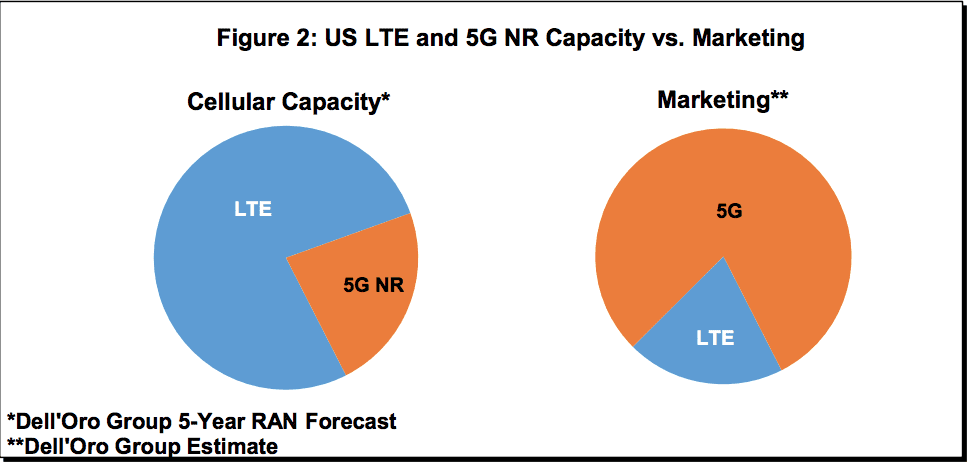
Mobile service provider marketing quickly is going to pivot to “5G,” even if most consumers are going to continue buying 4G services. That is not unusual, for several reasons.

Since 5G is the new network, that is the network whose value, features and services have to be sold to consumers who will be unfamiliar with the value proposition, at first. But at a broader level, mobile service marketing often focuses on elements of the experience that arguably are tangential or almost trivial.

Mobile marketing focuses on geographic coverage, even when most usage happens indoors. Mobile offers focus on price, when the differences are rather limited, or on usage buckets, even when virtually every service provider offers similar usage for broadly-similar prices.

But 5G also will get the marketing attention because it will offer dramatically better performance attributes, compared to anything consumers have seen to date. That is similar to the marketing on "gigabit" services in markets where that is available.

Generally, consumers tend to buy services that offer reasonable value for reasonable price, and that is rarely the fastest speed tier or the most-basic level of service.  

That is not unusual. Looking even at the ways people use internet access services, the “headline” offers often do not match the actual consumption or buying pattern very closely.

Back in the days when cable TV operators first were rolling out consumer Internet access at speeds of 100 Mbps, it was virtually impossible to get subscriber numbers from any of the providers, largely because take rates were low.

In the United Kingdom, then planning on upgrading consumer Internet access speeds to “superfast” 30 Mbps, officials complained about low demand. In fact, demand for 40 Mbps was less than expected.

So “gigabit” internet access remains mostly a marketing platform, not an indicator of what services people actually buy, when they have access to gigabit services. Retail price almost always is an issue for such buying patterns.

In the fixed network internet access business, most consumers do not buy gigabit connections, even if service provider marketing, in markets where gigabit services is available, often focuses on that high-end offer.

AT&T executives have said that, where it is available, about 30 percent of customers buy a gigabit per second service, even when other tiers of service are available. In part, that relatively high take rate reflects the fact that AT&T builds gigabit networks first in neighborhoods where propensity to buy is highest.

That same principle is likely to apply in the 5G market, if speed tiers are introduced.

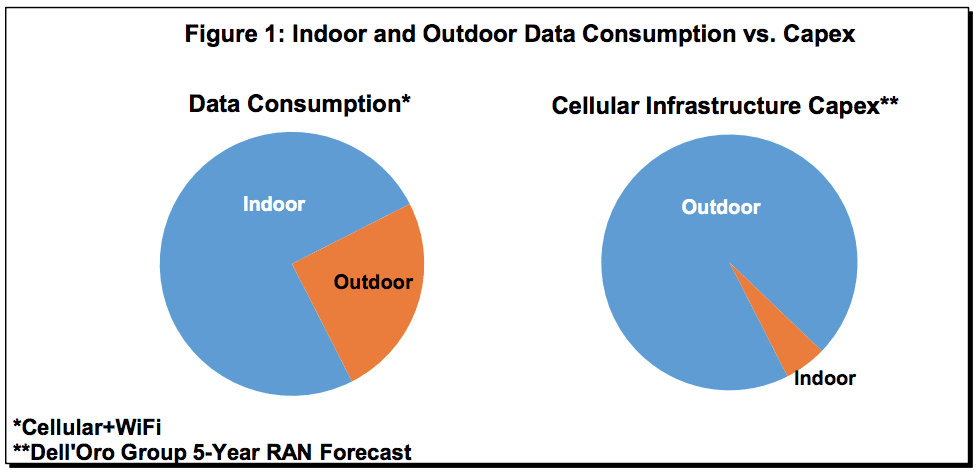
Most consumers in the U.S. and other markets use their mobile devices “mostly” indoors, yet service provider marketing always focuses on the “outdoor” signal coverage.


But the marketing context does shift over time. In the 3G era, Wi-Fi access was valued by consumers because access speeds on Wi-Fi tended to be faster than the mobile network. These days, on most 4G networks, Wi-Fi is slower than staying on the mobile network.

In the 5G era, the mobile network might be the fastest connection by an even greater margin.
source: Dell'Oro Group

5G Payback May Well Hinge on IoT

AT&T, Verizon Communications, Sprint and T-Mobile US might see a five-year to 10-year wait for “significant” payback on 5G, credit-rating agency Standard and Poors says. And the ratings agency seems to believe that the financial upside will come from internet of things use cases, not consumer broadband services.

On the other hand, many observers believe the initial use cases will be consumer broadband related--both mobile and fixed. The issue there is that much of that activity will simply shift revenue from existing 4G to replacement 5G accounts, with unclear revenue upside.

Still, significant financial returns within a five-year window should be counted as a clear success; a 10-year wait perhaps not unexpected if IoT drives major new revenue sources. It might well take that long for IoT to drive significiant incremental revenue.

The useful life of a mobile network is about 20 years, with a peak reached about 11 years into the commercial use of the network. Significant payback in five years is normally an indication of success, with a network reaching its peak of use within about 11 to 13 years.

Also, since many of us believe the big boost in revenues will come from enterprise use cases and internet of things, and since that will build towards the latter half of the 5G life cycle, a surge in revenues toward the latter half of 5G network useful life would not be unexpected.


Standard & Poor's, for example, says AT&T and Verizon, along with T-Mobile US and Sprint should focus 5G services on the industrial Internet of Things as a growth opportunity.

"For U.S. telecommunications companies, we have a cautious view on 5G wireless and believe that accelerated deployments could hurt balance sheets that are already stretched because of mergers and acquisitions, mature industry conditions, and competitive pressures," S&P analysts Allyn Arden and Madhav Hari said.

"We believe the revenue growth associated with 5G will be constrained," the analysts added.

“The bulk of the (Internet of Things) revenue opportunities may not materialize for at least five to 10 years," they say.

Is Sora an "iPhone Moment?"

Sora is OpenAI’s new cutting-edge and possibly disruptive AI model that can generate realistic videos based on textual descriptions.  Perhap...