Wednesday, December 6, 2017

For Retail Access Providers, Moving up the Stack is Imperative

With the caveat that undersea capacity providers cannot easily, and therefore probably should not, try to  “move up the stack” (occupy higher-value parts of the value chain), it seems undeniable that retail service providers selling services to consumers and businesses must do so.

The reason is that the access and transport businesses are low growth, lowish margin businesses. And that increasingly applies even in the formerly high-growth mobile business.

Another way of saying this is that access providers must vertically integrate, even if this is highly risky.   

Even if one agrees with that imperative, the issue then becomes “how and where” to move up the stack. In the past, the logic has been to move into computing services (information technology). That has produced mixed results.

A newer prescription is to move into video entertainment. The rationale is simple enough. Video services add significant amounts of revenue; create opportunities for bundling and value creation; get access providers back into the application business as legacy apps (voice, messaging) erode; and create opportunities for differentiation.

Some believe more room yet exists to create value and differentiation in the “dumb pipe” internet access business. That would be quite helpful. But the fact remains that “bit transport and access” are challenging businesses.

Looking only at price changes in the industry between 1997 and 2010, telecom retail prices were flat, even as prices for other “utility” services moved higher, and sharply higher, in the case of water and wastewater services.
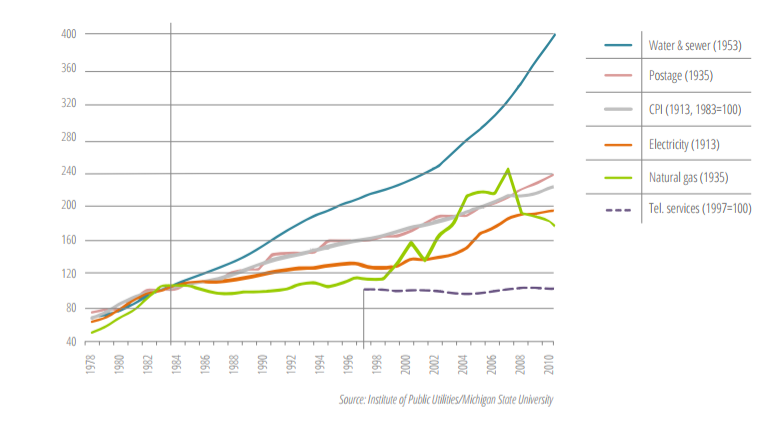
Some might argue telcos still can create new revenue sources and value for their dumb pipe internet access services. Comcast certainly believes that can be done by tweaks and enhancements to the Wi-Fi portion of the experience.

Verizon believes a shift to unlimited mobile internet access can contribute by convincing customers to buy higher-price plans. And AT&T believes fiber to the home and gigabit services can create a strong value proposition.

Still, the data suggests it will be difficult to impossible to increase end user spending on access services too much. In the consumer space, discretionary income is limited. In the business space, newer services with higher value simply cost less than the legacy services they replace.

And competition stil is growing. If all that continues to operate, significant new revenue sources, to offset declining legacy revenues, must be found elsewhere than in the access business.

5G Small Cell Will Build on 4G Small Cell

The start of 5G small cell deployment will come in 2020, with 68 percent of respondents surveyed on behalf of the Small Cell Forum planning to do so between 2020 and the end of 2022.

By the end of 2019, 81 percent of respondents plan to have cells supporting the most modern 4G releases, LTE-Advanced or LTE-A Pro. In fact, the fastest uptake of a new radio technology in small cells during this period will be seen in Licensed Assisted Access, which enables LTE to run in the unlicensed 5 GHz band.

Almost a third of respondents expect to  have deployed that by the end of 2019, and over a third expect to have MulteFire by 2019. MulteFire allows LTE to be run completely in unlicensed spectrum.


Long term Impact of Shift to Unlimited Plans is Unclear

The long-term impact of mobile unlimited data plans in the U.S. market is not yet clear, despite the obvious implication that, under such a regime, it is hard for service providers to produce incremental revenue based on incremental increases in usage.

In the near term, unlimited usage plans might even be revenue positive. In the early going, a shift to unlimited plans might have lead to lower average revenue per account, as heavy users were able to shift to unlimited usage plans that cost less.

For most other users, a shift to unlimited plans will generally lead to higher average revenue per account.

Also, as usage generally increases, service providers are adding huge amounts of new capacity. So the immediate impact of the shift to unlimited plans might be higher usage, leading to more potential for congestion.

But even there, the pattern of usage matters. If users actually consume more data off-peak, the congestion impact is minimized. If users consume more data at peak, congestion issues are magnified. It is not yet clear how unlimited plans might add new load (at peak or off peak).

But consumers generally are rational. They are able to weigh value against price. “The people who are going to step up to unlimited, they may not want to pay $20 a month more for an extra 4 gigs, but they'll pay $20 a month more to move from whatever bucket they're on to unlimited,” said Matthew Ellis, Verizon CFO. “If you give somebody the chance to save money and get something more a lot of them are pretty quick to do that.”

So the long-term ARPU impact of unlimited might not be negative, if it results in significant numbers of customers buying higher-priced plans, and if the pattern of higher usage is off peak, or at peak.

Monday, December 4, 2017

In 5G Era, Many Users Could Have Disincentives to Use Wi-Fi

It goes without saying that user behavior depends, in part, on tariffs. Lower access prices, all other things being equal, will lift usage; higher access prices, all other things being equal, will depress usage.

Up to this point, that is why Wi-Fi has been so widely used by smartphone users. As this data from Deloitte suggests, a great percentage of users have mobile data plans featuring less than 5 Gbytes of monthly usage. Some 35 percent of survey respondents are in this category.

On the other hand, about a quarter of respondents say they are on unlimited usage plans. Over time, especially once we get to 5G, we should see big behavioral differences between the “small usage plan” and “unlimited or big usage plan” customers.

Basically, users on unlimited and big usage plans will not have incentives to switch to Wi-Fi, as doing so will not save them any money, and 5G speeds are likely to be far faster than Wi-Fi, as well.


Mobile Subscriptions Now Greater than Global Population

The number of mobile subscriptions worldwide now exceeds the global population, according to the International Telecommunications Union, a finding that will not surprise anybody who routinely follows such developments.

Nor will it come as any surprise that mobile internet is the way most human beings around the globe get access to the internet. In this ITU graph, total mobile accounts are in light blue, and have the greatest adoption.

The orange line shows adoption of mobile broadband, which you can compare to the yellow line, which is fixed network internet connections. The dark blue line shows fixed network voice lines.

At the same time, the number of fixed network voice subscriptions has continued to fall, dropping below one billion worldwide, and is particularly low in the least developed countries, the ITU says.

The number of mobile broadband subscriptions worldwide now exceeds 50 per 100 inhabitants.

source: ITU

Will DirecTV Now Prove a Watershed?

DirecTV Now might be quite important for AT&T, but also quite important for other tier-one mobile service providers hoping to gain a significant position in the over the top video streaming market.

DirecTV Now also seems to have proven a new way to create differentiation in the consumer mobile business, as well as to increase perceived value. So much so that it has now become commonplace for mobile service providers to bundle an OTT video service as a feature of their mobility package.

AT&T initially lead with “HBO bundled with mobile,” and soon was followed by the other major U.S. carriers bundling Netflix or Hulu. Sprint bundles Hulu. T-Mobile US bundles Netflix. Verizon has taken a different tack, offering image quality tiers.    

The reason DirecTV Now could be a breakthrough is that the service seems to be getting traction, and at rates exceeding what Dish Network has achieved with its SlingTV service.

It is highly unusual and rare for any “telco-owned” over the top service to compare well with other application provider offers of the same type. Think about telco-owned messaging, voice or mobile app platforms and you get the point.

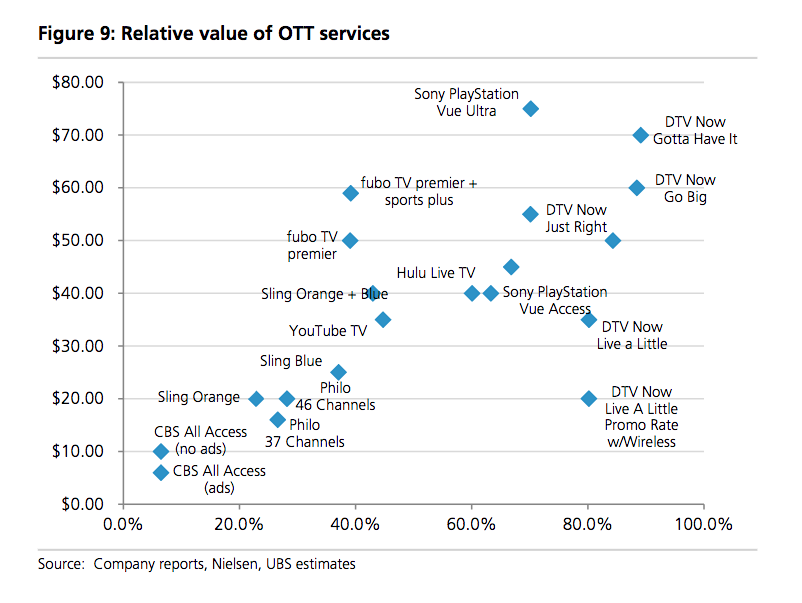
Unusually, then, AT&T’s “DirecTV Now” service gets top marks from analysts at UBS evaluating the value of current over the top “live” video services, which lead in “value’ rankings at numerous price points from $20 a month up to $70 a month.

The UBS analysis did not look at the full on-demand services such as Netflix, but only the services offering “live TV.” Some believe the OTT “live streaming” services eventually will develop as an important segment within the overall streaming market that includes “on demand” services such as Netflix that specialize in pre-recorded content, rather than “live” or “real-time” TV.


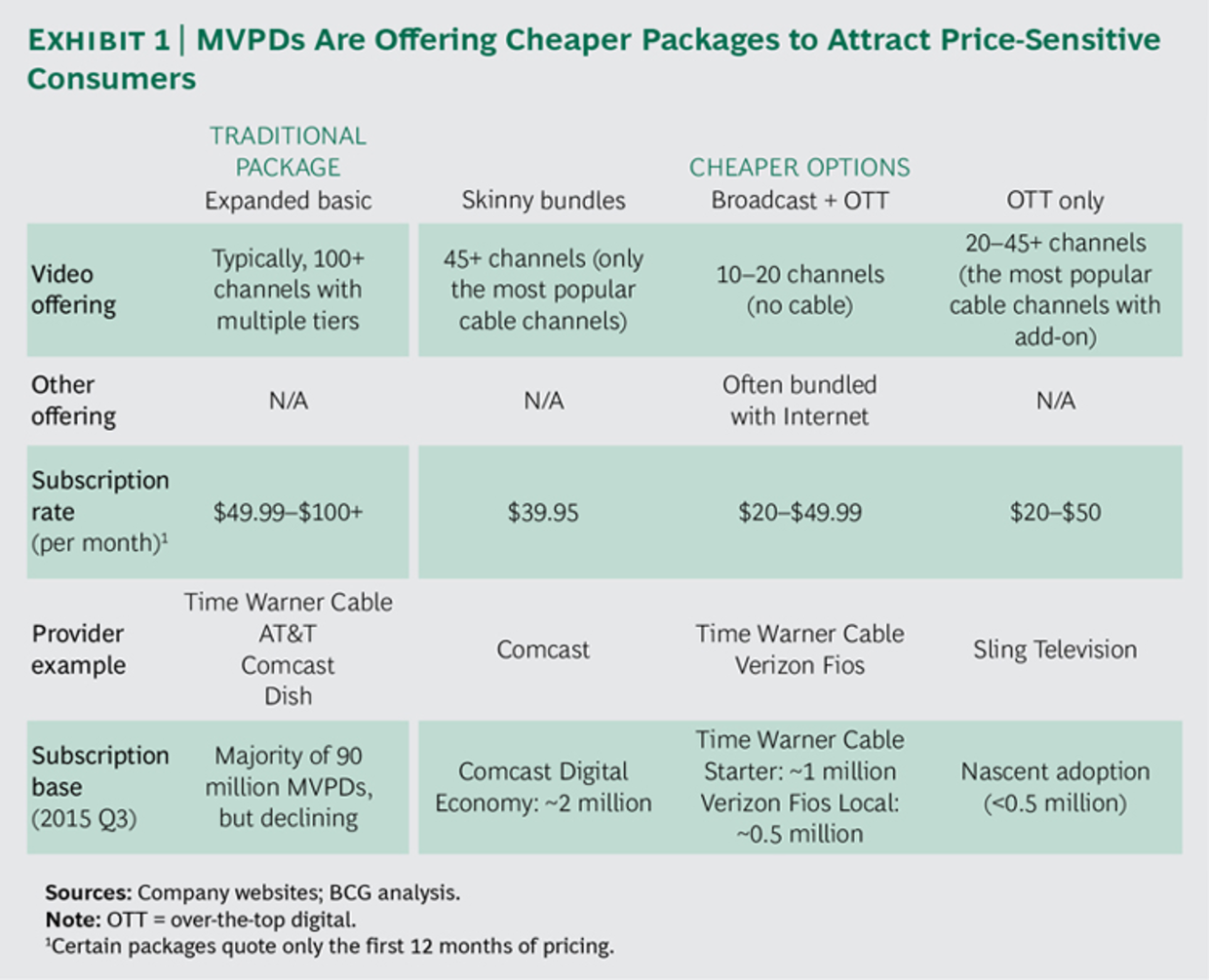
At the moment, the notion of “skinny bundles” captures the idea behind OTT live TV streaming. The idea is that there remains significant demand for “live TV” (linear channels). But there is less appetite for larger, more-expensive live TV bundles.

In many cases, on-demand services such as Netflix are complementary, as Netflix does not support or offer live TV. In essence, OTT live TV streaming captures demand that remains for over the air TV broadcasting, sports, news, events and other scheduled TV series consumption.

The point here is that a tier-one telco seems to be creating OTT live TV services that have appeal at multiple price points, and might even be deemed competitive with other similar services. If that translates into significant market share growth, it will represent a major victory for at least one telco in the effort to fashion OTT apps and services that do have mass appeal and significant market share.

That has not happened in the internet era.

Thursday, November 30, 2017

4G Fixed Wireless Closes Cost Gap with Cabled Networks

One traditional reason mobile networks have not been direct substitutes for fixed (cabled) networks for internet access is the value-price relationship. Where mobile network data consumption has been priced at about $9 to $10 per Gbyte, fixed networks have offered gigabytes at less than $1 per gigabyte (tariffs sometimes below 20 cents per Gbyte).

Basically, mobile data has cost 20 times (actual usage) to 60 times (retail price compared to usage limit) that of cabled access. Leaving speed out of the analysis, mobile data has not been affordable, compared to equivalent amounts of cabled network usage (between 160 Gbytes to 200 Gbytes, for example).

Speed also has been an issue, as mobile networks traditionally have been slower than fixed (cabled) networks.

But AT&T already is moving to eliminate much of the “cost of data” gap, using its 4G network, in rural areas, in fixed mode.

The 10 Mbps AT&T fixed wireless service includes a usage allowance of 160 Gbytes per month, and actually uses the Long Term Evolution (4G ) network in a fixed mode.  For most consumers, that will close the “cost per Gigabyte” problem.

Speed remains an issue, however, at least until the 5G network and millimeter wave bandwidth is made available. Still, the AT&T deployments show that mobile networks can move closer to comparability with cabled networks, using 4G, and could close the gap entirely in the 5G era.

AT&T has launched its fixed wireless service in Georgia, planning to reach 26,000 locations by end of 2017 and over 67,000 locations across Georgia by 2020.

AT&T plans to reach over 400,000 locations nationwide using fixed wireless by the end of 2017, and over 1.1 million locations nationwide by 2020.

Is Sora an "iPhone Moment?"

Sora is OpenAI’s new cutting-edge and possibly disruptive AI model that can generate realistic videos based on textual descriptions.  Perhap...