Thursday, November 16, 2017

What Will Drive 5G Success?

A paradox of life, especially for sentient beings that frankly prefer certainty to uncertainty, is that many “realities of life” are paradoxical: both “now and not yet,” nuanced and contradictory, subtle instead of clear cut.

So it is with 5G. It is fair enough to say 5G is “overhyped,” as Johan Wibergh, Vodafone Group CTO, characterizes matters. Each new generation has been hyped. But not every next generation mobile network has been deemed equally successful. “Why” that is the case matters.

“I think as an industry we got 2G and 4G very right, it was technology that worked and gave great services for our customers, made  business cases work for the operators and work for the vendors,” he said. “ If we think about 3G, that wasn’t a success in many parts of the world.”

It matters “why” this statement is “correct.” One problem with 3G was not so much the other elements of the business case as it was the “overpaying for spectrum.” It is correct to note that 3G was the first platform expected to support creation of many new services beyond voice and texting.

Eventually, that did happen, particularly with regard to mobile email, mobile browsing and tethering of PCs, if not for any great new class of application. The point is that new use cases did arise.

What damaged the business model was vastly-inflated service provider payments for new spectrum. Had that not been the case, it is unclear whether 3G would have been deemed “not so successful.”

Service providers will not make the mistake of overpaying for spectrum, ever again. First, they know what happened with 3G, when operators overpaid for spectrum. Second, service providers know they can rely on Wi-Fi and unlicensed spectrum to boost end user experience.

Third, there are huge amounts of new spectrum, dwarfing all current supply, coming available. Finally, new ways of using existing spectrum (spectrum sharing) and a massive shift to small cells and better radios also will help supply huge amounts of effective new capacity.

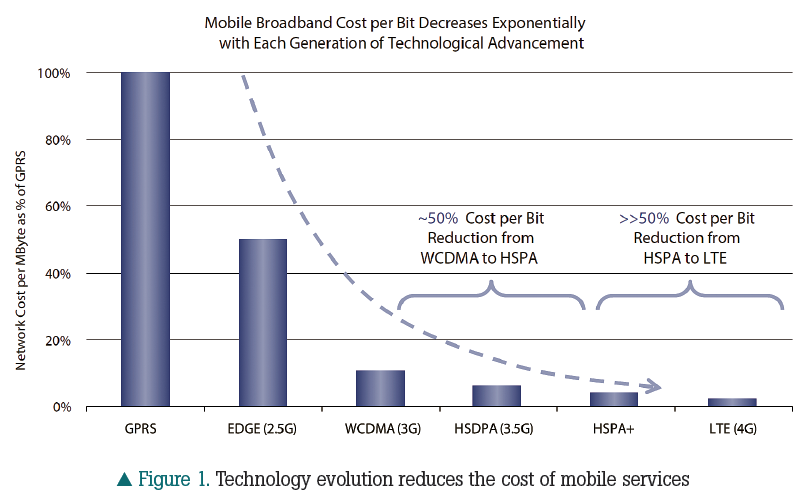
Wibergh is correct that 5G will supply bandwidth at lower costs per bit.

Pointing out that 5G networks will be an order of magnitude less costly than 4G, Wibergh suggests that near-term business upside related to mobile broadband is more important than the other longer-term opportunities.

Here he might be partially right. Many have argued that the upside from 4G was precisely the lower cost to deliver bandwidth, especially at first. It is harder to argue this was the advantage later on, when 4G underpinned a shift to consumption of entertainment video as a key trend.

Also, where 3G was inferior to Wi-Fi as a connection platform, in terms of speed, 4G actually offers better end user experience than does Wi-Fi, in many to most settings.

Wibergh says he I doesn’t “understand why we as an industry are not talking more about this, because in the beginning of 5G there is going to be much more mobile broadband usage, and cost is a challenge for us.”

There are some reasons for the emphasis on new apps such as internet of things, connected cars and so forth, rather than cost per bit. By now, most industry executives already believe that mobile broadband--no matter how efficiently it is delivered--will fail to produce significant new revenues.

There are limits to end user willingness to pay; competition keeps driving cost per bit lower; consumers will use “no incremental cost” Wi-Fi to control their spending; and in many markets, “unlimited usage” means there is no revenue upside for increased usage, except at the margin, when consumers are less-costly usage-based plans are enticed to spend a bit more for such unlimited plans.

Fundamentally, that is why the attention is focused on new applications--and internet of things in particular--and not on cost reduction for mobile broadband. Though lower cost is quite helpful, the human-driven mobile broadband market is reaching a natural limit.

And if one believes that half of current mobile revenue will be lost over the first decade of 5G operation (as has been the case in recent decades for telecom, generally),  cost savings are not the answer to sustainable business models.

The other issue therefore is product substitution and maturity. Over the course of the 3G and 4G life cycles, voice, which has been the revenue driver, has begun to falter, replaced by mobile data revenues, which represents nearly all the growth in developed markets.

In developing markets, subscription growth--based on voice--still matters.

But mobile data has characteristics unlike those of voice. Generally speaking, when voice usage increased, so did revenue. The relationship was fairly linear. In the internet era, as usage of data increases, revenue does not follow in a linear way. Higher usage can result in nearly-zero incremental revenue for the service provider, or in revenue gains that do not track higher usage.


Instead, new revenue drivers, representing half of current revenues, must be created. That is why we do not hear executives hyping cost savings as the rationale for 5G. Such savings simply would not be sufficient to justify the investment.

To the extent that 3G is not universally viewed as a success, it is arguably more because of too-costly spectrum purchases, not the operating performance of 3G, or its ability to underpin new use cases and revenue drivers.

In the 5G era, new revenues will be the key. As the old saying goes, “you cannot cut your way to success.”

Wednesday, November 15, 2017

Mobile Cost Per Bit Will Approach Fixed Network Cost in 5G Era

Some might still doubt that 5G will create, for the first time, full product substitution by mobile networks for fixed network internet access. Traditionally, the objections were well founded, and based on value and price objections.

Mobile traditionally has been much slower than fixed, and cost per bit has been at least an order of magnitude higher for mobile alternatives.

Of course, nothing stands still, where it comes to network platforms and technologies for internet access. Even before spectrum sharing, aggregation of licensed and unlicensed spectrum and new allocations of millimeter wave capacity, each mobile broadband network generation has reduced cost per bit by about 50 percent.

So there is little reason to believe 5G will be different. To wit, a reasonable person would forecast that cost per bit for mobile internet access will drop at least another 50 percent.

To be sure, mobile bandwidth, on a cost-per-bit basis, remains an order of magnitude or so more expensive than fixed alternatives.

Of course, that comparison has been based solely on “mobile” versus “fixed” economics. In the next era of spectrum sharing and aggregation of licensed and unlicensed assets, “fixed” access becomes part of “mobile” access.

That logically should propel “mobile” access faster down the cost curve, as “mobile” access is based, in substantial part, on use of unlicensed (“no incremental cost”) assets.

When aggregating mobile access with unlicensed, the assumed cost of the unlicensed capacity is fairly close to zero, as there is no “cost of goods” (the unlicensed access is provided on a no-additional-charge basis).

A mobile service provider supplying a unit of access service to a device blends the cost of using its own network ($ per delivered gigabyte) with “no out of pocket cost” (close to zero dollars per gigabyte) unlicensed gigabytes.

If you assume the mobile network cost of delivering a gigabyte will drop 50 percent from 4G to 5G, an incremental drop will be added by shifting much usage to the Wi-Fi or other unlicensed spectrum networks.

The point is that the cost of using a gigabyte of “mobile” access will be quite close to the cost of using a gigabyte of “fixed” access, especially on an “actual consumption” basis.

Obviously, the actual cost of using any internet access service, no matter what the posted retail rate, is directly related to the actual amount of usage, compared to the retail recurring cost.

A user might pay for use of 10 Gbytes on a mobile network, at $2 to $8 per gigabyte, compared to a fixed network cost of perhaps five cents per gigabyte.

The out of pocket cost of the mobile access might be $30 a month, while the cost of the fixed access might be $60 a month. The new reality, though, is that the mobile cost will include use of an almost-unlimited amount of unlicensed network access.

That means the “actual” cost of a $30 a month mobile plan includes hundreds of gigabytes of effective usage. In that case, the cost per bit of mobile access is virtually indistinguishable from the cost per bit for fixed access.

Tuesday, November 14, 2017

Will IoT Lead to "Subscriptionless" Billing?

With the emergence of ubiquitous Wi-Fi and mobile network coverage, two billing models have dominated: “no incremental charge” access to Wi-Fi and “subscription-based” access to the mobile and fixed networks.

Huge new internet of things deployments might enable creation of a significant third approach: episodic access to mobile networks (and perhaps fixed networks), with billing based on an on-demand, consumption-based basis, with no fixed and recurring payments.

That would create a third charging method in between “no revenue” and “recurring revenue.”
So ff the internet of things creates new demand for occasional sensor connectivity that might not warrant an actual recurring subscription cost, it is logical to suggest that new subscriptionless billing models could develop, where an enterprise, app or service provider pays for episodic use of a public network, “on demand.”

One obvious question is how to handle the billing operations, which traditionally are relatively costly, for small ticket amounts.


A significant part of the IoT connectivity market includes clients or sensors that may only need to communicate on an “event” basis (potentially many days/months between events) with a small amount of data. These devices may only need to communicate in short bursts of data providing or receiving information on an “as needed” basis.

That is quite different from the traditional subscription model used by telecom service providers.

“Network slicing” is likely to be a key underlying capability to support subscriptionless use and billing, in that regard, according to the Alliance for Telecommunications Industry Solutions (ATIS).

As a business model issue, some way has to be found to allow such episodic use of the network, at prices app and service providers can justify for large deployments of low-bandwidth, low-usage sensors.

Basically, ATIS suggests, a new class of authentication providers could arise, handling the usage and billing when IoT devices need to connect to a network, but only on an occasional use, non-subscription basis.

AT&T, Verizon, Tillman Infrastructure Partner for New Cell Towers

AT&T, Verizon and Tillman Infrastructure have entered into a joint agreement to build hundreds of cell towers, with the potential for significantly more new site locations in the future, Verizon says.

Tillman builds and operates towers, small cells and smart cities infrastructure. Verizon has in the past said it needs more flexibility from its tower suppliers, arguing that traditional tower leasing model with the large incumbents is not cost-effective or sustainable.

Tower leases for macrocells can cost from $100 a year to $150,000 a year, depending on location. An average leasing cost might be $1300 a month, according to Steel in the Air.

source: Steel in the Air

As in many other parts of the communications ecosystem, buyers and sellers often find their business interests do not fully align. Disputes between programming networks and distributors provide examples. So do negotiations between buyers of cell tower space and the suppliers of such space.

Saturday, November 11, 2017

5G Will Feature Many New Use Cases Where "Best Effort" is Not Good Enough

One objection I have had to network neutrality rules is that mandating “best effort only” levels of network performance for all consumer apps does not make sense, if there are apps that require higher-quality (speed or latency, but especially latency).

That is abundantly clear as requirements for 5G, connected car and other apps are developed. It is one thing to say that best effort internet access is satisfactory for most consumer applications and people using smartphones.

It is quite another thing to say that best effort actually works for new applications used by sensors and systems that are expected to develop once ultra-low-latency 5G is available.


There still remains a potential antitrust or restraint of trade argument that all lawful applications requiring ultra low latency, and offered as “internet apps” must be permitted by all access providers. That “no blocking” rule would still be relevant.

But there might be many new instances where ultra-low-latency access with specific thresholds must be assured. Then the issue of differentiated access network performance becomes quite important.

Also, since such networks are virtually synonymous with “private enterprise” networks, and since business networks always were exempted from network neutrality rules, there will be a case that such private networks (managed services) must be able to provide quality of service assurances beyond the new “best effort” characteristics of the 5G networks.

In the 5G era, there will be many more instances where quality of service must be assured, and where the new “best effort” level of access will not be satisfactory. As with any managed network, the terms of use for such QoS-assured services might not be the same as for a consumer-grade internet access service.

Friday, November 10, 2017

Mobile Data Drives Small Cell Need

Mobile data traffic already is dominated by video. By 2022 video will drive 75 percent of mobile data traffic, up about seven to eight times from 2016 levels, according to Ericsson.

That is a major reason why new approaches, such as use of millimeter wave spectrum, spectrum sharing, aggregation of licensed and unlicensed spectrum, plus small cell architectures and better radios are so important.

In office environments, small cells might be located just 20 meters (65 feet) apart. In dense urban environments, small cells might be located 200 meters (656 feet) apart. In other areas small cells might be located 1732 meters apart (5682 feet, or about a mile).
source: 5G Americas

LAA is Part of Shift from Scarcity to Abundance

The shift from scarcity to abundance--with all that could imply--is coming to the global communications business. Where end user capacity has often been expensive, it is going to get cheaper; where limited, capacious; where supplier access has been limited, it will become widespread.

As you can well imagine, that shift from scarcity to abundance will cause business model upheaval. To the extent that business models are built on “moats” caused by resource scarcity, abundance will weaken or eliminate such moats.

New competitors will be enabled. The prop that spectrum scarcity arguably provides for profit margins--and keeping competitors away--will fall. Not only will it be possible for new suppliers to enter the market, but access might well shift in a historic way from fixed to mobile or wireless modes.

That might shift the business value of most fixed networks to mobile backhaul, in a major sense. At the same time, the cost structure of the fixed network will become a bigger issue, as more of the value is created at a wholesale level, not retail. That means potentially-less retail revenue.

And sustainable wholesale business models necessarily require operation at lower costs than retail networks.

Better technology is part of the supply push. But so is radically new spectrum quantity; new network architectures and new ways of authorizing spectrum use.


Consider just one of those trends, the ability to aggregate licensed and unlicensed spectrum.

“Operators don’t have enough licensed spectrum to get to gigabit,” said Qualcomm Technologies Senior Director of Marketing Peter Carson. Those comments come in the context of 4G networks.

Using license assisted access, which aggregates licensed mobile and unlicensed Wi-Fi spectrum, “literally 90 percent of all operators in the world can get to gigabit LTE.

“This is the great equalizer,” he said. Of course, as we move forward to 5G, in many markets there will be even more unlicensed spectrum available, as well as network protocols that will allow creation of private LTE networks, especially for venues and campuses.

Precisely how much all that changes present retail markets for mobility services is unclear. In some senses, private 4G networks (or 5G networks, eventually) simply become new forms of venue access, as we have seen with Wi-Fi.

But we might see new premises access providers that supply indoor or venue access on a wholesale basis (neutral host providers). As has been the case with Wi-Fi, we might also see use of LAA and other approaches (shared spectrum) as a tool for supplying access bandwidth at lower cost than relying exclusively on the licensed assets.

source: Nokia

Is Sora an "iPhone Moment?"

Sora is OpenAI’s new cutting-edge and possibly disruptive AI model that can generate realistic videos based on textual descriptions.  Perhap...