Tuesday, February 14, 2017

How Important Might AirGig Be?

How important might AT&T’s AirGig platform eventually be? Within AT&T’s current footprint, it could mean the firm has a new gigabit internet access platform that works anywhere there is electrical power.

Elsewhere, outside its current footprint, the platform could generate additional opportunities, either allowing AT&T to partner with power companies to supply internet and other services; allowing AT&T to partner with platform suppliers to sell the access platform, earning royalties; and offering a new international growth path.

AirGig might also play a role in many internet of things applications, obviously for power companies and others supplying in-home or in-building “smart home” and “smart office” areas.

That international angle has been emphasized by AT&T in its own statements about the platform.  
“This technology will be easier to deploy than fiber, can run over license-free spectrum and can deliver ultra-fast wireless connectivity to any home or handheld wireless device,” AT&T said.

“Project AirGig has tremendous potential to transform internet access globally,  well beyond our current broadband footprint and not just in the United States,” said John Donovan, AT&T chief strategy officer.

AirGig has the potential of multi-gigabit speeds in urban, rural and underserved parts of the world,” AT&T has said.

Nokia 4.9G Radios Boost Cell Capacity Up to 5X

Nokia 4.9G is the term the firm uses to describe its new radios that increase capacity and speeds to several gigabits per second.  A 4.9G massive MIMO (multiple input, multiple output) adaptive antenna will also increase cell capacity by up to five times.

Nokia also expects to demonstrate its “3D beamforming” software, expected to be deployed by Sprint,  to deliver throughput gains of up to eightfold uplink and fivefold downlink.

The 4.9G platform allows additional numbers of carriers to be aggregated, while also enabling bonded use of additional licensed and unlicensed spectrum.

The new radios also will reduce latencies to less than 10 milliseconds.

T-Mobile US Results Will Spur More Promotions

T-Mobile US  reported fourth quarter 2016 results that will reinforce competitor commitment to new  marketing efforts that in recent days have included new unlimited offers and price reductions.

T-Mobile net customer additions were 2.1 million in the fourth quarter, the 15th consecutive quarter in which T-Mobile generated more than one million total net customer additions. For full-year 2016, total net additions were 8.2 million marking the third year in a row of more than 8 million.

Service revenues increased by 11 percent in the quarter,  the 11th consecutive quarter that T-Mobile has led the industry in year-over-year service revenue percentage growth.

For full-year 2016, service revenues increased by 12 percent to $27.8 billion. Total revenues increased by 23 percent in the latest quarter to $10.2 billion,  the 14th time in the past 15 quarters that T-Mobile has led the industry in total revenue percentage growth.

For full-year 2016, total revenues increased by 16 percent to $37.2 billion.

Branded postpaid phone average revenue per user (ARPU) was $48.37 in Q4 2016, up 0.7 percent year over year.

For the full year, branded postpaid phone ARPU was $47.47, down 0.4 percent.

T-Mobile US net income increased by 31 percent year over year. For full-year 2016, net income increased by 99 percent to $1.5 billion.

Adjusted EBITDA increased by 12 percent,  year over year.

For the third year in a row, T-Mobile US added more than eight million total customers and captured all of the industry’s postpaid phone growth.

Those results are likely to spur competitors to maintain and perhaps even deepen promotional activity in coming days. Even before the release of T-Mobile US financial and operational results, three of the four leading carriers launched new promotions.

The Sprint unlimited plans offer unlimited mobile data, talk and text messaging for $50 per month for the first line (with automatic payment); two lines for just $90 a month; and the third, fourth and fifth lines supplied for free.

In other words, five lines cost just $90 a month. Some might note that, as always, the promotions are time limited, so the long term impact is hard to gauge. Some might argue that additional promotions tend to follow, until the suppliers reach whatever market share goals they have targeted.

Savings through March 31, 2018. After the promotional period is over, customers will pay an  additional $10 per month for first line, the second line remains at $40 per month and each of lines three to five are $30 per month.

Verizon then launched new unlimited plans, something Verizon had eliminated in 2011. The Verizon Unlimited plan costs $80 a month, for unlimited data, talk and text, using paper-free billing and AutoPay features.

Both T-Mobile US and Sprint gained market share in the second half of 2016, presumably on the strength of  aggressive “unlimited usage” promotions. Verizon previously had stopped selling unlimited plans in 2011.

At the moment, all four leading U.S. carriers offer unlimited usage plans of one sort or another.

Just prior to the Verizon announcement, Sprint introduced a new family promotion, offering five lines of unlimited data for $90 per month excluding taxes and fees. Sprint's promotion lasts through March 31, 2017.

A current T-Mobile US unlimited plan costs $180 plan for five lines and $160 plan for four lines,  including taxes and fees.

Multi-user plans cost $45 per line for four lines. Some nevertheless are going to complain. After 22 GB of data usage on a line during any billing cycle, Verizon says it “may prioritize usage” in the event of network congestion. That “throttling” feature always is criticized in some quarters as a violation of the “unlimited” feature, but others simply see that as “fair use” policies.

Also included are up to 500 MB per day of 4G LTE roaming in Mexico and Canada.

T-Mobile US announced the addition of high-definition quality (HD) video and 10 GB of T-Mobile hotspot access, at no extra charge, with monthly taxes and fees included, for T-Mobile US customers on “T-Mobile One” customers,  T-Mobile US says.

T-Mobile US also introduced a new offer of two lines on T-Mobile ONE for $100 a month.  

The upgrades are available starting February 17, at no extra charge for customers on “T-Mobile One” service plans. Customers can simply activate their new features in the T-Mobile app or at my.t-mobile.com.

Previously, T-Mobile US had been offering unlimited video streaming--without usage charges on the customer’s mobile data plan--at standard definition. The latest move bumps up image quality, and also bandwidth consumption per minute of use.

Customers will get HD quality video streaming and up to 10GB of high-speed Mobile Hotspot data per month, so they can ‘tether’ a laptop or other device to access the Internet. And, after the included 10GB of high-speed data, customers still get unlimited 3G data through the end of the month.

Monday, February 13, 2017

Mobility Drives Hyperscale Data Center Traffic Flows

There are lots of implications as “consumer computing” shifts to mobile usage. Among the key changes is that almost all such activities are “content consumption” activities of one sort or another, and that, by definition means cloud computing. And since much of the content consumption is supported by a relative handful of apps and services, hyperscale data centers typically are the places consumer mobile devices are communicating to and fro.

That helps explain why hyperscale data centers now are shaping global traffic flows.

Among many other changes to the global telecom business caused by a shift to internet, mobile and cloud communications, global bandwidth patterns have changed. In the past, long haul traffic was originated and terminated at central offices. As the internet become dominant, long-haul traffic began to originate and terminate at internet exchange points and other internet points of presence.

Now, with the dominance of mobile-consumed content and apps, generally cloud-based, traffic originates and terminates heavily at hyperscale data centers.

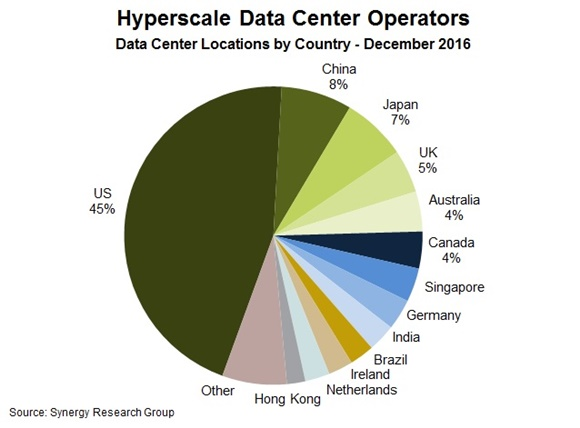
Asia-Pacific has been the fastest growing region in terms of hyperscale data center location and will continue to grow more rapidly over the next five years, although North America will still account for 43 percent of hyperscale data centers by the end of 2020, says Cisco.

Annual global cloud IP traffic  will reach 14.1 ZB (1.2 ZB per month) by the end of 2020, up from 3.9 ZB per year (321 EB per month) in 2015, Cisco predicts, nearly quadrupling (3.7-fold) over the next five years.


Overall, cloud IP traffic will grow at a CAGR of 30 percent from 2015 to 2020. On a global basis, cloud IP traffic will account for more than 92 percent of total data center traffic by 2020.


Hyperscale cloud operators are defined by Cisco as entities representing more than US$1 billion in annual revenue from infrastructure as a service (IaaS), platform as a service (PaaS), or infrastructure hosting services (for example, Amazon/AWS, Rackspace, Google); more than US$2 billion in annual revenue from software as a service (SaaS) (for example, Salesforce, ADP, Google); or more than US$4 billion in annual revenue from Internet, search, and social networking (for example, Facebook, Yahoo, Apple); or more than US$8 billion in annual revenue from e-commerce and payment processing (for example, Amazon, Alibaba, eBay).

Hyperscale data centers will grow from 259 in number at the end of 2015 to 485 by 2020, according to Cisco,  representing 47 percent of all installed data center servers by 2020.


Hyperscale data centers also represent a large portion of overall data, traffic, and processing power in data centers, accounting for 34 percent of total traffic within all data centers and driving 53 percent of in-data-center traffic by 2020.

Hyperscale data centers will also represent 57 percent of all data stored in data centers and 68 percent of total data center processing power.

Other data centers also are helping to shape traffic flows. Annual global data center IP traffic will reach 15.3 zettabytes (ZB) (1.3 ZB per month) by the end of 2020, up from 4.7 ZB per year (390 exabytes [EB] per month) in 2015, Cisco says.

Overall, data center IP traffic will grow at a compound annual growth rate (CAGR) of 27 percent from 2015 to 2020.

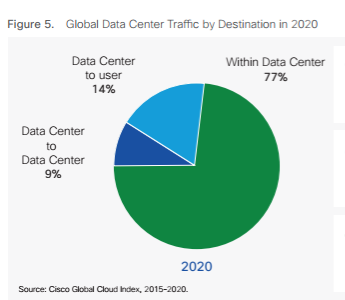
Overall, east-west traffic (traffic within the data center and traffic between data centers) represents 86 percent of total data center by 2020,


All Things Equal, Does Verizon Feel "Unlimited Usage" Pinch First?

Now that all four leading U.S. mobile service providers now offer some form of unlimited usage plan, consumer behavior and service provider behavior become crucial. The big objection many service providers have had with "unlimited" plans is the additional stress it might place on networks that might be ill-suited to rapid and unexpected changes in the demand curve.

With growing video consumption, that concern is well-founded. In other markets, consumers have shown a tendency to decrease offload access, and increase mobile network access, when the cost of mobile network access suddenly becomes much more affordable. Could that happen in the U.S. market? To some extent, it should.

Such additional demand is less dangerous when a network has plenty of spare capacity, either because networks are relatively lightly loaded, or because spectrum and network assets are plentiful.

It is not so clear that Verizon or AT&T enjoy that advantage, for example, while Sprint and T-Mobile US arguably are better positioned, in that regard.

Will consumer usage increase, and by how much, where and when? Will service providers keep the unlimited offers prominent in their marketing efforts?

If mobile network usage profiles change, how will that affect quality of experience on the various networks? And what will mobile service providers have to do to maintain quality in the face of increased network demand? How much can they do, near term?

In other words, will network congestion suddenly become a much-bigger issue? And what will mobile service providers do to alleviate any such changes?

Though the rankings will change after the final results of the 600-MHz auction are concluded, mobile spectrum holdings might start to matter in the U.S. market, as all of the four biggest mobile service providers offer unlimited usage. Since that tends to increase consumer consumption, mobile operators, consumers and investors will be watching not only revenue and profit trends, but potential new stress on networks, in terms of quality.

Before the additional 600-MHz spectrum to be added, U.S. mobile service providers had about 650 MHz of licensed capacity.

Eventually, those figures will be vastly eclipsed by all the new spectrum  to be made available, plus spectrum sharing and offload.  Millimeter wave spectrum will eventually have a big role.  In the near term, only offload is going to help in the near term, and even that help could be limited if consumers start relying on the mobile network more heavily in the wake of the unlimited plans.


Sunday, February 12, 2017

All 4 Leading Mobile Firms Now Offer Unlimited Usage

We might soon get some sense of how much "unlimited data" plans affect consumer usage, and mobile network infrastructures, as all four leading U.S. mobile firms now offer unlimited-usage plans.

Verizon Wireless has introduced an unlimited data plan. The Verizon Unlimited plan costs $80 a month, for unlimited data, talk and text, using paper-free billing and AutoPay features.

Both T-Mobile US and Sprint gained market share in the second half of 2016, presumably on the strength of  aggressive “unlimited usage” promotions. Verizon previously had stopped selling unlimited plans in 2011.

At the moment, all four leading U.S. carriers offer unlimited usage plans of one sort or another.

Just prior to the Verizon announcement, Sprint introduced a new family promotion, offering five lines of unlimited data for $90 per month excluding taxes and fees. Sprint's promotion lasts through March 31, 2017.

A current T-Mobile US unlimited plan costs $180 plan for five lines and $160 plan for four lines,  including taxes and fees.

Multi-user plans cost $45 per line for four lines. Some nevertheless are going to complain. After 22 GB of data usage on a line during any billing cycle, Verizon says it “may prioritize usage” in the event of network congestion. That “throttling” feature always is criticized in some quarters as a violation of the “unlimited” feature, but others simply see that as “fair use” policies.

Also included are up to 500 MB per day of 4G LTE roaming in Mexico and Canada.

Some Amount of Spectrum Inefficiency is Unavoidable

About half of all U.S. communications spectrum is allocated for use by government entities, and some argue that only a fraction of that spectrum is intensively used. Some studies suggest that most spectrum is lightly used or not used at all.


Consider mobile networks, which can be congested, at some locations, during the morning and evening rush hours, but are lightly used between 11 p.m. and 6 a.m., generally the pattern for fixed networks as well. But most cell towers--up to 80 percent--likely encounter relatively light peak loads.

Still, some amount of spectrum inefficiency is unavoidable. "Peak hour" demand is much higher than average demand. Guard bands designed to protect against interference obviously cannot be used for communications purposes. Small allocations (less than 10 MHz) necessarily entail a greater percentage of "wasted bandwidth" in that form, compared to allocations of larger continuous bands (20 MHz to 200 MHz).


Still, all public networks are built to serve “peak hour” demand, not average demand, and certainly not off-hours demand. In most cases, there are clear geographic differences in demand. Urban sites have more demand than rural sites. Mobile towers close to major highways and roads get more use than towers serving residential areas. Coast guard and other national defense usage tends to be higher near the oceans, not so much in the continental interior.


As always, there will be economic drivers. It might make more sense, for many users, to share spectrum in new regions (millimeter wave and unlicensed bands), compared to sharing in lower-frequency bands, simply because the cost and difficulty of doing so will be lower for new blocks of spectrum than for legacy blocks of spectrum.


Most of the lower blocks of spectrum are chopped up into slivers that would require much amalgamation to create the bigger contiguous blocks of spectrum now used by modern mobile and wireless networks.


Federal government exclusive and shared bands account for 64 percent of all spectrum allocations below 3.1 GHz, the New America Foundation estimates.


At the same time, it is time-consuming and quite costly to move users out of one band and into another.


That is why some many no advocate less reliance on exclusive spectrum licenses and more reliance on unlicensed or shared spectrum approaches, especially in existing communication bands at lower frequencies, where “coverage” spectrum is nearly all licensed on an exclusive-use basis.


Is Sora an "iPhone Moment?"

Sora is OpenAI’s new cutting-edge and possibly disruptive AI model that can generate realistic videos based on textual descriptions.  Perhap...