Friday, May 20, 2016

India Spectrum Auction, Summer 2016, to Let More than 2,000 MHz

There is a stunning mobile spectrum auction about to be held in India, though delayed, perhaps by the late summer of 2016.


The Indian government says 2,000 MHz of spectrum will be up for bid. Compare that to a total former allocation of 200 MHz to 300 MHz for the entire Indian mobile industry. The total apparently includes spectrum held by firms with expiring licenses, as well as some newly-released spectrum.


The new spectrum lies in the 700 MHz band. But that hardly will move the needle, in terms of overall spectrum to be made available, as the total new 700-MHz capacity will add but 35 MHz of incremental bandwidth.


One is left to guess that the 2,000 MHz (total spectrum actually might even rise to as much as 2,400 MHz after harmonization measures) figure is the total amount of spectrum across all 20-odd telecom “circles,” as the serving areas are known.


Oddly enough, mobile operators actually oppose auctioning the 700-MHz spectrum, on the grounds that they will be spending heavily on the rest of the airwaves, and that 700-MHz-capable handset availability, in India, is non-existent.


In fact, some analysts have suggested that spending just for the 35 MHz of 700-MHz spectrum  will represent as much as 74 percent of total auction proceeds.


The reserve prices represent an amount about double all prior investment in spectrum in India, across every auction, according the the GSM.

On the other hand, limited ability to pay might be a strategic consideration encouraging both AT&T and Virgin Media to consider re-entering the Indian market, which both firms earlier had done, before withdrawing.

If the pool of bidders for 700-MHz is limited, that might be a net positive for AT&T and Virgin Media, even if prices are deemed "too high" by existing mobile operators.


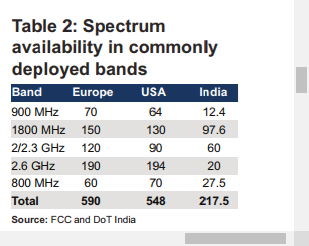
Some have noted that India has very low capacity at 0.2 Hz per subscriber, compared to levels in other markets such as the United States and Europe. Overall, India has 217.5 amount of spectrum, far behind the 548 MHz in the United States and 590 MHz in Europe.

Analysts have documented that “spectrum cost in India is one of the highest in the world.” Its spectrum pricing runs around “25 times costlier than the countries such as U.S., France, Singapore, Germany, Spain and Sweden,” according to one study by Brookings.


Also, licenses run just for 20 years, which some argue limits the ability of any mobile operator to reap a return, given market conditions that are extremely competitive.


A 2014 report from Merrill Lynch Global Research compares the Herfindahl-Hirschman Index (HHI) for various countries and India has the lowest market concentration at 0.22. The HHI is a standard test for industry concentration that runs from zero to one.


The U.S. market has in recent years had an HHI score of about 0.25, by way of comparison. Globally, mobile markets have an average HHI score of about 0.34.


The high levels of competition that result from low market concentration is reflected in the significantly lower tariffs and difficulties firms have in generating profits.
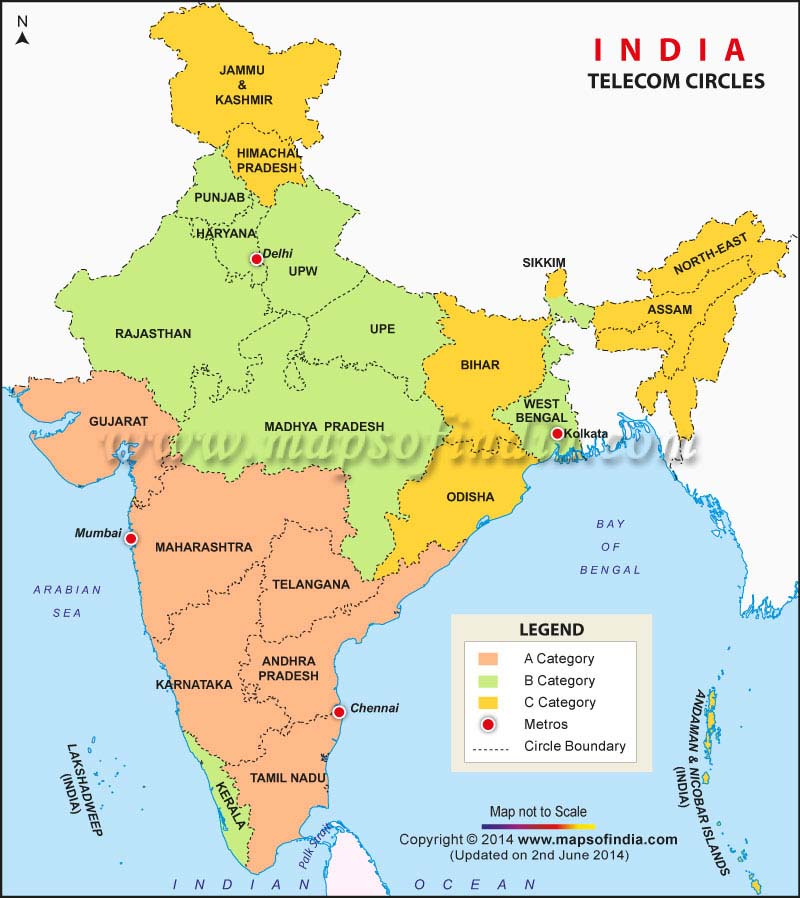

source: Maps of India

Vodafone to Focus App Partner Efforts on IoT

Vodafone’s vision for third-party developers to use its APIs to help them build new products in
Internet of Things areas such as smart cities, smart energy, and smart health, according to Lester Thomas, group chief systems architect at Vodafone.


As envisioned, Vodafone will provide the scale, the capacity, and the end-to-end operations to enable the new products and will enter into revenue-sharing arrangements with third-party application developers.


That is a switch from much of the earlier thinking by tier-one telcos about working with developers.


Much of the early activity was focused on consumer market apps, particularly for voice, messaging, location, and billing.

The new focus seems to be on business-to-business apps, or business-to-business-to-consumer. That is one reason a number of tier-one service providers are supporting a set of application program interfaces (APIs) that simplify the process of creating and supporting applications running on telecom networks, developed with the TM Forum.

Axiata, Bharti Airtel, BT, China Mobile, China Unicom, NTT, Orange, Telefonica and Vodafone have formally adopted the suite of digital service management APIs put together by TM Forum.

Mobile--Especially Mobile Data--Drives Revenue in Latin America

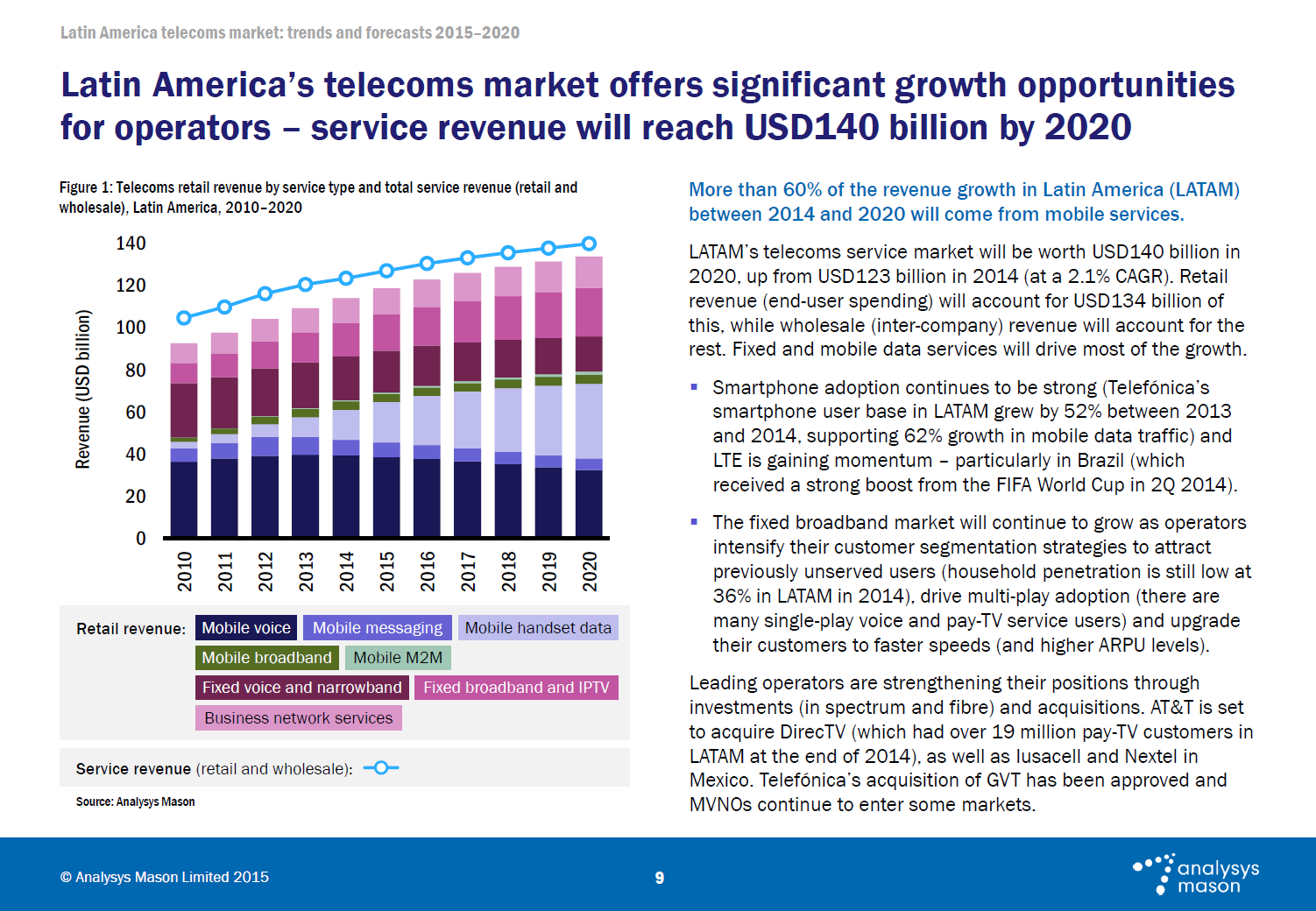
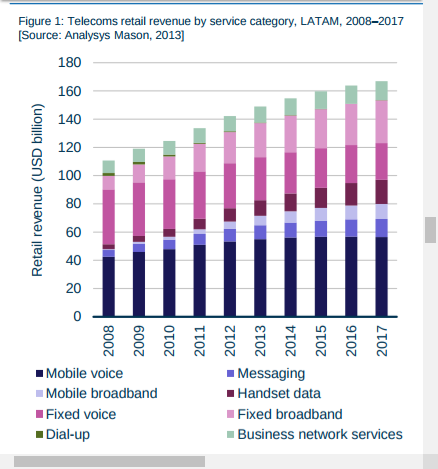
Mobile services will account for more than 60 percent of telecom revenue growth in Latin America between 2014 and 2020, researchers at Analysys Mason have predicted. That expectation has changed over the last several years, with the key change being forecasts for mobile data revenue.

The 2015 forecast shows the importance of mobile data.


The 2013 forecast did not include that sizable jump in mobile data revenue.

source: Analysys Mason

Forecasting remains an unpredictable and difficult undertaking. Non-linear change is very hard to predict, and mobile data revenue is a non-linear phenomenon.

The timing of major recessions, which cut revenue, cannot be predicted, either. At the moment, a difficult economic situation is affecting revenue and subscriptions in Brazil, for example.

Thursday, May 19, 2016

Charter Could Use Verizon to Create MVNO

Up to this point, Charter Communications arguably did not have the bulk (subscribers, footprint) to consider creating an MVNO based on “Wi-Fi first” access principles. With the acquisition of Time Warner Cable, all that arguably changes.

Charter emerges as a stronger number-two cable operator nationwide, with access to Time Warner Cable’s rights to use the Verizon Wireless network for MVNO services. The bigger subscriber footprint means more ability to rely on it own network of Wi-Fi homespots to connect its potential mobile users.

Historically, Charter has been much less interested in mobile services than Comcast has been. But with major investor Liberty Global pushing ahead with mobile services in Europe, it is likely Charter would revisit the issue of branded mobile services as a strategic matter.

4G Now Driving India Mobile Device Sales

source: IDC
New spectrum, supporting new networks, always shapes demand for consumer devices and apps. That is true in India as Long Term Evolution 4G networks are activated.

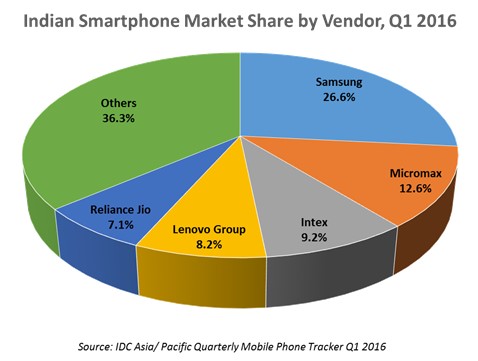
Sales of 4G smartphones shipments reached 15.4 million units in the first quarter of 2016, up more than six times over the same period of 2015,  says International Data Corp.

“4G based device shipments accounted for 65.5 percent of overall smartphone shipments in Q1 2016 driven primarily by Samsung’s J-series models,” said Jaipal Singh, IDC market analyst.

Smartphone shipments in India grew about five percent in the first quarter, year over year, says IDC.

The 23.5 million units shipped in India in the first quarter of 2016 were, however, down by 8.2 percent sequentially from the fourth quarter of  2015.

Shipments by Indian vendors Micromax, Intex and Lava collectively dropped 20.4 percent sequentially.

LeEco entered the Indian smartphone market in the first quarter. Chinese vendors such as  Oppo, Xiaomi, Vivo and Coolpad also gained traction in the first quarter of the year, IDC notes.

The “Make in India” campaign now has more than 25 suppliers manufacturing smartphones locally in India.

More than 66 percent of the smartphones shipped in the quarter were assembled within India.

Wednesday, May 18, 2016

Google Fiber, Cable TV, Iliad Show the Future of Fixed Network Business

As uncomfortable a notion though it might be, Iliad’s business model, a precursor in some ways to Google Fiber and resembling in many ways the cable TV approach to costs, might represent the future of the landline service provider business, which is to say, if costs must be attacked, Free, Google Fiber and cable TV companies already are showing key ways that can unfold.

Use of Wi-Fi access to economize on use of mobile network resources is a principle Iliad Free Mobile relies upon, and which cable TV companies also are expected to employ as they enter the mobile services business.

Like Google Fiber and Facebook, Iliad builds its own customer premises equipment. And like Google Fiber and cable TV companies, Iliad vigorously controls operating costs, operating with fewer people, and using more streamlined, self-provisioning processes.

So far, it seems to work. For the past four years, Iliad has added the most new accounts of any French mobile company. In its most recent quarter, Iliad added 215,000 net new subscribers for the 17th straight quarter.

Iliad also added 78,000 new Interent access subscribers, the second-best performance in terms of net adds in the fixed networks business.

At the same time, overall revenues grew about eight percent, year over year, 10 percent in the mobile segment and four percent in the fixed network segment.


The requirement for driving out cost and capital intensity is one reason traditional services providers are shifting to virtualized networks, open source software, making greater use of Wi-Fi and eventually will use more shared spectrum as well.

Tuesday, May 17, 2016

Can Facebook Jumpstart Rural ISPs?

In the U.S. market, many innovators have looked to the concept of “anchor tenants” as one way to build a sustainable Internet access service. Schools, hospitals or government buildings often are seen as suitable anchor institutions.
Facebook‘s “Express Wi-Fi” uses the same concept, encouraging anchor tenants to become local Internet service providers, providing a sustainable business model.
“We are already live in India and Indonesia with Express Wi-Fi,” said Ryan Wallace, Facebook technical program manager. “If you look at Myanmar as a great example that has got poor fiber infrastructure so satellite would probably be an interesting play there.”
“The Philippines is an island nation, so fiber is very much within the metropolitan areas. Satellite could be a big play there.”

Facebook has partnered with an Indian rural Internet access provider, AirJaldi, to manage the actual installation and operation of the Express Wi-Fi service.

For AirJaldi, which is based in Dharamsala and mostly provides Internet services to large customers like the Dalai Lama’s Tibetan government in exile, the project is a chance to figure out how to make money serving a widely dispersed customer base.

Is Sora an "iPhone Moment?"

Sora is OpenAI’s new cutting-edge and possibly disruptive AI model that can generate realistic videos based on textual descriptions.  Perhap...