Thursday, February 18, 2016

Wireless Internet Access Might be Entering a New Phase

Telco or cable TV bashing is a bit of a sport in some quarters, just as non-critical support for clean energy is dogma. The problem is that neither position (non-objective opposition or support) is a reasonable intellectual approach. Most transition processes (both energy and communications are in transition) are simple.

And we often discount new technology as reasons for making prudential judgments about the assumed motivations of contestants in virtually any market.

Caution about the wisdom of fiber to home, or fiber to business access platforms--in terms of the business case--is not unusual. In many cases, the optimism has not been rewarded. Verizon was the foremost proponent of the value of fiber to the home, but has learned that the business case was not as good as expected.

AT&T historically has been even more skeptical. But the skepticism is based on business case issues. And with rapidly-evolving wireless and mobile access capabilities, the skepticism might yet prove to be correct, for substantial numbers of potential customers and users.

Google, for example, has asked for permission to test fixed wireless access in 3.5-GHz shared spectrum. That presumably suggests Google also believes some deployment scenarios will not support a fiber to home approach.

AT&T already has committed to installing 13 million new fixed wireless connections, a similar judgment that fiber to home does not work, in rural and lower-density areas.

Competitive dynamics now sharply shape the business case, as cable TV operators are proving they can upgrade much faster, at far lower cost, than telcos can do. Under such conditions, ubiquitous fiber deployment is almost certain to fail, over the longer term, as cable proves to be the lower cost provider.

And with fifth generation access speeds initially slated for 1 Gbps per device, and plans to extend to as much as 10 Gbps, wireless increasingly will be a functional substitute for fiber to home or other fixed access technologies.

The point is that skepticism about the business case for any particular access platform, in any particular deployment, in severely competitive markets, is simply prudent.

To the extent that any fixed network service provider expects to survive, it must somehow figure out how to continue upgrading Internet access speeds. But “how” to do that, in a sustainable way, continues to evolve, with wireless becoming ever more viable.

To be sure, proponents have been arguing precisely that point for decades. But the background is changing. Moore’s Law makes possible more reliable service, under a wider range of commercial conditions.

Mobile networks based on 5G will offer additional options. Shared spectrum allows even more options.

The point is that huge capital investment decisions are risky at a time when business conditions are changing so fast. For many Internet service providers, while fiber to location has its place, most deployment scenarios might actually prove sustainable using wireless access.

How Much Can Better Modulation Boost 5G Performance?

Though most advances in usable mobile bandwidth come about through network architecture or access to additional bandwidth, better antenna technology and air interfaces (including modulation methods) also play a role.

Cohere Technologies, for example, touts its Orthogonal Time Frequency and Space (OTFS) technology, which supports “fadeless” radio performance at distances beyond four kilometers.

In tests, Cohere radios were able to maintain a minimum of four bits per second per Hertz in 10 MHz of bandwidth, achieving at least 120 Mbps up to 320 Mbps throughput.

Cohere argues that  OTFS supports 100 percent coverage, 10 times the spectral efficiency and a 50 percent cost savings over existing solutions.

Some, including executives at Nokia, believe an order of magnitude improvement can be wrung--between 2010 and 2020--from new spectrum allocation, transmission efficiency and smaller cell architectures.

Between 2012 and 2017, for example, Nokia believes a 14 percent capacity gain can be wrung from air interfaces, more than the 12 percent gain Nokia expects from new spectrum allocation.


Wednesday, February 17, 2016

Google Wants to Test Shared 3.5-GHz Spectrum for High Speed Access

Google wants to test use of 3.5 GHz shared spectrum in Kansas City, a development that could suggest Google believes it can use fixed wireless access instead of optical fiber for high speed Internet access.

AT&T also has promised a widespread deployment of fixed wireless access for high speed Internet access, reaching at least 13 million locations.

Google’s request to test 3.5 GHz access, including use of the 3550-3700 MHz Citizens Broadband Radio Service spectrum.

It now appears that wireless local loop, which has been tried for decades, might finally be on the cusp of widespread deployment.

With cable TV operators starting to deploy gigabit DOCSIS 3.1 services, and as CableLabs works to create symmetrical 10 Gbps services using new full-duplex platforms, there might be many new alternatives to fiber access available for commercial deployment in the U.S. market.

Mobile Grows Everywhere Except Latin America in 2015

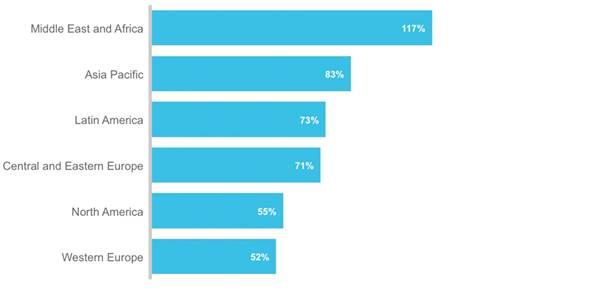
Even in industry segments that generally are growing, there are regional differences. It appears that mobile service actually declined by 14 million accounts in Latin America in 2015, a development Ericsson attributes to economic pressures that caused consumers to abandon use of mobile services.

Global mobile subscriptions grew three percent year over year. India grew the most in terms of net additions during the fourth quarter of 2015 (+21 million), followed by China (+6 million), the United States (+5 million), Myanmar (+5 million), and Nigeria (+3 million).


Mobile "Coverage" Footprint Can Reach Most People, Even When Not Covering Most "Areas"

T-Mobile US CEO John Legere says T-Mobile's Long Term Evolution coverage now covers 90 percent of the footprint of Verizon's LTE coverage. 

If so, that means not many people live in much of the U.S. geographic footprint, which is the case. T-Mobile's "pink" areas are 90 percent of Verizon's "red" areas. 

Tuesday, February 16, 2016

IoT Eventually Will Drive Significant Mobile Connections Growth

Use of mobile phones is growing twice as fast as world population, but future subscription growth will shift to Internet of Things sensors.

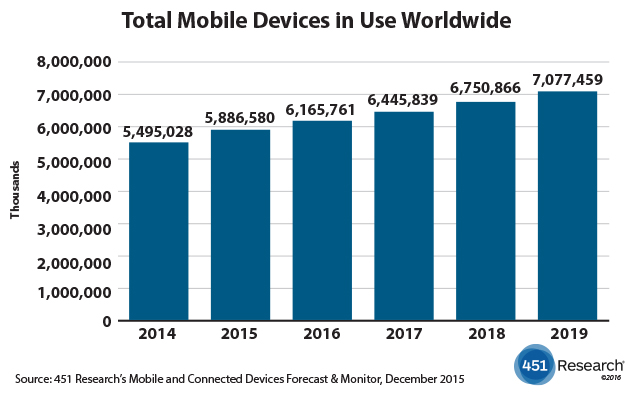
By 2020, there will be 8.2 billion handheld or personal mobile-ready devices and 3.2 billion M2M connections (GPS systems in cars, asset tracking systems in shipping and manufacturing sectors, or medical applications, for example).

The number of mobile-connected devices per capita will reach 1.5 by 2020. At that point, smartphones grow at a 40 percent compound annual growth rate, while IoT devices represent 26 percent rate. according to Cisco.

Smartphones will produce 80 percent of mobile data traffic demand  by 2020, while
75 percent of the world’s mobile data traffic will be video by 2020.


Asia Pacific will account for 45 percent of global mobile traffic by 2020,

Monday, February 15, 2016

Idea Cellular to Add 43,901 New Cell Sites in 2016

Idea Cellular plans to install 43,901 new cell sites in 2016, a clear response to new regulations imposing significant fines for call drops.

Some of us had argued that it would not take long to remedy the call drop problem identified by the Telecom Regulatory Authority of India. But it will take money.

Though it might not be an especially affordable solution, adding many new towers--or acquiring additional spectrum--are the two main tools available to address the problem. Other changes--such as substituting more-efficient antennas, or changing modulation schemes, take longer to implement.

To create incentives for change, TRAI has instituted new rules requiring user compensation for call drops at the rate of Re. 1 per call drop, up to a maximum of three calls per day.

Though it might take some time to add many new cell towers, a remedy many would agree is necessary, the Cellular Operators Association of India (COAI) argues operators already have taken measures to improve performance in just two months time.

“TRAI’s observation that there is no improvement in call drops after conducting the second drive test in September 2015, is not in consonance with the reports submitted to DoT by operators, which shows marked improvement in the operators’ networks over the past eight weeks,” says COAI.

The industry has added almost 70,000 additional cell towers in the last six months alone, COAI argues.

Lack of spectrum also is an issue. Compared to many countries, India has allocated less bandwidth per potential customer. According to at least one survey, consumers are more concerned about tmobile Internet access han call drops, though.


Is Sora an "iPhone Moment?"

Sora is OpenAI’s new cutting-edge and possibly disruptive AI model that can generate realistic videos based on textual descriptions.  Perhap...