Friday, January 15, 2016

Reliance Jio's Huge Bet Will Reshape Indian Mobile Market

It would be hard to underestimate the importance of Reliance Jio’s entry into the Indian mobile market. The move instantly moves Reliance Jio from a positive to a negative balance sheet.


The $14 billion foray into mobile services already is reshaping the rest of the business as well, triggering capital investment boosts, mobile data price cuts, spectrum sales and acquisitions, and a few market exits by smaller players, ultimately.


Bharti Airtel, the biggest telecom firm in India, launched its high-speed 4G services way ahead of R-Jio to take the first-mover advantage, offering 4G at the cost of 3G service.


Of course, those investments mean more balance sheet pressure for Airtel and the other main competitors, all of which must expect to bleed millions of customers, in addition to spending more on their networks, and likely being forced to spend more on marketing as well.


At least one analyst believes the other leading Indian mobile firms could lose 45 million accounts to Reliance Jio, over a two-year period.


“A significant step-up in capex clearly reflects fear of disruption by R-Jio and it would keep the balance sheet stretched. Moreover, as competition is going to accelerate post R-Jio, we believe RoE’s (return on equity) on incremental capex would remain under pressure, hence, delaying payback on investments,” said Emkay Global Financial Services.

“Even as Idea (Idea Cellular) management has maintained it does not expect FY17/18E wireless network capex levels to be materially higher than FY16E guided levels of Rs.60-65 billion (Rs.6,000-6,500 crore), increase in Bharti’s capex spends may force a recalibration of Idea’s capex plans, in our view,” said Kotak Research.

Thursday, January 14, 2016

Mobile Operators Will be Careful about Overspending in Coming 600-MHz Spectrum Auction

Spectrum auctions often wind up becoming burdensome. Ask executives who were with major mobile service providers in Western Europe when third generation spectrum was auctioned.

It might yet be the case for  3G spectrum auctions in India, as well. "The auction design and the scarcity of spectrum have resulted in exorbitant bids to secure the spectrum, particularly in renewal circles, where huge investments have already been made on the assurance of a continuity of business enshrined in the licenses issued by the DoT," said Gopal Vittal, Bharti Airtel's CEO for India and South Asia.

Put another way, spending already seems to have strategic implications, as a  winnowing of suppliers from as many as eight in a region to perhaps five already seems underway.

For some of the smaller providers, the spectrum auctions will eventually be seen as contributing to their acquisition by other providers, in addition to new competition from Reliance Jio.

“The only way it gets bigger is if there’s some dark horse bidder like a private investor," said Jennifer Fritzsche, an analyst with Wells Fargo Securities.

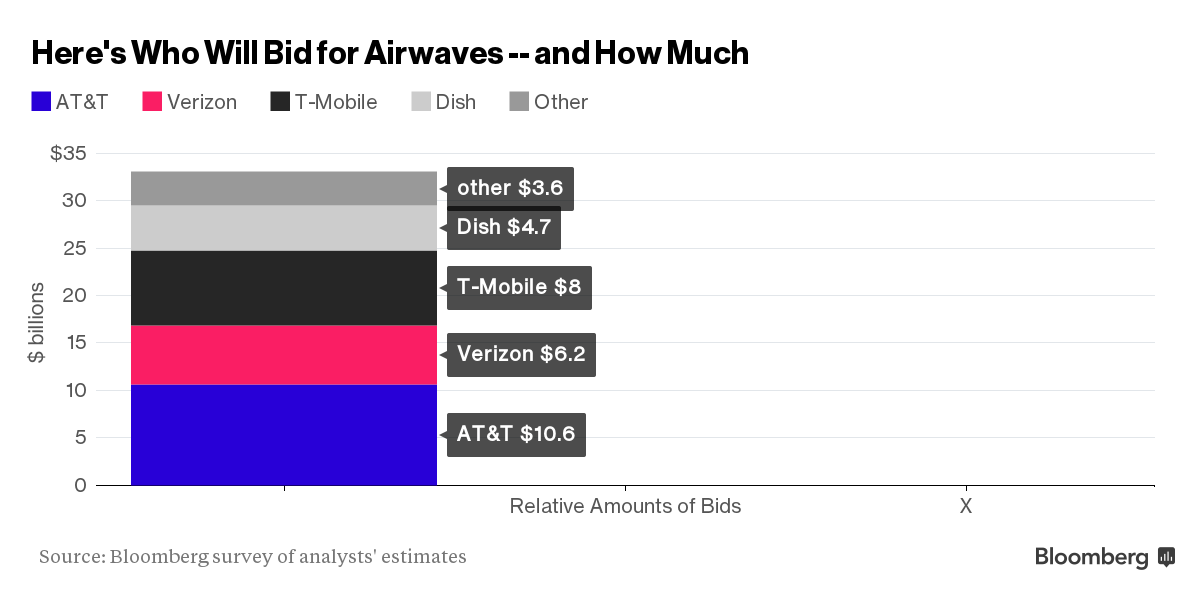
Less than a year ago, bidders pledged $44.9 billion in the so-called AWS-3 auction. Aggressive price competition, though, is hitting profits, crimping willingness to boost capital spending and making additional debt loads unappetizing.

AT&T and T-Mobile US generally are believed to be setting up for vigorous bidding, while Sprint will not bid and Verizon and Dish Network have not been too forthright about their own potential plans.

Comcast and possibly a few others might also decide to bid.
source: Bloomberg

Interference Protection: More Dynamic in the Future

Other considerations aside, a disagreement over how to protect existing licensed users in future U.S. 3.5-GHz shared spectrum illustrates the transition we now are making between traditional and next generation methods of dealing with potential interference issues.

Traditionally, interference mechanisms have been based on physical and static attributes such as space division, or power limitation. Space division includes both frequency division and geographic separation.

Aside from the reliance on physical means, the protection mechanisms were static. But different, more dynamic means are becoming available. Databases and sensing devices that can dynamically avoid potential interference, are becoming available.

Wednesday, January 13, 2016

Reliance Jio Could Take 45 Millioin Customers from Airtel, Vodafone India, Idea Cellular

Reliance Jio Infocomm could acquire 80 million 4G Long Term Evolution customers in 24 months, gaining at least half that number from Bharti Airtel, Vodafone India and Idea Cellular, investment banker CLSA said.

Vigorous competition for 4G customers, as well as Reliance Jio’s market entry, will lead to a trebling of data revenue to Rs 80,300 crore (about $12 billion) over the next two years.

That prediction is based on history. New entrants typically gain two percent to five percent market share within eight quarters of entering a market with six to seven operators, CLSA said.

But CLSA expects Reliance Jio to grab seven percent market share by March 2018, assuming a March 2016 launch, getting 16 percent share of all India mobile data subscribers, CLSA said

CLSA expects a majority of Jio's early subscriber additions will happen in urban areas.

As for losses suffered by the rival carriers, CLSA expects Reliance Jio to take 15 million accounts from Bharti Airtel, perhaps 10 million from Idea Cellular and 20 million from Vodafone India.

26% of Smartphone Users Abandon"Carrier" Voice Calls

Some 26 percent of global smartphone customers in developed markets will make no traditional phone calls in a given week in 2016, predicts Deloitte.


That attention-grabbing headline is likely misleading, however. Perhaps most of those “non-users” will talk, but will rely on over the top apps, not carrier voice.

Those consumers also will rely on messaging (including text messaging), voice and video services delivered over the top and social networks to communicate, especially with friends and family.

Tuesday, January 12, 2016

Difference in Value of Licensed, Unlicensed Spectrum Will Narrow

Very few observers would say that, today, unlicensed spectrum has the same value as licensed spectrum.

But there are ever-fewer who would argue that the differences will remain as pronounced as they presently are, as a foundation for business strategy.

There are several reasons why the value of licensed or license-exempt spectrum is nearly certain to narrow. To start with, significantly more licensed spectrum, plus more unlicensed spectrum, will be allocated.

Since scarcity drives price, prices should moderate, at least for new spectrum in the millimeter bands. Since signal reach and bandwidth are directly related to frequency, and since most of the new spectrum is in the high frequency millimeter bands, capacity will increase far more than the stated bandwidth would suggest.

In other words, any given amount of bandwidth at millimeter frequencies vastly outstrips the same amount at lower frequencies (600 MHz to 800 MHz).

At the same time, as some countries move to allow spectrum sharing in bands currently allocated to government users (initially in the 3.5-GHz bands in the United States and 2.3 to 2.4 GHz bands in Europe, spectrum supply also will increase.

Finally, Wi-Fi bandwidth increasingly will be made more “carrier-like,” in terms of its predictability.

Also, the use of public Wi-Fi (including huge networks of “homespots” that leverage consumer fixed connections) will create coverage that is more ubiquitous than ever before possible.

Dynamic access databases, cognitive radios and frequency-agile devices will enable sharing where that has not been possible before.

The two major standardized approaches, Licensed Shared Access (LSA) in Europe and Authorized Shared Access (ASA) in the United States,  

In Europe, shared access is being tested in France. In the United States, the 3.5 GHz band will be first to see shared spectrum. Both the 2.3 GHz and 3.5 GHz bands have been designated for mobile broadband by the International Telecommunications Union.

The upshot is that the value of licensed and license-exempt spectrum to support mobile access is going to narrow.

Monday, January 11, 2016

Wi-Fi Will Support More Mobile Data Consumption than the Mobile Network by 2018

Since more than 80 percent of all traffic originates or terminates indoors, and since the mobile phone now is the Internet access device of first choice, it perhaps is no longer surprising that, in 2015, Wi-Fi offload traffic from mobile devices exceeded 4G mobile traffic.

By 2018, Wi-Fi traffic is set to exceed all 2G, 3G and 4G cellular traffic combined, according to ABI Research.

That has implications for the value of the fixed network, which increasingly is backhaul for Internet traffic, including untethered traffic consumed by smartphone users at home, in the office and elsewhere.

In-building wireless data traffic will grow at a double-digit rate to reach 53 exabytes per month worldwide in 2020, ABI Research says.

The Asia-Pacific region will continue to consume almost half of the worldwide in-building wireless traffic through 2018.

The other important role for the fixed network is a delivery mechanism for entertainment video, consumed on premises by a variety of devices ranging from TVs to game players to smartphones.

Indeed, as more video traffic moves to  “on demand” Internet formats, it is hard to separate the backhaul  function from the video delivery function.

Is Sora an "iPhone Moment?"

Sora is OpenAI’s new cutting-edge and possibly disruptive AI model that can generate realistic videos based on textual descriptions.  Perhap...