Tuesday, January 11, 2022

Capex and Opex Matter, So Long as the Other Business Model Elements are Aligned

Rakuten might be correct about its own capital investment and operating cost savings from a virtualized and open radio access platform. Still, revenue upside, spectrum assets, marketing prowess and other elements of strategy--including the timing of capex--arguably are more important. 


That might be especially true as the early deployment of a next-generation mobile network begins, where other competitors have been able to move faster in deploying that network. 

source: Rakuten, LightReading 


source: Rakuten, LightReading 


Capex and opex matter, but in the context of the other elements of the business model. Low capex with low deployment might also mean low subscriber growth for a challenger, especially when facing competent incumbents with more resources and a bigger installed base of customers.


Sunday, January 9, 2022

How Much New Demand Will Infrastructure Bill Create?

The actual impact of the 2021 infrastructure bill passed by the Congress will hinge on the rules governing disbursement of the funds. But the funds are sure to decrease the cost of adding new infrastructure and increase demand as well.


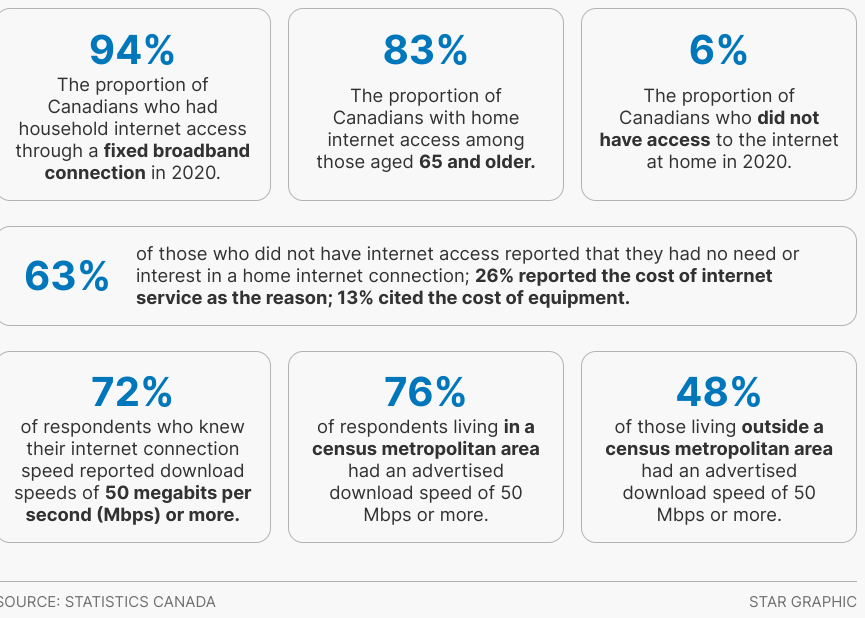
It also is worthwhile noting that not every household “does not have access” to broadband for reasons of supply. In Canada, for example, six percent of homes do not buy fixed network broadband. Some 63 percent report they do not wish to buy. Some 39 percent claimed they could buy, but that cost was the issue. 


Note the non-existent percentage of “non-buyers” who say they “cannot buy” because the service is not available. In the U.S. market, it often is estimated that about 1.5 percent to two percent of homes literally do not have any fixed network service available to them. 


The point is that most buyers unable to use “broadband” (defined as a minimum of 25 Mbps) actually do have internet access from one or more providers, though speeds are not what most of us prefer. 


That is important as we look at the potential impact of new U.S. federal government support for broadband. 
source: Statistics Canada 


Though money can be spent on digital literacy, equipment support or other training, most observers are likely waiting to see what impact can be made on quality of service. Connecting the “unconnected” also is important, for the last one to two percent of homes. 


But quality of service is the bigger issue for most. 


So how might the money could affect a single state, such as Hawaii. Assume total spending is about $300 million. What could that do? Much depends on the mix of demand and supply incentives, and none of that is clear yet. 


Assume, for the sake of argument, half is used to stimulate demand, and half is used to stimulate supply. At a subsidy rate of $30 per month, the fund means $360 in annual benefits for eligible households. That arguably means 416,667 annual subsidy accounts. Over a decade, that would mean 41,667 households per year could save $360 in access fees. 


That might actually exceed actual demand. 


Assume10 percent of people cannot buy internet access. Some might not buy because there are no facilities or cost is deemed too high. Those are easier problems to solve than gaining adoption by households that see no value to computers or internet access, or who see mobile broadband as a reasonable substitute product. 


According to Broadband Hui, some 55,000 households in Hawai‘i (nearly 12 percent) do not buy internet access services. That does not mean they cannot, they simply do not. That might be a demand issue more than a supply issue.


Perhaps seven percent of those homes simply do not wish to buy internet access, or about 3850 households. That implies 51,150 households that either cannot currently buy internet access; have access but not at 25 Mbps or choose to use mobile access instead. 


Mobile-only households might be 15 percent to 20 percent of all homes. Use the lower figure. At 15 percent, that implies 8250 households prefer to use mobile access in place of fixed access. So the potential pool of customers for the $30 subsidies might be 42,900. 


It is not clear that all those households would qualify for, or use, the $30 subsidies, though. Nor is it clear that the new subsidy actually increases adoption very much. 


There are other assistance programs already in place. For example,98,000 households might qualify for the $30 subsidy as recipients of support from the Supplemental Nutrition Assistance Program (SNAP). Medicaid recipients also are eligible. So are students receiving Pell grants. 


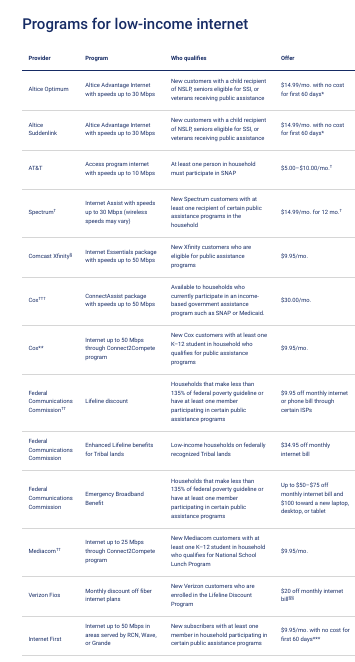
But most internet service providers already were providing low-cost internet access for low-income customers,supplying 25 Mbps access at prices between $5 and $15 a month.


The point is that low-cost 25 Mbps access already has been available to households at prices between $5 and $15 a month from all the major suppliers. It is not clear how many low-income households that want internet access were not already buying. 

source: High Speed Internet.com 


The point is that the $30 subsidies are more likely to shift demand from some service plans to others than to cause non-subscribers to become subscribers, since the subsidies can be used to defray consumption of any tier of service. 


In that sense, allocating half the estimated $300 million to service subsidies might have relatively slight impact. The bigger problem might be lack of any service, and inability to buy any grade of service faster than 25 Mbps. 


So there is likely a public policy argument for spending most of the broadband funds on infrastructure improvements, rather than additional service subsidies.


Thursday, January 6, 2022

When Slowing User Speed is a Good Thing

When are slowing mobile data speeds a good sign? When a new network is launched, there are relatively few customers, so data speeds through the network with little congestion. As networks add many more new users, congestion increases and speeds drop. 


source: Ookla 


But that is a good sign, as it shows the new network is getting traction. So new data showing

slowing 5G speeds in many markets is a good thing, not a bad thing. 


On mobile networks there also is a trade off between the frequencies used to support 5G and the capacity of those networks, as low-band signals provide better coverage but mid-band and millimeter wave supply much more capacity. 


The example is the U.S. market, where much of the early coverage used low-band spectrum. Combined with millimeter wave sharply limited coverage, with mid-band resources slower to come online, the almost-paradoxical result is high coverage but low speeds. 


source: Ookla 


source: Ookla

Wednesday, January 5, 2022

How Big a Niche is 5G Fixed Wireless?

Many observers believe 5G fixed wireless is a niche. The issue is how big a niche it might be. 


Verizon's 5G fixed wireless now is available for $25 a month. Those plans come with extras such as streaming content subscriptions. Typical  download speeds of 90-170 Mbps with higher speeds and peaks over 1 Gbps in areas where millimeter wave capabilities are activated.


Typical upload speeds of 15-30 Mbps with peak upload speeds over 100 Mbps. 


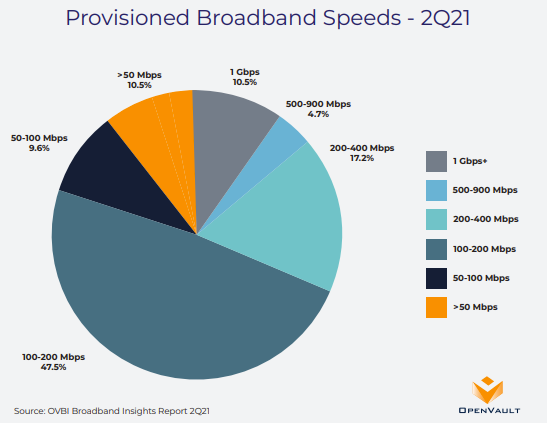
Based on current buyer behavior, that might appeal to 20 percent to perhaps 30 percent (or more) of the home broadband market, the lower figure representing customers who already buy service at 100 Mbps or less. The higher figure adds customers who might prefer faster speeds, but for whom a $25 monthly cost is preferable to $50. 


Single-user households or price-sensitive customers are likely possible buyers. 


source: Openvault 


For Verizon, fixed wireless is important as it extends Verizon’s home broadband coverage so much. The company expects fixed wireless will represent 71 percent of its home broadband passings by about 2025.   


AT&T Expects Market to Turn to Consolidated Offers

AT&T says it added total postpaid net adds of 1.3 million in the fourth quarter of 2021, including some 880,000 postpaid phones. “Each of the 2021 quarters has improved,” said John Stankey, AT&T CEO. 


For the full-year 2021, postpaid phone net additions were 3.2 million, “AT&T’s highest annual postpaid phone net adds in more than a decade,” the company says. 


Many observers believe the rather-torrid pace of net additions in the mobile service market should cool in 2022, though. 


Covid restrictions on schooling and work also are considered to have accelerated growth, possibly pulling forward some latent demand. Some amount of higher subsidies should also have helped boost sales. 


Competition from cable TV companies and Dish Network eventually will affect growth prospects as well. 


And some argue that a wave of promotions likewise has stimulated demand that is essentially pulled forward as well. Stankey does not agree with that argument. “Our cost per acquisition is dropping,” he said. “Our lifetime embedded value is increasing as churn goes lower and average revenue per user grows.”


In the event that such growth drivers end, overall growth rates could--or should--slow. In that case, net market share gains by some companies or others will become more important. T-Mobile, for example, has been gaining share for years.  


In operational terms, Stankey also suggested the industry might well be seeing a turn towards consolidated offers where single-supplier offers might be viewed more attractively. One example might be the value proposition that “it doesn’t matter where you go, we will handle your bandwidth,” Stankey said. 


As you might expect for a firm that has the largest fixed network position in the market as well as mobile assets, Stankey believes there “could be a reordering of industry structure” coming that favors firms with broad fixed and mobile offerings. “My gut tells me there are more consolidated offers coming,” where one firm supplies all a customer’s needs. 


"Vodafone Always Connected" Uses 4G to Automatically Backup Home Broadband

Vodafone Always Connected is a 4G backup for home broadband, now offered in Ireland. If the home broadband line has an interruption, access is switched automatically to the 4G mobile network using an in-home appliance. 


When the fixed network issue is resolved, the connection switches back to the home broadband fixed network.


That “4G as a backup” strategy has been used for some time by some business customers who want a failover strategy for their primary fixed network connection. 


To my knowledge, this is the first mass market service to offer the same feature to consumer customers. 


The Vodafone Always Connected device is self installed and delivered by mail. 


It uses its own standard subscriber information module. The device connects to the USB port at the back of the customer’s existing broadband modem. The device autoconnects. That is pretty much it. 


Vodafone notes that this backup service works only when 4G is available, as is the case for about 99 percent of locations in Ireland. 


Vodafone points out that the backup solution works when there are:

  • Alterations to connections and wiring inside your home,

  • Any local or exchange faults on your broadband,

  • Fallen lines due to building work or;

  • Storms, high winds, or adverse weather conditions that cause damage to the fixed broadband network.


Instances where it does not help: 

  • The customer modem does not have power. For example, if there is a power outage, your modem will not be powered and Vodafone Always Connected will not work.

  • The 4G mobile network is down at the same time as your broadband or;

  • There is any damage to a customer’s modem.


Of course, when there are local power outages, then the appliances and devices using the internet (TV, PC, dongles and devices using Wi-Fi) also will not work, unless the customer has a backup power source. But that is the case for all locally-powered devices. 


As was the case for locally-powered cordless phones, they are useless when local power is lost, even if the connection remains operational. 


Widespread power outages are another problem. If cell towers are damaged or power is lost over a wide area, for many hours, then the mobile network itself is likely to be unavailable as well. 


For most consumers, higher levels of backup are probably not considered worth the cost and effort. That would entail generator power and battery backup for the whole house and ample supplies of fuel, plus the proper permits. 


Still, the feature is an interesting extension of a business service to the consumer market. For most of the internet era, the diffusion of technology actually ran the other way: from consumer to business. 


We often forget that many current business-grade tools initially came to work when workers wanted to use the same tools they had available to them as consumers. 

The service costs €5 a month.

Monday, January 3, 2022

Millemeter Wave is Tactically a Chore but Strategically Essential

Opinions about millimeter wave spectrum for mobile networks often focuses on short-term issues rather than long-term realities. In the near term, millimeter wave spectrum does require denser, small cell networks. 


That means higher network costs and construction issues. Mobile operators naturally will prefer to build 5G on mid-band spectrum, which can reach high coverage with important advances in potential bandwidth much faster than a “millimeter wave only” alternative. 


Long term, as mobile bandwidth demands continue to increase, no matter what is done with cell sizes, reclaiming low-band spectrum and more-sophisticated radio technology, the only available spectrum to support 6G and future generations will be found in the millimeter regions. 


In this illustration, the existing 2G, 3G and 4G spectrum assets are shown at the far left. The width of the blue bars roughly illustrates the amount of capacity at different frequencies. 


The horizontal axis represents the frequency spectrum from approximately 1 GHz to 90 GHz on a relative scale (mobile services tend to use frequencies at 600 MHz to 800 MHz at the low end).


The orange bars show the approximately 11 GHz (capacity, not frequency)  of new spectrum released by the FCC for both licensed and unlicensed use. Note that the total amount of new bandwidth is orders of magnitude more than all bandwidth presently available for mobile purposes.


The red and green blocks show frequency allocations for the aerospace, defense and satellite communications industries, parts of which might ultimately be available using shared spectrum mechanisms.


source: Anokiwave  


The point is that higher data demand will require additional spectrum, even if all the other tools (smaller cells, spectrum sharing, better radios) are used. The illustration below makes the same point. The traditional “mobile spectrum” is shown in light blue. For the most part, other users have rights to use spectrum below 600 MHz. 


That means new spectrum must come from the millimeter and other high-band spectrum areas. 


source: Researchgate 


Millimeter wave is not as easy to engineer as low-band or even mid-band resources. Much more backhaul facilities are required. More radio engineering often is necessary. And indoor signal coverage is nearly a separate task, as millimeter signals are largely restricted to outdoor coverage. 


So it is quite understandable that some do not believe millimeter wave will be so important, near term, as mid-band spectrum. 


Longer term, networks will have to be crafted to use millimeter wave assets, though. There simply are no other sources of new spectrum to be tapped, once all other mobile spectrum from legacy networks is repurposed.


Is Sora an "iPhone Moment?"

Sora is OpenAI’s new cutting-edge and possibly disruptive AI model that can generate realistic videos based on textual descriptions.  Perhap...