Tuesday, January 12, 2021

17% of Mobile Operators Have Commercially Launched 5G

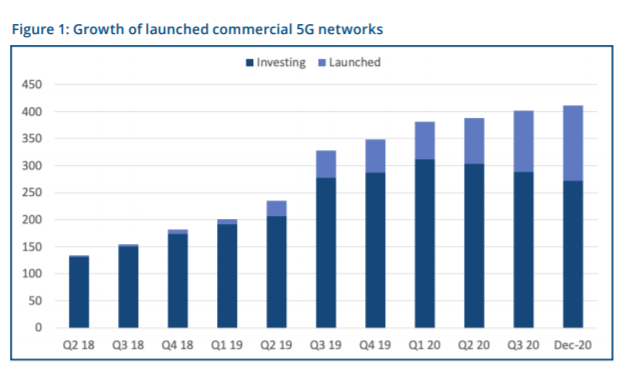
In December 2020 there were 412 mobile operators in 131 countries and territories investing in 5G networks, including 140 operators in 59 countries or territories that have launched commercial 3GPP-compatible 5G services (either mobile or fixed wireless), according to the Global Mobile Suppliers Association. 


So about 17 percent of mobile 4G operators have begun commercial 5G service. 

source: GSA 


There are 806 operators with commercial LTE (4G) networks offering broadband fixed wireless access and or mobile services, the GSA says. 


GSA says 423 firms operate LTE fixed wireless access services while 742 operators operate mobile LTE services.


Monday, January 11, 2021

C-Band Auction Activity Suggests Network Slicing Not a Substitute for Spectrum Licenses

One possible conclusion we might draw from the robust activity in the U.S. C-band auction is that major mobile service providers continue to base their network plans on licensed spectrum. Use of unlicensed spectrum remains important, but it does not appear any major service providers will deviate from historic patterns. 


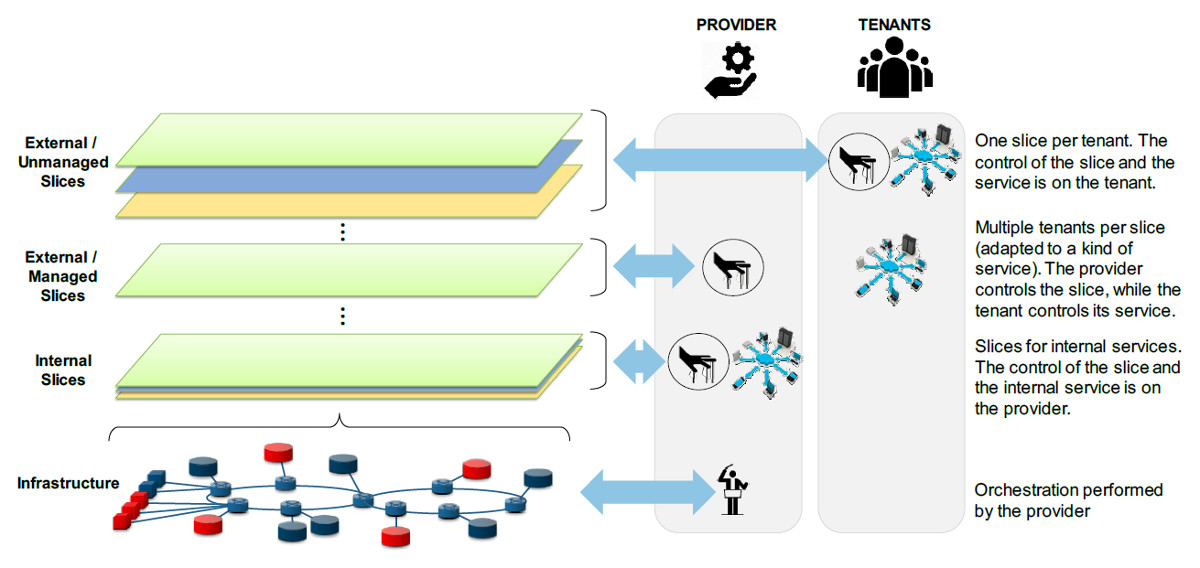
What remains to be seen are possible uses of network slicing features of 5G networks by specialized and smaller providers. In principle, at least, a network slice could form the national backbone and access network for a specialized enterprise network using 5G access. 

source: IEEE 


Also, in principle, such an enterprise user could be a wholesale customer running a 5G network of its own, much as a mobile virtual network operator buys wholesale capacity from a facilities-based mobile operator. 


As always, cost matters. It may well turn out that buying a network slice is an uneconomical way to support the transport and access functions of a custom 5G network. As it simply makes more sense for an application provider to use “any available access connection” to support users, so it may not make any sense for an app provider to spend capital on the access infrastructure. 


Still, it remains conceptually possible for a smaller mobile service provider to consider network slicing an alternative to purchasing wholesale capacity from a facilities-based service provider. Whether there are feature or cost advantages remains to be seen. 


What seems more likely are uses of network slices to support custom services supplied on a turnkey basis to end users, especially those with latency-performance requirements.


Thursday, January 7, 2021

C-Band Auction Prices Rise; Still Not at AWS-3 Levels

The C-band auction is producing prodigious amounts of bid magnitudes. But the important price per potential user (MHz-POP) has yet to eclipse prices paid in the important AWS-3 auction that supported 4G. 


C-Band Auction Nationwide Price Per MHz-POP, End of Round 65


Auction Prices Only

Fully-Loaded Prices

Average Across All Categories:

$0.937601

$1.088994

Category A:

$1.308321

$1.615574

Category BC:

$1.182931

$1.338849

Category ABC:

$0.540820

$0.612104

Category BC and ABC:

$0.841242

$0.952123

source: Sasha Javid 


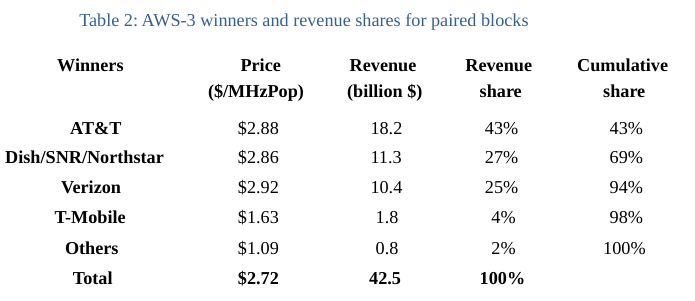
Even including the clearing costs, C-band prices have not eclipsed what was paid for AWS-3 capacity. 

source: Peter Cramton

U.S. 5G Speeds Will Improve Dramatically as New Spectrum is Activated

Building a nationwide next-generation network across a continent-sized country always takes a while. It arguably takes a bit longer when the spectrum assets needed to do so must be patiently assembled over a period of time. And that arguably is precisely what AT&T and Verizon face with 5G. 


Both firms have a significant trove of millimeter wave assets, but both have had a real shortfall of mid-band spectrum offering the best balance of coverage and capacity. 


T-Mobile, on the other hand, has lots of 2.5-GHz mid-band spectrum to deploy, putting both the other two firms at a near-term disadvantage, though T-Mobile’s early 5G coverage also has been based on low-band spectrum, meaning relatively limited speed differentials compared to 4G. 


That appears to be why the C-band auction has drawn such interest, though we do not yet know which firms are bidding for the rights. 


In the meantime--for coverage--AT&T and Verizon have had to make do with either new low-band spectrum (AT&T) or dynamic spectrum sharing (Verizon), which essentially diverts 4G capacity to support 5G. 


“We’ve always been very transparent and said the nationwide 5G layer would be built on our best-in-class 4G LTE network,” says Ronan Dunne, Verizon’s consumer group CEO.  What we’re generally seeing is between five-percent to 20-percent performance improvement over 4G. 


Over time, the speed differential between 4G and 5G will widen dramatically. But building a continent-sized network does take a few years, even when spectrum and other assets already are in position. 


That has not generally been the case in the U.S. market, where 3.5-GHz assets used in most other countries to support 5G have been unavailable. The Citizens Broadband Radio Service spectrum auctions were part of the effort to rectify that problem. The C-band auctions are the bigger part of the answer.

Wi-Fi 6 Might be Used Indoors for Signal Trunking

Though Wi-Fi 6 obviously will be used as a direct interface for access points, adding to the existing 2.4 GHz and 5 GHz bands, it might also be used to support mesh network AP signal trunking indoors. 

Friday, January 1, 2021

Device Density Could Push Some Enterprises to Private 5G

Some enterprises--especially those in industrial or manufacturing settings with lots of expected use of sensors--will find private 5G a reasonable substitute for Wi-Fi networks. In some cases, latency performance, device management, security or some other value will tip the decision. 


Device density might be one of the requirements that favors private 5G over Wi-Fi. 


Wi-fi networks are considered “high density” if more than 30 client devices connect to a single access point. Even many commercial Wi-Fi 6 routers only promise simultaneous support for 30 to 60 users. 


Today’s generally deployed Wi-Fi networks can--in principle--support up to 255 devices (the router’s memory limit) or up to a theoretical limit of about 2,000 devices per access point. It is not clear any specific deployment of low-bandwidth, infrequently-transmitting devices, all located fairly close to the access point, would reach the theoretical limit. 


That is the reason many industrial and other end users might consider using private 5G as a connection platform for indoor or local area networks. 5G will support many more users per access point or base station. 


5G is expected to support up to one million connected devices per .38 square miles, compared to around 2,000 connected devices per .38 square miles with 4G. 


If a typical U.S. suburb contains about 2213 households per square mile, then a reasonable approximation of Wi-Fi indoor coverage is that a .33 square mile area would have no less than 738 access points, covering indoor areas. 


Double that to include all outdoor areas and a Wi-Fi network covering a .33 square mile area would have at least 1475 access points. So a 5G solution might be more expensive, initially, but also should be far less complex to design and operate.


Is Sora an "iPhone Moment?"

Sora is OpenAI’s new cutting-edge and possibly disruptive AI model that can generate realistic videos based on textual descriptions.  Perhap...