Wednesday, July 8, 2020

T-Mobile Fixed Wireless in Grand Rapids, Mich. Area is a "Value" Play

T-Mobile has launched fixed wireless home internet service to households in Kent, Muskegon and Ottawa counties of  Michigan, at $50 per month--final cost without additional taxes and fees--featuring average download speeds around 50 Mbps and no data caps. Kent includes the city of Grand Rapids, Mich. Muskegon is northwest of Grand Rapids, while Ottawa County is west of Grand Rapids. 


New entrants in any market have to figure out how to position themselves against the incumbent leaders, and T-Mobile appears to be positioning as a value supplier. The quoted monthly fees include all taxes and fees, no hardware rental fees, sign-up fee or installation costs and unlimited usage. 


T-Mobile competes with AT&T, Comcast, MediaCom and Frontier in those areas. T-Mobile’s offer likely does not reach the top speeds offered by Comcast or MediaCom and might be better than Frontier’s or AT&T’s speeds. 


But T-Mobile terms and conditions are almost certainly better than offered by the local telcos and cable companies, with a “no hidden costs” approach. Most observers likely expect T-Mobile to take market share from the cable suppliers, as cable firms have the largest market share, and also offer the highest speeds in any area, as a rule.


Tuesday, July 7, 2020

How Much Upside for Mobile Service Providers in Supporting Private 5G?

Though infrastructure suppliers obviously will gain as 5G private networks in industrial and other private network settings are built. But some service providers could benefit as well.


Much hinges on how enterprises decide to build their private networks. Enterprises might choose to build and operate their own private 5G networks on premise, as they already run Wi-Fi and other local networks. 


On the other hand, it is possible to operate enterprise private networks that share resources with public 5G networks, in which case service providers would be paid to supply wholesale capabilities.


And, in some cases, service providers might be hired as system integration contractors to design and build the private networks. Accenture and AT&T are supplying a private 5G network for Phillips 66 refinery in Belle Chasse, La. AT&T did the engineering for the private network solution, for example.


Deploying a private network in conjunction with a public network might involve shared radio access, control plane functions or app servers, for example.

source: Ericsson


It remains to be seen which approaches catch on.


Chinese Phones Dominate India Market

Chinese phones dominate the market in India, and Chinese device market share has grown steadily since 2015. 

source: Counterpoint Research


Friday, July 3, 2020

Why Millimeter Wave Makes Total Sense for 5% of Base Stations, Likely Sense for Another 15%

There almost always is an 80/20 rule in life and nature. Also known as a Pareto distribution, the 80/20 rule appears in business life, or in life, generally. Basically, the theorem states that 80 percent of results come from 20 percent of the actions.


The Pareto distribution applies to business performance, It seems to apply to telco capex. As applied to mobile network traffic, Ericsson points out that half of all mobile network traffic comes from 20 percent of the mobile sites. Conversely, half of all sites represent just 15 percent of total traffic. 


About 20 percent of traffic is generated at just five percent of all sites. 


source: Ericsson


One whimsically asks why we bother with all the other operations, if 80 percent of profits, for example, are generated by 20 percent of customers. As one example, 80 percent of sales come from 20 percent of clients. There are many practical reasons why tier-one service providers cannot focus only on the 20 percent of most-profitable customers. Regulators might require, as will customers, that coverage and service be universal. 


So even if half of traffic comes from just 20 percent of sites, the ability to sell service at all will require network coverage across nearly 100 percent of the geography, one way or another. As a practical matter, service providers with full coverage will have an easier time marketing and selling than service providers than have less coverage. 


On the other hand, traffic statistics such as these also explain why use of millimeter wave frequencies makes sense for capacity: it obviously should be used at the five percent of sites that generate 20 percent of  demand, plus the 15 percent of sites representing 30 percent of demand. 


Whether it will generally make sense to deploy rapidly--or ever--across half to 80 percent of the geography is the issue. 


5G Will Reduce Base Station Energy Consumption

By some estimates, there are about five million mobile base stations (towers, in many cases) in the world,  with average power draw at about 6 kilowatts (kW) rising to between eight and 10 kW at peak traffic periods, according to Schneider Electric.


That amounts to a global energy footprint of 50GW at peak power, operating at a power utilization efficiency (PUE) ratio of 1.5, meaning that about half of the power is wasted. More efficient base stations possible with 5G mean lower electrical consumption and lower carbon emissions. 


Eventually, as 5G standalone base stations are added, electrical consumption will fall, and fall more once the older 2G, 3G and eventually 4G base stations are decommissioned. That will take some time, but the point is that better energy efficiency is coming, allowing operation with 4 kW on average and 6 kW at peak. 


The savings come from the ability to put 5G radios into sleep mode when not actively transmitting customer traffic.

Thursday, July 2, 2020

Millimeter Wave Upside and Downside in 2 Charts

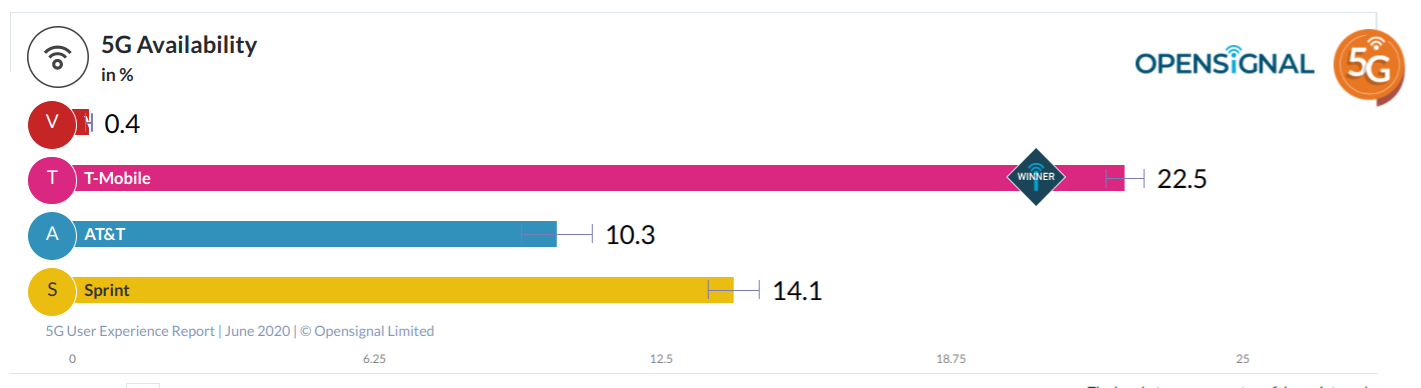
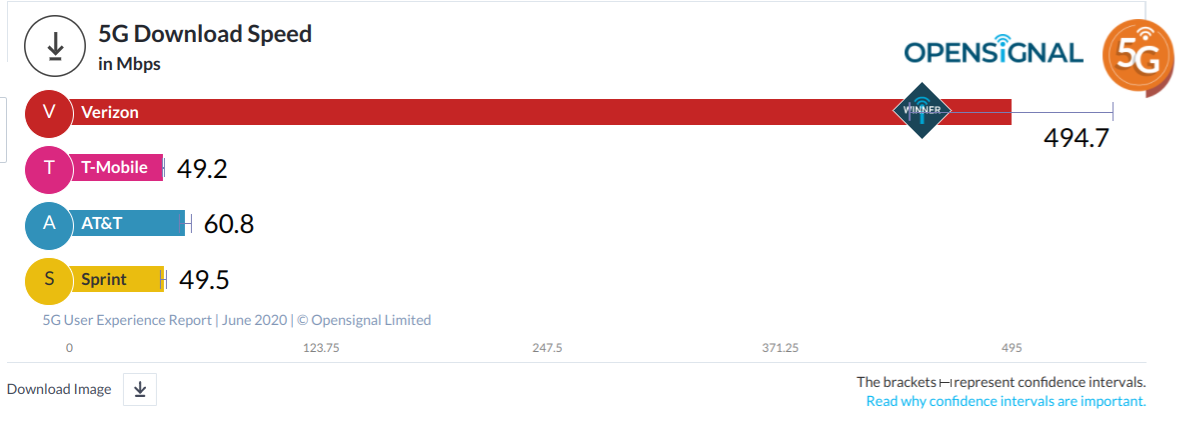
Here, in two charts, is the upside and downside of millimeter wave spectrum for 5G. As always, it is coverage versus capacity as the fundamental trade off. 


Verizon’s millimeter wave approach initially sacrifices coverage, but gains capacity. T-Mobile and AT&T mostly rely on low-band spectrum. Sprint has had more mid-band spectrum. They gain coverage, but at the price of capacity. 


source: Opensignal


source: Opensignal


Wednesday, July 1, 2020

EC to Allow Permitless 5G Small Cells, Says RF Emissions Similar to Wi-Fi

European Commission officials believe 5G small cells will be small enough that permitting processes for them should be essentially eliminated. 


The EC also believes small cells will produce low levels of electromagnetic emissions. “In fact, they could be compared to Wi-Fi installations,” which most of us would likely not consider a health issue.


“Small cells will use lower power levels and therefore create lower exposure levels than existing 4G infrastructure,” the EC says. “The overall exposure with the rollout of 5G networks will therefore be comparable to existing levels – it will be well below the strict EU exposure limits, which, for the general public, are 50 times lower than what international scientific evidence would suggest as having any potential effect on health.”


Is Sora an "iPhone Moment?"

Sora is OpenAI’s new cutting-edge and possibly disruptive AI model that can generate realistic videos based on textual descriptions.  Perhap...