Wednesday, May 13, 2020

FCC Authorizes Broadband for Users of 900-MHz Spectrum

The Federal Communications Commission today took action to make six megaHertz of 900-MHz spectrum available for the development of critical wireless broadband technologies and services. 


The 900 MHz band is currently designated for narrowband land mobile radio communications and primarily used by land transportation, utility, manufacturing, and petrochemical companies. 


Broadband access will enable industries to leverage technologies for applications like private LTE networks supplying Voice over LTE, grid resiliency and monitoring, wildfire mitigation and enhanced cybersecurity, for example. 


Utilities say they are eager to use broadband to modernize the electric grid. Southern California Edison, a utility in a state hard-hit by fires in recent years, predicts that broadband will enable innovative monitoring technologies that will help utilities detect and extinguish fires caused by downed power lines, FCC Chairman Ajit Pai says. 


The item approved today makes 6 MHz available for broadband licenses on a county by-county basis while reserving the remaining 4 MHz of spectrum for continued narrowband operations. 


The change will enable next-generation, mission-critical applications not available on the current narrowband systems. 


Specifically, the Commission approved a Report and Order, an Order of Proposed Modification, and two Orders that realign the band and establish a transition mechanism for prospective broadband licensees and existing narrowband incumbent licensees. 


Thursday, May 7, 2020

Nearly 400 Mobile Operators Already Sell Fixed Wireless, 5G Will Add More

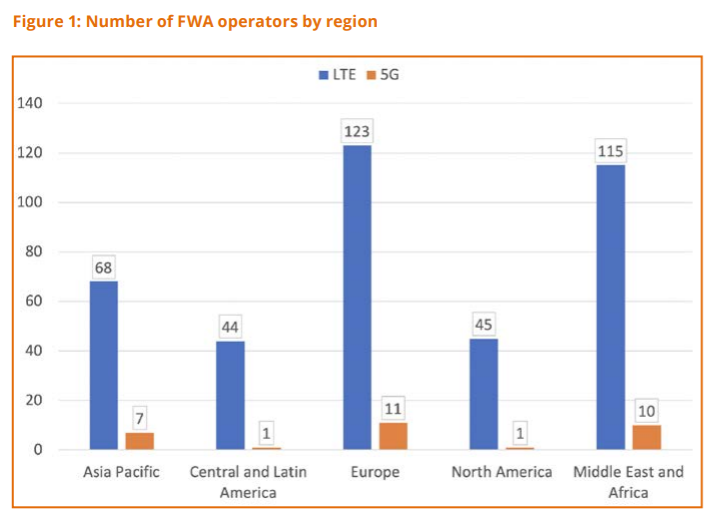
Some 395 service providers  in 164 countries are selling fixed wireless services using 4G mobile network platforms, according to the Global Mobile Suppliers Association. 

source: GSA


In addition, of the 73 operators that have announced 5G launches worldwide, GSA counted 37 operators that have announced the launch of either home or business 5G broadband using routers. 


Of these 37, GSA identified 30 operators selling 5G-based fixed wireless services. GSA counted 214 operators selling LTE or 5G MiFi/hotspot services in 120 countries, of which 45 (21 percent) did not also sell FWA services.


Wednesday, May 6, 2020

How Will 5G Revenue Break Out Between Consumer, Enterprise Segments?

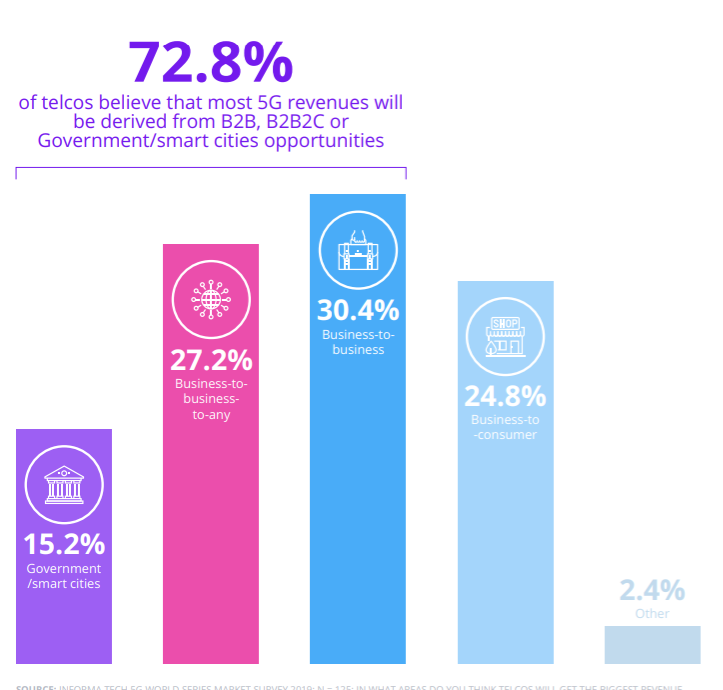
Will 73 percent of 5G revenues come from B2B souces? That is what a report from BearningPoint claims, based on a survey of telecom executives by Omdia.


It always matters how a question is asked, but some might be more than a little surprised that BearingPoint reports that most 5G revenue will be generated by B2B sources. If 68 percent of total mobile operator revenue often is earned from consumers, it is hard to see the business-to-business revenue remaining at such a high percentage of total, long term. Given that 5G will replace 4G, eventually nearly all 4G consumer accounts will switch to 5G.


Near term, executives expect perhaps 25 percent of 5G revenue will be driven by consumer accounts.Perhaps that is true in the short tern, but it is hard to see how that could be true, long term.

source: BearingPoint


The findings might indicate a belief that new incremental revenue sources and subscriptions will come from B2B use cases including internet of things. That would make more sense. Perhaps that is what the respondents meant, even if the reports indicate otherwise. Certainly some of us have argued that the chief incremental revenue from 5G will come from new sources such as IoT. Perhaps that is the sense in which the Omdia survey data makes most sense.


Open RAN Policy Coalition Launches with 31 Charter Members

Thirty-one global technology companies have launched the Open RAN Policy Coalition to promote policies that will advance the adoption of open and interoperable solutions in the Radio Access Network (RAN) and expand the supply chain for advanced wireless technologies including 5G. 


Without question, the effort intends to create standards and support products that do not rely on core Chinese technology provider Huawei. 


Founding members include Airspan, Altiostar, AT&T, AWS, Cisco, CommScope, Dell, DISH Network, Facebook, Fujitsu, Google, IBM, Intel, Juniper Networks, Mavenir, Microsoft, NEC Corporation, NewEdge Signal Solutions, NTT, Oracle, Parallel Wireless, Qualcomm, Rakuten Mobile, Samsung Electronics America, Telefónica, US Ignite, Verizon, VMWare, Vodafone, World Wide Technology, and XCOM-Labs.


The group says there are three big and different approaches. Open RAN features disaggregated RAN functionality built using open interface specifications between elements. It can be implemented in vendor-neutral hardware and software-defined technology based on open interfaces and community-developed standards.


O-RAN refers to the O-RAN Alliance or specification. O-RAN Alliance is a specification group defining next generation RAN infrastructures, empowered by principles of intelligence and openness.


vRAN is an implementation of the RAN in a more open and flexible architecture which virtualizes network functions in software platforms based on general purpose processors. vRAN utilizing open interfaces is one component of Open RAN.


Some May Use Private LTE Networks Because Wi-Fi Cannot Support the Use Cases

Tuesday, May 5, 2020

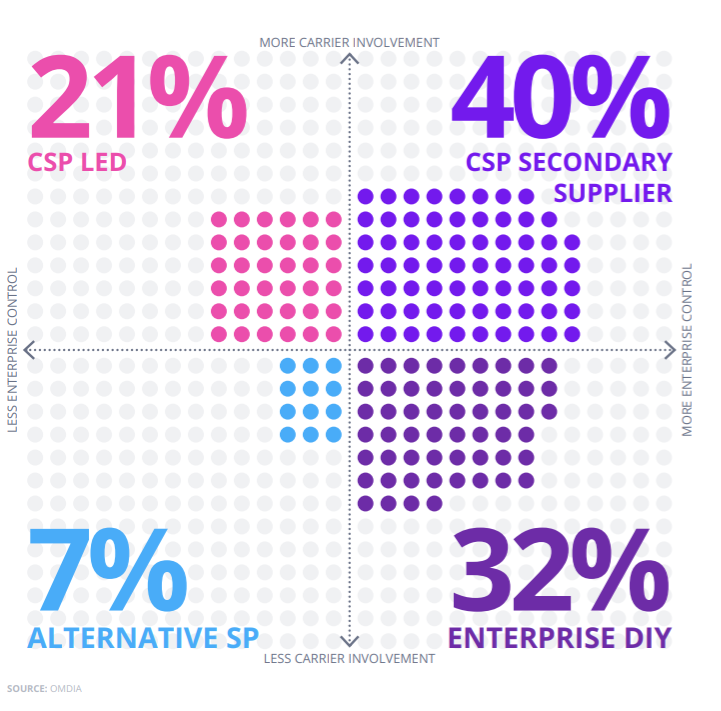
72% of Execs Believe Private 5G Mostly Will be Built DIY or Using Telco Infrastructure Suppliers

Private 5G and 4G networks are coming, so we possibly should not be too surprised that leadership is coming directly from enterprises themselves. 


Think about all prior local area network (private networks) deployments in the past and the pattern will not surprise. Private and local area networks, by definition, are owned and operated by enterprises, not public network providers, in almost all cases. 


In the case of 5G private networks, an Omida survey found 72 percent of executives believe enterprises will do private 5G themselves, or use a telco infrastructure supplier. About 28 percent believe a service provider of some sort will be the supplier. 

source: BearingPoint


Friday, May 1, 2020

As with Millimeter Wave Spectrum, Stratosphere Open to New Uses?

As millimeter wave spectrum--prior to powerful and cheap signal processing--could not be harnessed commercially for mobile and fixed mass market communications, so now technology might enable use of the stratosphere in new ways. 


Earth’s stratosphere--at 11 km (seven miles) to 50 km (31 miles) high--”has long been deemed unsuitable for commercial (communications) operations because of its harsh conditions,” according to the High Altitude Platforms Alliance, which includes Alphabet’s Loon, Airbus Defence and Space, HAPSMobile, Intelsat US and Nokia.


source: Shutterstock


Commercial airlines fly in the lower reaches of the stratosphere, between 30,000 feet and 42,000 feet. Loon’s communications balloons fly at about 20 km (65,000 feet) high. 


The advantage, say members of the HAPS Alliance, is the ability to place “cell towers 20 km above Earth.” Loon, for example, makes it possible to use balloons at this altitude to deliver 4G LTE and 5G connectivity in partnership with mobile network operators, connecting directly to mobile phones and other devices using standard 4G and 5G protocols.”


“HAPS can act as floating cell towers, providing network latency that is comparable to that of terrestrial cell towers but with up to 200 times the geographic coverage from a single vehicle,” the HAPS Alliance argues.

Is Sora an "iPhone Moment?"

Sora is OpenAI’s new cutting-edge and possibly disruptive AI model that can generate realistic videos based on textual descriptions.  Perhap...