Friday, August 5, 2016

T-Mobile Makes Lemonade

In a number of ways, business strategy is nothing more complicated than “if you have lemons, make lemonade.”

So it is that T-Mobile US downplays the near-term importance of 5G, while Verizon touts it; dismisses the importance of fixed access as an important near-term 5G application; or minimizes new services initiatives such as Verizon’s mobile content and advertising business.

As many other mobile executives likely would argue, focusing on monetizing 4G investments before getting heavily into 5G makes sense, if a firm has been investing heavily in 4G recently.

Verizon arguably is at a different point in its 4G investment cycle, having been the first U.S. mobile operator to activate 4G. Verizon largely has recouped its 4G investment, so is preparing for 5G.

T-Mobile US arguably cannot do so; it has to recover a substantial portion of its 4G investments.

Similarly, Verizon, with a significant fixed network business, has different incentives to use fixed wireless than does T-Mobile US, which has no such network.

Also, T-Mobile US prefers its own “zero rating” of content consumption to becoming a content or advertising platform provider, as Verizon Wireless is doing.

That also is a function of business scale. If one assumes that every mobile service provider essentially will have to replace half its current revenues every decade, then Verizon, as a qualitatively-bigger contestant, needs to replace far more revenue than smaller T-Mobile US.

Verizon cannot rely on market share gains to do so. T-Mobile US believes it can, to a significant extent.

Simply, Verizon has to place bigger bets on growing new lines of business. T-Mobile US arguably cannot afford to do so, and has other options for growing revenues organically.

Simply, T-Mobile US is playing a different game. It probably cannot realistically hope to overtake either Verizon or AT&T for leadership of the U.S. mobile business. Parent Deutsche Telekom apparently still wishes to sell the asset, at some point.

So the “take as much share as you can in the existing business” makes sense for T-Mobile US. It does not make sense for Verizon, which really does have to create huge new lines of business.

Thursday, August 4, 2016

Why Quadruple Play Might Not be So Good for Mobile Revenues

New data from Ofcom, the U.K. communications regulator, confirms the fact that consumer service bundling is a form of discounting.

So despite some advantages for customer acquisition and retention, as well as average revenue per account, quadruple-play bundles including mobile service might mean even more discounting.

Of course, within a bundle it is hard to say for certain which particular services get discounted the most. Historically, telcos have probably discounted video to protect voice prices, while cable TV companies have merchandised voice to protect video prices.

In the future, when quadruple-play offers are more prevalent, voice or video might be discounted to protect mobile or high speed access prices.

Telcos are more likely to discount high speed access to protect mobile profit margins, while cable TV companies are more likely to discount mobile to protect high speed access, at least in the U.S. market.

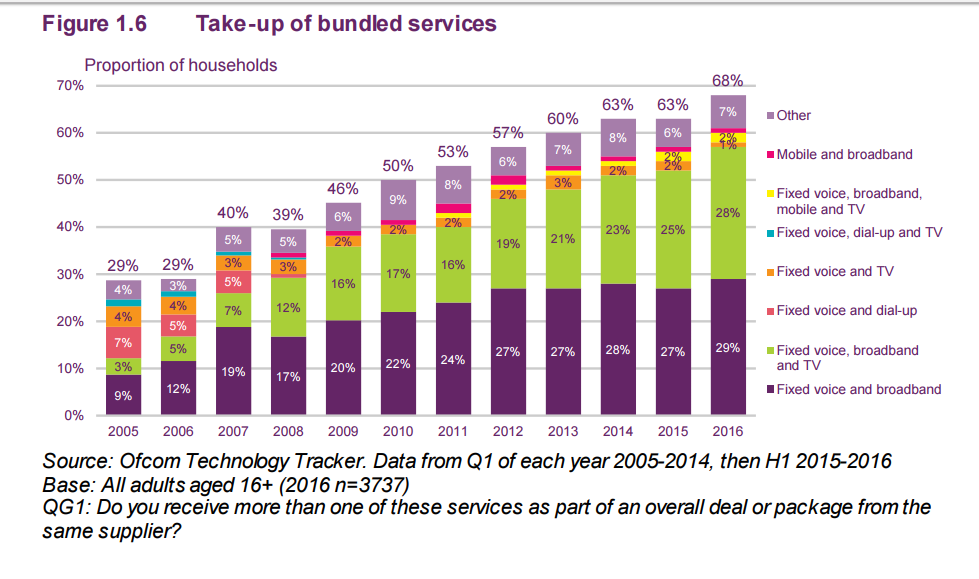
Some 68 percent of U.K. consumers reported buying at least two of their communications services together in a bundle in 2016, a five percentage point increase on the previous year’s figure (63 percent).

Dual-play packages of landline and broadband, and triple-play packages of landline, broadband and TV, were the most popular representing most of the buying.

Promotional discounts tend to target customers purchasing bundled services, with the discount most frequently applied to the overall bundle price or the fixed broadband or TV elements of the bundle.

On average, 94 percent of all dual-play plans and 98 percent of triple-play plans offered by the UK’s four largest residential fixed telecoms providers (BT, Sky, TalkTalk and Virgin Media) had some element of discounts in 2015, compared to 86 percent of dual-play and 79 percent of triple-play plans offered in 2013.

source: Ofcom

Wednesday, August 3, 2016

Even in Developed Nations, Rural Area Mobile Coverage is Challenging

In developed or developing nations, mobile or communications network rural coverage is an issue. In the United Kingdom, for example, two percent of road miles have zero 2G network coverage, while 12 percent of road miles have only partial 2G coverage, the RAC Foundation says.

On six percent of road mileage, there is no 3G coverage, while 45 percent of road miles have only partial 3G coverage.

Some 56 percent of road miles have no 4G coverage, while 27 percent of road miles have only partial 4G coverage.

Miles (%) of road in Britain with…
Full network coverage
Partial network coverage
No network coverage
2G
211,753
(86%)
28,975
(12%)
4,561
(2%)
3G
119,057
(48%)
111,679
(45%)
14,554
(6%)
4G
43,070
(18%)
65,950
(27%)
136,271
(56%)

As a general rule, networks serving such areas are not sustainable on their own, meaning that potential revenues never will justify building facilities. Instead, such investments must be subsidized either from surplus generated elsewhere on the network, or by direct government subsidies.

There is, in other words, no sustainable business model for facilities in such areas. One way or the other, service has to be subsidized in some way, as there is no organic way to support service, using conventional mobile network technology.

That is why work on new platforms, more affordable and therefore potentially able to close the business model gap between revenues and cost, are so important.

Put simply, costs must drop much more, consumers must perceive the value of Internet services and be able to pay for such services, or alternative methods of subsidizing end users must be created.

Some of us would argue all of those developments are required. That is why developments such as Telecom Infra Project, Free Basics, Project Loon, unmanned aerial vehicles, unlicensed and shared spectrum, use of millimeter wave radio and creation of new apps and services that drive value are so important.

Without serious innovation in the access networks business, it might literally not be possible for many service providers to continue operating.

Bringing stakeholders together to understand changing supply and demand issues, and the business model for Internet access, is a key focus of the Spectrum Futures conference. Here’s a  fact sheet and Spectrum Futures schedule.

Innovations in platform and business model will be part of the discussion at Spectrum Futures.

What If Quality Internet Access is Unsustainable with Current Business Models?

Mobile service providers in many emerging nations might be facing an industry-altering problem: high capital investment and regulatory risk that makes the business model unsustainable.


Put in simplest terms: is there enough potential revenue in some emerging markets to support robust investment in  network bandwidth?


If there not enough revenue, and investment requirements cannot be radically reduced, then business models could go upside down.


Be clear, that also means most service providers cannot stay in business, without radical changes in service provider cost structure, growth of end user demand, plus ability to sustain business models over time.


Put simply costs must drop much more, consumers must perceive the value of Internet services and be able to pay for such services, or alternative methods of subsidizing end users must be created.


Some of us would argue all of those developments are required. That is why developments such as Telecom Infra Project, Free Basics, Project Loon, unmanned aerial vehicles, unlicensed and shared spectrum, use of millimeter wave radio and creation of new apps and services that drive value are so important.


Without serious innovation in the access networks business, it might literally not be possible for many service providers to continue operating.


Bringing stakeholders together to understand changing supply and demand issues, and the business model for Internet access, is a key focus of the Spectrum Futures conference. Here’s a  fact sheet and Spectrum Futures schedule.


Also, access providers are capturing a smaller share of overall ecosystem value. Bluntly, one might say, access providers really are becoming commodity dumb pipe providers while value and revenue shift to app providers, device suppliers and others.

“Even after accounting for Wi-Fi and new technologies and alternate business models, there will be still significant global wireless data demand that is not economically possible to serve,” says James Sullivan, J.P. Morgan head of Asia equity research.

Sullivan will share his thinking at the Spectrum Futures event.

The inevitable conclusion is that major changes in business model are essential if everyone, everywhere, has use of the Internet, while providers can sustain delivery on a sustainable basis.

It is not impossible to solve such problems. But it will be hard, for many in the ecosystem.

Tuesday, August 2, 2016

It's Going to be Easier to "Bring Your Own Access"

In many ways, “bring your own access” is an accurate way to describe the way end users reach their preferred app and service providers.

It seems inevitable that greater reliance on a mix of spectrum, networks and licensing regimes will be a hallmark of all next-generation networks from this point forward. You might call this an example of "bring your own access " in the communications-related businesses.

That is a new approach, historically. Telcos, TV and radio broadcasters, cable TV companies and others have essentially supplied the access function as part of their core services.

Wi-Fi was the first major break in the pattern. In that case, the end user supplies his or her own access, in the sense of paying for the access connection and the local small cell transmitter function.

For the first time, the app is fully separated from the access, in terms of who pays for the access connection and features.

On the supplier side of the value chain, we are moving from communications using “only my owned resources” to a heterogeneous world where the access function routinely uses a mix of resources (both “my assets” and “any other available assets.”

On the user side of the value chain, access is a decision logically separate from the “which apps do I want to use?” decision.

Consider the implications for supplier business models. Up to this point, nearly all big commercial wireless industries have been built on the use of licensed spectrum that also has been highly regulated in terms of what protocols can be used in each frequency band and often even what applications are lawful in such bands.

Wi-Fi has been the first shift away from that pattern. Having shown the role license-exempt spectrum can play in supporting many industries, including those using licensed spectrum, new work is being done to increase the amount of license-exempt spectrum available for communications uses.

There are business model implications. To the extent spectrum remains a relatively scarce commodity, licensing creates moats around some business models.

Freeing up more license-exempt spectrum creates new ways for businesses to be built on communications spectrum at vastly lower cost.

And that is what the U.S. Federal Communications Commission has planned: releasing 7 GHz of new unlicensed spectrum, as part of a planned release of 29 GHz of new communications spectrum, in millimeter bands.

Obviously, all that new spectrum, plus spectrum sharing in a number of other bands, will increase the odds that new providers of Internet access are going to enter the market.

Monday, August 1, 2016

168 Million People Will Begin Using Mobile Over the Next Five Years

At the end of 2015, 46 percent of the population in Africa subscribed to mobile services, representing 557 million people and 965 million connections, making Africa the second largest region behind Asia Pacific in terms of unique subscribers (12 percent of the global subscriber base).

The region’s three dominant markets--Egypt, Nigeria and South Africa--together accounted for around a third of the region’s total subscriber base, according to the GSMA.

Still, Afica mobile adoption trails the global average of 63 percent, the Middle East (58 percent), Asia Pacific (62 percent) and Latin America (65 percent).

Over the next five years, an additional 168 million people will be connected by mobile services across Africa, reaching 725 million unique subscribers by 2020, according to the GSMA. Eight markets will account for the majority of this growth, most notably Nigeria, Ethiopia and Tanzania, which will together contribute more than a third of new subscribers.

Mobile broadband connections accounted for a quarter of total connections at the end of 2015, but will rise to almost two-thirds by 2020.

Mobile revenues grew by 3.8 percent year-on-year in 2015 to reach $53.5 billion, mainly driven by data revenues, which now account for a fifth or more of total revenues for many operators.

source: GSMA Intelligence

Internet Access is a Problem, But Not the Only Problem, for Gaining Value from Internet

Mobile and untethered Internet access is a necessary, but not sufficient precondition for reaping value of Internet technologies.

“The full benefits of the information and communications transformation will not be realized unless countries continue to improve their business climate, invest in people’s education and health, and promote good governance,” the World Bank says.

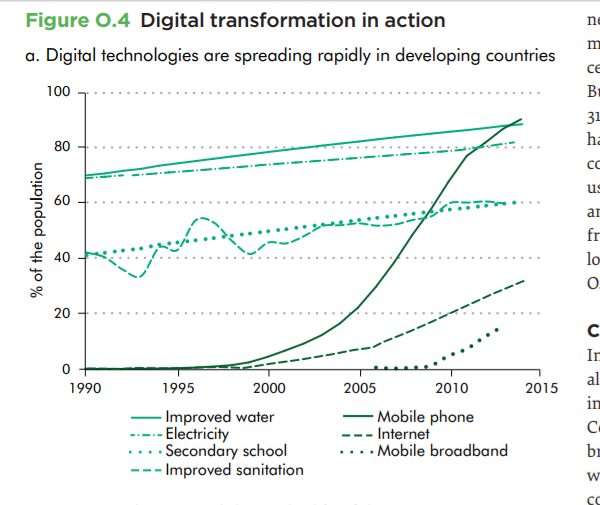
On average, 80 percent of people in the developing world own a mobile phone, and the number is steadily rising. Even among the bottom fifth of the population, nearly 70 percent own a mobile phone.

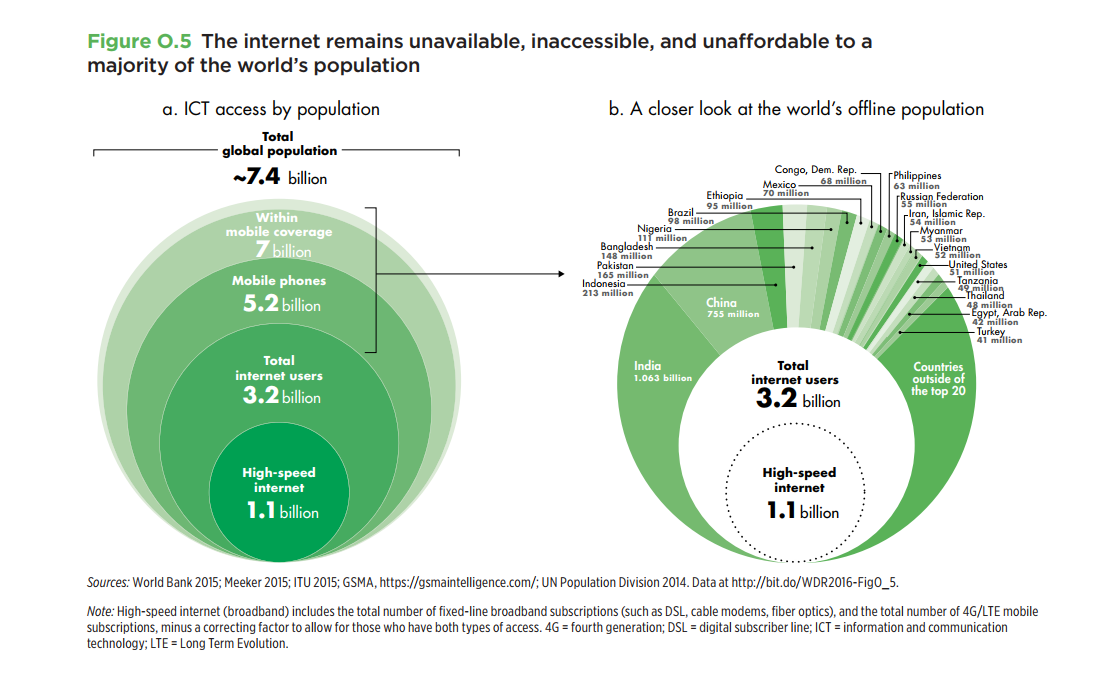
But internet adoption lags behind considerably: only 31 percent of the population in developing countries had access in 2014, against 80 percent in high-income countries.

Only around 15 percent can afford access to broadband internet, according to the World Bank, and 80 percent of people with Internet access do so using a mobile phone.

Globally, nearly 21 percent of households in the bottom 40 percent of their countries’ income distribution don’t have access to a mobile phone, and 71 percent don’t have access to the internet.


“In countries where these fundamentals are weak, digital technologies have not boosted productivity or reduced inequality,” a World Bank report says. “Countries that complement technology investments with broader economic reforms reap digital dividends in the form of faster growth, more jobs, and better services.”

In other words, as important as access networks might be, institutional framework really does matter.

“Greater digital adoption will not be enough,” the World Bank says. Countries also need to strengthen regulations that ensure competition among businesses, adapt workers’ skills to the demands of the new economy, and assure that institutions are accountable.

Is Sora an "iPhone Moment?"

Sora is OpenAI’s new cutting-edge and possibly disruptive AI model that can generate realistic videos based on textual descriptions.  Perhap...