Tuesday, June 7, 2016

M2M (Internet of Things) 46% of Total Connected Devices by 2020

By 2020, machine-to-machine (M2M) connections will be 46 percent of total connected devices and Internet access accounts, Cisco now forecasts.

That total includes devices such as smart meters, video surveillance, healthcare monitoring, transportation, and package or asset tracking.

Globally, M2M connections will grow nearly 2.5-fold, from 4.9 billion in 2015 to 12.2 billion by 2020.  

For many, that is almost a secondary matter. The bigger question is which markets will grow fastest, and reach mass market status, soonest.

Connected home applications, such as home automation, home security and video surveillance, connected white goods, and tracking applications, will represent 47 percent, or nearly half, of the total M2M connections by 2020, Cisco predicts.

Connected healthcare, with applications such as health monitors, medicine dispensers, first-responder connectivity, and telemedicine, will be the fastest-growing industry segment, at 49-percent CAGR.

Connected car applications will have the second-fastest growth, at 37-percent CAGR.


Though many M2M applications will require connections of modest bandwidth, video will drive traffic volume, as is the case in the smartphone and consumer Internet spaces.

Although the number of connections is growing threefold, global M2M IP traffic will grow sixfold to 2020.

Video applications such as telemedicine and smart car navigation systems are prime examples.

Friday, June 3, 2016

Entertainment Video is a Prime Area for ISP, Content, App Provider Collaboration

source: Vindicia
Though the challenge is greater than in many other markets that are both large and linguistically unified, over the top entertainment video remains a logical area for ISP participation, either as equity owners or partners in distribution and marketing.

Not least among the attractions is the fact that customer demand and proven business models already exist. ISPs and mobile operators do not have to guess about the extent of demand, or create viable revenue models. The value of scale is obvious, as is the role of distribution partners, which is well established.

The challenges include the need for some reasonably consistent amount and quality of mobile Internet bandwidth, as well as the cost of buying or using such bandwidth. In many markets, the supply of bandwidth is an issue. In many areas the cost of using the bandwidth is an issue, while in many markets both problems exist.

Still, OTT entertainment video services are a promising area for collaboration between ISPs and content providers.

In the U.S. market, for example, Verizon, AT&T and T-Mobile US already have invested capital and marketing attention to the specific value of over the top content as a business value contributor.


As a region, Asia Pacific is characterised by very high levels of linguistic diversity, making it harder for local OTT entertainment video services to expand from their home market across the region, unless they focus solely on international audiences, Vindicia says.

source: Vindicia
Countries across the region have widely varying and distinctive national cultures, with many consumers exhibiting strong preference for local content. The clear implication is that it is harder to build large content businesses--linear or over the top--that can win viewers and customers on a wider scale.

On the other hand, many “mobile-first markets” also are prime candidates for mobile-delivered OTT content, for the simple reason is that, by definition, a mobile-first market provides the base of potential users for an application that often or typically relies on scale for business success.

That said, most markets now have potential mobile audiences that can challenge existing screen formats.


Thursday, June 2, 2016

Tata LoRa Network for IoT to Cover 400 Million People, Initially

Tata Communications plans to activate  India’s first LoRa network for Internet of Things apps nationwide, beginning with deployments in Mumbai, Delhi and Bangalore.

The first phase network will cover 400 million people across in India, Tata Communications has said.

In addition to ultra-low power consumption, which allows the battery in the end device to last for more than a decade without replacement, the Tata Communications LoRa network supports communications in deep water and up to 50 meters underground. This makes it suitable for use in metro stations and car parks.

The network has a coverage of 15 km.

Mobile operators are placing bets on a number of different network platforms. Orange and Bouygues Telecom in France are using LoRa as well. Altice, on the other hand, will use SigFox.

Vodafone, on the other hand, is using the narrow band Internet of Things platform.  China Unicomm also favors NB-IoT.

Wednesday, June 1, 2016

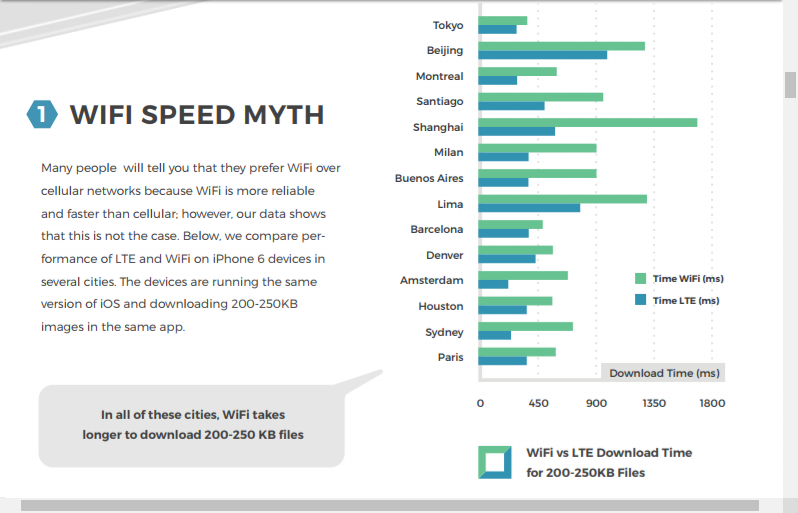
4G Networks Now are Faster than Wi-Fi, in Major Global Cities

Back when 3G mobile Internet access was the norm, Wi-Fi connections almost always were faster. That is not true when 4G is the standard mobile Internet access network. Tests by Twin Prime confirm that, in most big cities globally, Long Term Evolution 4G connections are faster than Wi-Fi.

So the value proposition has changed. Where consumers would switch to Wi-Fi to gain the advantage of faster speed, they now switch to Wi-Fi to avoid incurring usage from their mobile data plans.

Wi-Fi still is valuable. It simply is valuable for a different reason in 4G markets, compared to 3G markets.

source: Twin Prime

Airtel Might Skip 700-MHz Auction in India

Expectations about spectrum prices in many markets might be too high. In India for example, Bharti Airtel might not bid at all on new 700 MHz spectrum.

In the U.S. market, Sprint and Liberty Global will not bid on 600 MHz spectrum. In most cases, non-bidders will point to existing spectrum resources as reasons for bidding on new spectrum.

The unstated rationale is that capital might not be readily available to do so, debt loads are an issue, or prices are seen as too high.

“We do not expect Bharti to bid in the upcoming auction of 700MHz in India, given the high indicative price for this spectrum, limited device availability and the company’s ownership of alternative spectrum (1800MHz/2300MHz) to roll out 4G services,” said Fitch Ratings.

Airtel already has the ability to offer 3G and 4G services on a pan-India basis, unlike most of its peers, and although more spectrum always is welcomed, the cost is an issue.

Operating EBITDAR (earnings before interest, taxes, depreciation, amortization, and restructuring or rent costs) margin will decline to 34 percent in the 2017 fiscal year and 31 percent in the 2018 fiscal year due to an increase in competition as Reliance Jio likely offers cheaper data tariffs, forcing others to lower their prices as well.

Bharti Airtel earlier in 2016 had acquired 1800 MHz spectrum in six Indian service areas, or "circles", from smaller telco Videocon.

The acquisition will give Bharti the ability to offer 4G services in 19 of 22 circles compared with Reliance Jio, which has access to 4G spectrum in all 22 circles.

Vodafone and Idea have 4G spectrum in five and 12 circles, respectively.

Bharti's deal comes amid rapid growth in data services, as usage is doubling annually while data average revenue per user (ARPU) per month has jumped to over INR200 - higher than Voice's INR137.

The top four Indian telcos have been keen to acquire spectrum from smaller unprofitable firms since September 2015, when the regulator allowed spectrum trading among telcos.

Fitch maintains a negative outlook on the Indian mobile  industry for 2016 as we expect the credit profiles of the top-four telcos to come under pressure from tougher competition, larger capex requirements and debt-funded mergers and acquisitions.  The entry of Jio will intensify the competition.

The industry blended tariffs should fall by five percent to six percent, as a result.

The Indian telco industry will continue to consolidate, and we expect five to six operators to emerge from the shake-out. The top four--Bharti, Vodafone India, Idea Cellular and Reliance Communications--are likely to raise their revenue market share to 80 percent, up from 77 percent in 2015.

South Asia, Southeast Asia Lead Mobile Subsciption Net Adds in 1Q 2016

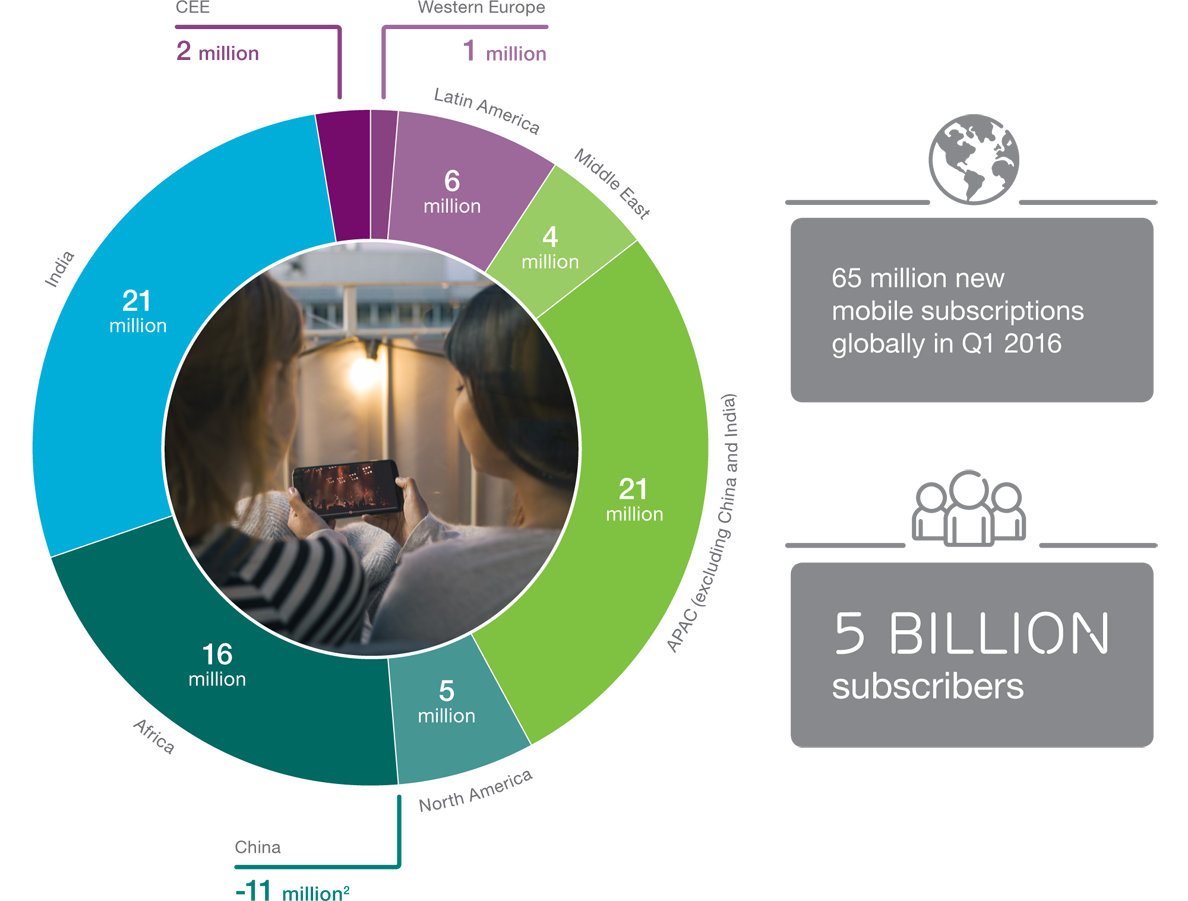
Mobile subscriptions are growing around three percent year-on-year globally and reached 7.4 billion in the first quarter of 2016, according to Ericsson. South Asia and Southeast Asia represented most of the growth.

India grew the most in terms of net additions during the quarter (+21 million), followed by Myanmar (+5 million), Indonesia (+5 million), the United States (+3 million) and Pakistan (+3 million).


Enterprise Small Cells Wiil Grow at 63% CAGR to 2020

The deployment of small cells by carriers, for public access or enterprise use, will experience far higher growth in the second half of the decade than the more mature residential market, whose compound annual growth rate will be five percent, according to Rethink Research.

The total market growth rate in this period will be 20 percent, while that of the enterprise space will be 63 percent, Rethink Research estimates.

Enterprise small cells will be used for private company use, those providing venue Wi-Fi access for customers.

             Deployments of small cells, enterprise and total worldwide (000s of units)
source: Rethink Research

Is Sora an "iPhone Moment?"

Sora is OpenAI’s new cutting-edge and possibly disruptive AI model that can generate realistic videos based on textual descriptions.  Perhap...