Friday, February 6, 2015

TV Spectrum Reallocation: a 15-Year Transition in Europe?

With rapidly-growing demand for mobile data bandwidth, disputes about reallocating spectrum are bound to grow.

At least in part, spectrum allocation policies might, in many cases, determine prospects for delivery of 4K TV versus mobile Internet services and apps.

Some might argue about the future for over the air TV broadcasting long term, as viewing shifts increasingly to on-demand modes that are fundamentally incompatible with all linear content delivery methods (satellite, cable TV, over the air broadcast).

Right now, the big disputes might concern the timing of any big shift towards on-demand, Internet delivery, and away from linear consumption. As a simple matter of physics, point-to-multipoint networks are ill suited to on-demand delivery.

If and when consumption shifts to on-demand as the primary mode, point-to-multipoint networks will be largely to completely unworkable. So one might argue the long-term strategic shift is away from point-to-multipoint broadcast networks of all types and towards "any to any" communication networks.

Some of the disputes concern frequencies licensed to government entities. Other areas where industry assignments will be contested are satellite, television and unlicensed bands.
In Europe, for example, it has been suggested that TV spectrum in the 694 MHz to 790 MHz former analog TV band be reallocated to mobile service, by about 2020.

The 470 MHz to 694 MHz TV band should be preserved until 2030, a study suggests.

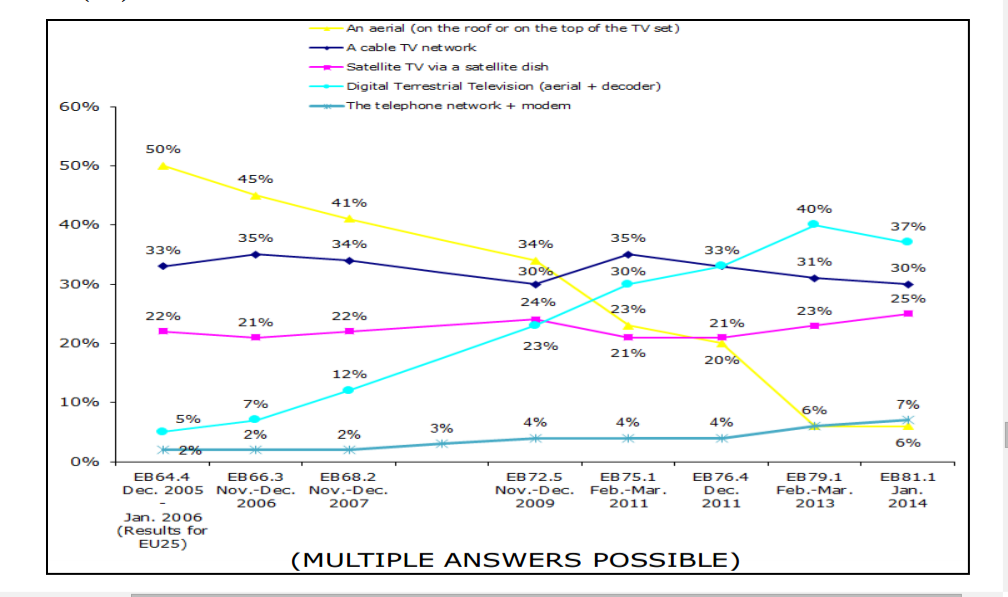
It might be argued that changes in spectrum allocation will be shaped by usage. In the U.S. market, for example, more than 80 percent of all TV connections use some form of non-broadcast delivery (cable TV, telco TV or satellite TV). That might not be the case in other markets, where more than 40 percent of viewers might still get signals using the over the air TV networks.

Spectrum Auction Enables One Carrier, Dooms Another

In case you needed a reminder of the foundational role played by communications regulators in creating and shaping the business, consider the situation in Norway, where new spectrum auctions and a shift to the next generation of mobile networks literally forced one of the leading providers to sell itself.

Tele2, the smallest of three Norwegian service providers, was forced to sell itself after it failed to acquire key spectrum rights in the spectrum auction in December 2013, leaving it with no path to fourth generation networks.

The deal might have left Norway with two established mobile network operators: TeliaSonera and market leader Telenor. But a new entrant, Ice.net, which won spectrum Tele2 had hoped to win, also is entering the market.

Regulators forced TeliaSonera to extend national roaming rights to the upstart carrier as a way of ensuring there are three service providers with full coverage. Still, the acquisition boosts TeliaSonera market share to about 40 percent, a very close second to Telenor.

To be sure, regulator action was not the only crucial issue. Tele2, arguably because it was the smallest provider, might not have had the financial resources to compete in the auction.

But without access to owned 4G spectrum, Tele2 essentially was forced out of business. Conversely, Ice was able to stake a claim in 4G by virtue of its spectrum winnings.

It might not be going too far to argue that spectrum policy in this case enabled one firm and doomed another.

Policymakers also won other concessions from TeliaSonera to strengthen Ice.net’s position in the market and ensure there still would be three facilities-based providers in the market.

Thursday, February 5, 2015

"Sustainability" Matters for South Asia Internet Access Business

“Sustainability” was not an issue in the old monopoly telecommunications world. With profits guaranteed by “rate of return” regulations, service providers literally could not lose money, and also were guaranteed a fixed rate of return on invested capital.

Also, in many cases, since the firms were directly owned by national governments, there was an implied financial backstop provided by the national government, as well.

All that has changed as firms have been privatized and deregulated, exposing all the former incumbents to market pressures and the risk of failure.

Also, with the rise of new services, especially Internet access, sustainability--and business model issues--are paramount. Unlike voice services, Internet access requires a number of other enablers.

Literate users, low-cost devices, knowledge of how to use the Internet, compelling applications, network costs, ISP operating costs and end user recurring cost, are key requirements.

As much progress as Internet service providers are making at supplying Internet access to everyone, at prices consumers can afford, supplying Internet access to virtually everyone in South Asia and Southeast Asia, within 10 years, will likely require an order of magnitude lower network costs.

A few examples will illustrate the issue.

Across Asia, for example, the cost of a prepaid mobile service, and the cost of a fixed network voice service typically are correlated.

The cost of mobile voice and fixed voice tend to cost about the same, at least where fixed networks actually exist.

In most Asian markets, the ability to buy mobile service exceeds 90 percent of people.

Internet access, limited and featuring dial-up speeds, can be significantly more expensive, however. In Bangladesh, mobile Internet access can be an order of magnitude more expensive than either mobile or fixed voice service, for example.

A mobile Internet plan featuring perhaps 200 Mbytes of usage can cost four times more than a prepaid mobile voice plan.

The price differential is about the same  n the Indian market as well.

So major cost reduction is required, to supply Internet access to most consumers in South Asia, which most have assumed would be provided by mobile service providers.

In 2012, fixed broadband prices represented 1.7 percent of monthly gross national income (per capita) in developed countries, where 80 percent of households often buy broadband Internet access.

In developing countries, fixed broadband services still remains expensive and unaffordable for many, at 30 percent of average monthly incomes. Whether new fixed networks can reduce costs 10 times in a decade, while increasing coverage by 10 times to 100 times, are key issues.

In Bhutan, about four percent of homes buy fixed voice service, for example. In India, perhaps five percent of homes buy fixed voice service. In either country, Internet access is purchased by perhaps one percent to two percent of households, according to Insight, a new research program by the Pacific Telecommunications Council available to all PTC members.

So the business model requires innovation. Services have to be priced reasonably, devices costs must drop and all network and operating costs likewise have to be right-sized.

Wednesday, February 4, 2015

Mobile Will be More Important for Internet Access Than Many Believe

No matter what ultimately happens with network neutrality rules in the U.S. market, competition between Internet service providers will grow, average speeds will continue to climb and prices per megabit per second will continue to decline.

Even ignoring growing competition in the fixed network business, competition is growing faster in the mobile segment of the business. And it is towards the mobile segment that usage is shifting.

Even if, historically, mobile bandwidth has been vastly more expensive than fixed network bandwidth, the difference is narrowing, and mobile access speeds might soon approach those of fixed connections, once 5G networks are deployed.  

That illustrates the importance of additional spectrum allocations for mobile access. Most observers believe that will happen in the millimeter range of frequencies.

Mobile connections already outnumber fixed Internet access connections globally.

Of roughly three billion Internet connections in service in 2014, about 2.3 billion used mobile access.  

That said, North American fixed network bandwidth consumption is between two and three orders of magnitude higher than median end user consumption.

But mobile consumption is growing, in part because more smartphones are in use, and in part because video is becoming the dominant driver of mobile bandwidth.

About 75 percent of mobile data traffic in 2019 will be driven by smartphones, according to the latest Cisco Visual Networking Index.

Mobile video traffic exceeded 50 percent of total mobile data traffic by the end of 2012 and grew to 55 percent by the end of 2014.

So mobile data traffic will grow at a compound annual growth rate of 57 percent from 2014 to 2019, reaching 24.3 exabytes per month by 2019, according to Cisco.

In a sense, mobile is growing in importance because it increasingly represents the way most people use the Internet. Mobile networks also are getting faster. For example, 4G traffic will be more than half of the total mobile traffic by 2017.

At the same time, Internet traffic now dominates global bandwidth requirements, and content--especially video content--dominates Internet traffic.

Increasingly, for all those reasons, mobile also drives Internet traffic, growing 45 percent annually.

Global mobile data traffic grew 69 percent in 2014, for example.

Granted, service providers have several tools to increase effective bandwidth. Different network architectures and better air interfaces will help. But almost nobody believes the growth can be accommodated without allocation of additional spectrum.

Still, more traffic will be offloaded from mobile networks--on to Wi-Fi networks--than remains on mobile networks by 2016. Without offload, mobile data traffic would have grown 84 percent rather than 69 percent in 2014.

Still, virtually every trend other than offload drives higher mobile data consumption.

Global mobile devices and connections in 2014 grew to 7.4 billion, up from 6.9 billion in 2013.

Smartphones accounted for 88 percent of that growth, with 439 million net additions in 2014.

Globally, smart devices represented 26 percent of the total mobile devices and connections in 2014; they accounted for 88 percent of the mobile data traffic.

Mobile network (cellular) connection speeds grew 20 percent in 2014. Globally, the average mobile network downstream speed in 2014 was 1,683 kilobits per second (kbps), up from 1,387 kbps in 2013.

In 2014, a fourth-generation (4G) connection generated 10 times more traffic on average than a non‑4G connection. Although 4G connections represent only six percent of mobile connections today, they already account for 40 percent of mobile data traffic.

Average smartphone usage grew 45 percent in 2014. The average amount of traffic per smartphone in 2014 was 819 MB per month, up from 563 MB per month in 2013.

Mobile is going to be more important than some realize.

Tuesday, February 3, 2015

Mobile Increasingly Drives Bandwidth Growth

It might still seem a bit unusual to hear an executive at a major company in the undersea bandwidth business argue that his firm, like all others, has to be “in” the mobile business.

“Without mobile, you are in trouble: you have to be part of mobile.” according to Andrew Kwok, Hutchison Global Communications president, international and carrier business.

That doesn’t necessarily mean offering retail mobile services. It does reflect a recognition of what drives global bandwidth.  Mobile connections already outnumber fixed Internet access connections globally.

Of roughly three billion Internet connections in service in 2014, about 2.3 billion used mobile access.  

That said, North American fixed network bandwidth consumption is between two and three orders of magnitude higher than median end user consumption.

But mobile consumption is growing, in part because more smartphones are in use, and in part because video is becoming the dominant driver of mobile bandwidth.

About 75 percent of mobile data traffic in 2019 will be driven by smartphones, according to the latest Cisco Visual Networking Index.

Mobile video traffic exceeded 50 percent of total mobile data traffic by the end of 2012 and grew to 55 percent by the end of 2014.

So mobile data traffic will grow at a compound annual growth rate of 57 percent from 2014 to 2019, reaching 24.3 exabytes per month by 2019, according to Cisco.

In a sense, mobile is growing in importance because it increasingly represents the way most people use the Internet. Mobile networks also are getting faster. For example, 4G traffic will be more than half of the total mobile traffic by 2017.

At the same time, Internet traffic now dominates global bandwidth requirements, and content--especially video content--dominates Internet traffic.

Increasingly, for all those reasons, mobile also drives Internet traffic, growing 45 percent annually.

Global mobile data traffic grew 69 percent in 2014, for example.

Granted, service providers have several tools to increase effective bandwidth. Different network architectures and better air interfaces will help. But almost nobody believes the growth can be accommodated without allocation of additional spectrum.

Monday, February 2, 2015

Are LEO Satellite Launch Costs Low Enough?

Iridium, which lost perhaps $5 billion, was among the biggest failures in the low earth orbit satellite communications business. Teledesic arguably lost less, because it failed earlier. And then there was Globalstar. And ICO. And Orbcomm.

But Thuraya succeeded.

So can Elon Musk, Richard Branson and Greg Wyler successfully create two new satellite communication networks that are sustainable? Some might argue the odds are far better, and for the same reason the odds of creating a successful application startup are higher than 15 years ago.

The information technology components of the business arguably are an order of magnitude lower.

And both the WorldVu Satellites and SpaceX ventures have access to backers who have their own launch technology, likewise with launch cost profiles substantially lower than what has been possible in the past.  

The continuing danger is that SpaceX might have a cost advantage of only 60 percent. Whether that is enough cost reduction is the issue.

The other issue is whether revenue opportunities are big enough.

The 41 Cents per Month ISP Challenge

Sustainability is among the most-important issues where it comes to providing Internet access to virtually everyone in South Asia, Southeast Asia, Africa and elsewhere.

The reason is simply that many consumers not able to use Internet access services are in that condition because we have not, so far, managed to create low-cost access networks, supply low-cost devices and create compelling applications that users understand and value.

Of those three requirements, compelling apps will likely continue to be the easiest problem to solve.

When the problems are solved, the issue will not be whether a big company solves the problem, but only which big companies will have done so. The reason is the need for scale, as a prerequisite for maintaining very low prices.

In India, for example, a 500 Mbyte mobile data plan costs about $3.40 a month. A smartphone to use such a plan might cost $248.

Perhaps 60 percent of rural residents in India have income of 57 cents a day, or $17 a month. So use of 500 Mbytes--ignoring the cost of the phone--could represent 20 percent of per-person income.

Some might argue a reasonable mass market price for 500 Mbytes or more of data, in such areas, would be 51 cents a month.

That illustrates the stringency of key business model inputs, ranging from backhaul to local distribution facilities, spectrum costs, licensing fees, taxes, marketing and operating costs. One might argue that all underlying recurring service provider costs have to be 41 cents or lower, per month, per subscriber.

Is Sora an "iPhone Moment?"

Sora is OpenAI’s new cutting-edge and possibly disruptive AI model that can generate realistic videos based on textual descriptions.  Perhap...